


 Top Rated Course

We may not have the course you’re looking for. If you enquire or give us a call on 01344203999 and speak to our training experts, we may still be able to help with your training requirements.
Top 14 Time Management Skills for Work and Life
The Knowledge Academy 16 July 2026Time Management Skills help you plan and organise tasks to meet deadlines, reduce stress, boost productivity, and maintain balance at work and life. Whether you are managing work responsibilities, personal commitments, or long-term goals, these skills help you stay organised, focused, and in control of your day.

Training Outcomes Within Your Budget!
We ensure quality, budget-alignment, and timely delivery by our expert instructors.
Table of Contents

Some days feel like a race against the clock with deadlines piling up, messages keep coming, and personal tasks getting pushed aside. Everyone has the same set of hours, yet some people struggle while others manage everything at ease. The difference comes down to strong Time Management Skills. When you learn to plan your day and focus on what truly matters, you can turn chaos into clarity and make time work for you.
In today’s world, time keeps moving faster than ever, making balancing work, responsibilities, and personal life challenging. That is why effective Time Management is necessary to remain productive without feeling constantly rushed or stressed. In this blog, you will explore key Time Management Skills, how to improve them, and more.
Table of Contents
1) What are Time Management Skills?
2) Why are Time Management Skills important?
3) Top 14 Time Management Skills
4) How to Improve Your Time Management Skills?
5) Common Time Management Problems
6) What are Three Examples of Time Management Skills?
7) Conclusion
What are Time Management Skills?
Time Management Skills help you to take control of how you use your time to achieve your goals. It involves prioritising what matters the most, staying organised, maintaining focus, and making thoughtful decisions about how you spend your time. It means to recognise when to say no, set boundaries, and delegate tasks when necessary.
Time Management Skills are considered soft skills, meaning they can be improved with practice and are transferable in nature. Developing these skills strongly helps you stay productive, reduce stress, and manage daily demands efficiently.

Why are Time Management Skills Important?
Time Management Skills are important for gaining both personal and professional success. It offers multiple benefits for enhancing productivity, reducing stress, and elevating overall well-being. Here are the key reasons why developing Time Management Skills is so useful:
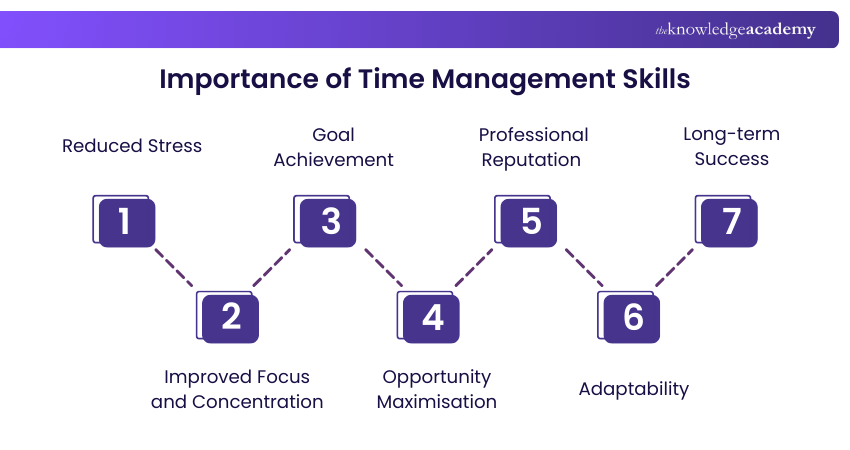
1) Reduced Stress: Proper Time Management minimises the likelihood of feeling stressed by tight deadlines and commitments assigned by the organisations to their employees. When tasks are organised and planned in the right way, individuals can experience lower anxiety levels and are able to approach their work with a clear and focused mindset.
2) Improved Focus and Concentration: Time Management cultivates discipline, helping individuals stay focused on tasks without succumbing to distractions. Concentration levels are heightened by setting specific time slots for activities and eliminating unnecessary interruptions, leading to better quality work.
3) Goal Achievement: Effective Time Management facilitates progress towards long-term goals. By breaking down objectives into manageable tasks and allocating time towards their completion, individuals can steadily work towards achieving their aspirations.
4) Opportunity Maximisation: Time Management enables individuals to seize opportunities as they arise. By efficiently managing their schedules, individuals can make room for new ventures, networking opportunities, and personal growth.
5) Professional Reputation: Professional reputation is reflected in a positive way by meeting deadlines consistently and gaining the ability to deliver high-quality work. This helps to build trust, reliability and credibility among colleagues, managers, and clients.
6) Adaptability: Effective Time Management develop adaptability within an individual during the course of unexpected challenges and changes. Individuals who have the relevant Time Management Skills are better equipped to adjust their schedules and priorities to accommodate unforeseen circumstances.
7) Long-term Success: Mastering Time Management stands as a cornerstone of long-term success. By cultivating discipline, organisation, and efficiency, individuals can position themselves to drive sustained growth, achievement, and fulfilment in their personal and professional lives.
Top 14 Time Management Skills
Cultivating strong Time Management Skills can help you accomplish both personal and professional goals more efficiently. Let's look at the top skills to help you manage your time and work more effectively below:
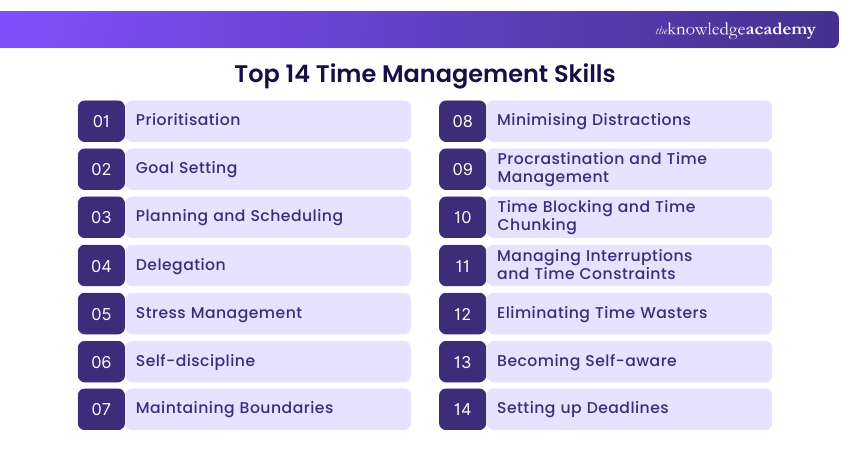
1) Prioritisation
To manage time effectively, you must decide the order in which tasks will be completed. Reviewing your daily schedule and identifying tasks based on urgency and importance will help you allocate time wisely. This ensures that high-priority responsibilities receive the attention they need.
It is also important to understand the difference between urgency and importance. Urgent tasks demand immediate action, while important tasks contribute to long-term goals. Clear prioritisation prevents confusion, improves focus, and ensures essential work is completed.
2) Goal Setting
Goal Setting gives you a clear direction and purpose to your efforts. When you define clear objectives, you can organise your tasks effectively and measure progress along the way. Goals help you break large ambitions into smaller, manageable steps.
Also, having structured goals reduces stress and confusion. When you know what you are working towards, it becomes easier to decide what tasks deserve your time and attention. This clarity keeps you motivated and focused on meaningful outcomes.
3) Planning and Scheduling
Planning and Scheduling are the two critical components of effective Time Management. They involve creating a roadmap for accomplishing tasks and allocating time for each activity. It is important to start with a clear understanding of the tasks that need to be accomplished. This involves breaking down bigger tasks into smaller steps and defining the specific actions required.
Scheduling mainly covers allocating time slots for each task within the plan. This approach helps you prioritise activities, manage workload, and ensure that essential tasks are completed as per a well-defined schedule. It also allows for better Time Management by visually representing how time should be allocated throughout the day or week.
4) Delegation
Delegating tasks helps to prevent work overload and allows you to focus on work that truly requires your time and attention. Assigning responsibilities to capable team members ensures that tasks are completed efficiently while sharing the workload to prevent burnout and ensure effective Time Management.
Effective delegation also improves teamwork and productivity. By trusting others with suitable responsibilities, you create time for complex or high-priority tasks and maintain better overall balance.
5) Stress Management
Stress Management is essential for maintaining productivity and focus. High stress levels can affect decision-making, concentration, and overall performance. This makes it harder to manage time effectively.
Incorporating simple habits such as taking breaks, exercising, or practising relaxation techniques can help maintain mental and physical well-being. Also, staying calm and balanced enables you to approach tasks with clarity and confidence.
6) Self-discipline
Self-discipline helps you stay committed to your plans and avoid distractions. It allows you to follow through on priorities even when motivation is low or interruptions arise. This inner control keeps you focused on what truly matters, manages impulses, and supports steady progress.
By practising self-discipline, you can overcome procrastination and maintain consistent progress. This helps to ensure that tasks are completed on time and goals are achieved without unnecessary delays. It builds consistency, strengthens focus, and helps you stay productive even in challenging situations.
7) Maintaining Boundaries
Protecting your time is essential for effective Time Management. Learning to say no to unnecessary requests helps prevent overcommitment and keeps your schedule manageable. This ensures your time and attention remain dedicated to meaningful priorities instead of being constantly diverted by low-value demands.
Setting clear boundaries allows you to focus on tasks that align with your priorities. Over time, this habit helps you maintain control over your workload and avoid unnecessary stress. Strong boundaries protect your time, support a healthier work-life balance, and ensure your energy is invested where it creates the greatest impact.
Strengthen your research and writing skills with our Academic Writing Course – Start now!
8) Minimising Distractions
Distractions are among the most common obstacles to productivity. This often leads to wasted time and minimised focus. By reducing distractions, you can not only maintain productivity but also stay on track with tasks at the same time.
One effective strategy to inhibit these distractions is by creating a workspace that is free from any kind of interruptions and provides you with positive vibes, such as your bedroom or patio. This can also include setting up a quiet area away from high-traffic areas or using noise-cancelling headphones to block out any kind of excessive external noise.
9) Procrastination and Time Management
Procrastination is a typical challenge that individuals encounter in managing their time in an effective way. It refers to the delaying or postponing of tasks, often opting for short-term pleasure or comfort over long-term productivity. This habit can slowly reduce efficiency, increase stress, and make even simple responsibilities feel more difficult over time.
Procrastination often arises due to various reasons. These include fear of failure, perfectionism, or feeling overwhelmed by the task at hand. Recognising these triggers is the first step to overcoming procrastination and building healthier, more productive work habits.
10) Time Blocking and Time Chunking
Time blocking and Time Chunking are effective techniques for managing and optimising time. They involve scheduling specific blocks or chunks of time dedicated to tasks. By implementing these strategies, individuals can enhance focus, improve productivity, and make the most of their available time.
Time blocking involves allocating dedicated time slots for different tasks, projects, or activities throughout the day. Time chunking, on the other hand, mainly covers grouping similar tasks or activities together within a specific time frame. Instead of switching between different types of tasks randomly, individuals allocate a set period for specific activities.
11) Managing Interruptions and Time Constraints
Managing interruptions and time constraints is among the two most critical parameters for managing time effectively. Interruptions can disrupt your workflow, leading to decreased productivity and difficulty in staying focused on important tasks. If you are aiming to minimise interruptions, it is crucial to identify familiar sources of disruptions and perform proactive measures to mitigate their impact and Improve Focus and Concentration.
Setting clear communication boundaries, such as communicating availability to colleagues or family members, is also vital. It can help minimise unnecessary interruptions. Additionally, allocating specific blocks for focused work and communicating unavailability during these periods can reduce the likelihood of interruptions.
12) Eliminating Time Wasters
Eliminating Time Wasters is a critical step towards effective Time Management. Time wasters are activities or habits that consume valuable time without contributing significant value or progress towards goals. By identifying and eliminating these, individuals can enhance productivity and focus on essential tasks.
Here are some critical time wasters and strategies to eliminate them:
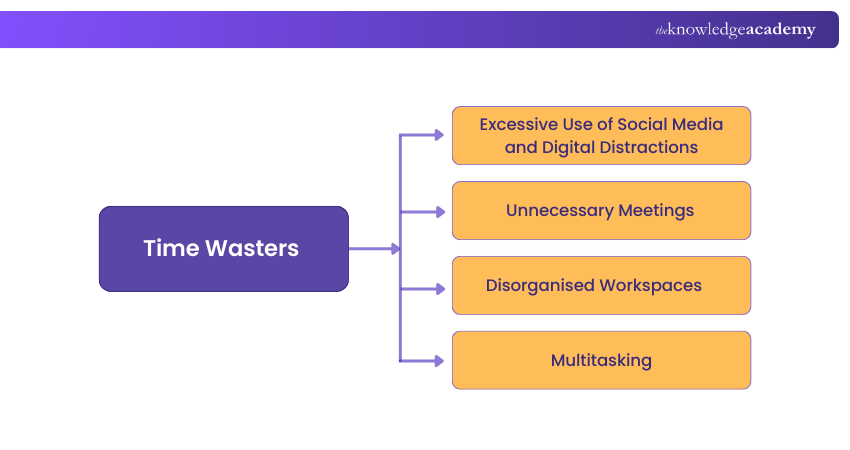
1) Excessive Use of Social Media and Digital Distractions: Endlessly scrolling through social media or browsing online can consume a substantial amount of time. Setting boundaries, such as allocating specific slots for social media or using website blockers, is highly important to minimise these distractions.
2) Unnecessary Meetings: Assess the importance and relevance of each meeting invitation before accepting it. See whether the objectives can be achieved through alternative means, such as email communication, brief updates, or personal meetings, is an urgency.
3) Disorganised Workspaces: Disorganised workspaces can lead to a lot of time wastage, for instance, by searching for documents or supplies. Adopting effective organisational systems and keeping a tidy workspace can save time and enhance efficiency. These include decluttering and using digital tools for file management.
4) Multitasking: Despite its perceived productivity, multitasking often leads to reduced focus and work quality. By embracing single-tasking, focusing on one task at a time and completing it before moving on to the next, you can save plenty of time. Furthermore, this approach improves concentration and overall productivity.
13) Becoming Self-aware
Understanding oneself lays the foundation to manage time effectively. By reflecting on personal work habits, energy levels, and distractions, individuals can tailor their schedules for better productivity.
For instance, someone might realise they have the best productivity in the morning. As a result, tackling complex tasks becomes a lot easier, in contrast to those who find their focus peaks in the afternoon. Recognising these patterns allows individuals to allocate tasks accordingly, ensuring they maximise their peak productivity hours.
14) Setting up Deadlines
Deadlines provide structure and motivation, helping people prioritise tasks and work more efficiently. Whether set by oneself or others, deadlines create a sense of urgency that pushes individuals to focus and make robust progress towards their goals. Breaking larger projects into smaller, manageable deadlines helps track progress and maintain momentum.
Setting realistic deadlines is key to effective Time Management. Unrealistic deadlines can cause stress, burnout, and poor-quality work. By accurately estimating the time needed for each task and allowing extra time for delays, individuals can set achievable deadlines that lead to success.
Build resilience with advanced Stress Management strategies- sign up for our Stress Management Course today!
How to Improve Your Time Management Skills?
You can improve your Time Management Skills by boosting your productivity and reducing a vast level of stress. Here are seven key tips to help you manage your time efficiently:
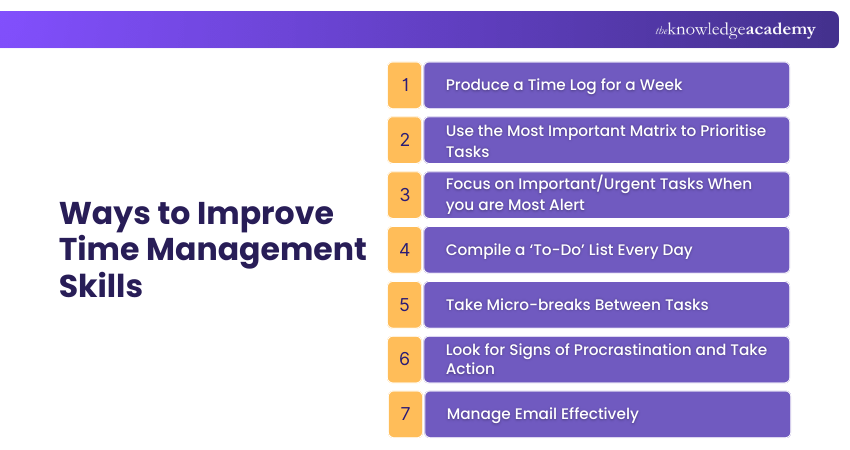
1) Produce a Time Log for a Week: Keep a weekly log for yourself. This will help you show and track how much you are currently spending your time on and what non-productive tasks are costing you time. This is especially useful if you are working in a hybrid environment, as it helps you manage your time better.
2) Use the Most Important Matrix to Prioritise Tasks: This matrix helps you focus on the most important and urgent tasks. Such an approach makes sure that your top priorities are addressed in the right way on the most urgent basis.
3) Focus on Important/Urgent Tasks When you are Most Alert: Make sure you tackle high-priority tasks first when you think your attention level is highest, such as in the morning or evening. Through this approach of alternating high and low-attention tasks or taking micro-breaks can allow your brain to recover from demanding and highly challenging tasks.
4) Compile a ‘To-Do’ List Every Day: A daily to-do list helps you track your priorities and progress. This is particularly useful for maintaining self-discipline when working from home.
5) Take Micro-breaks Between Tasks: Short breaks, such as making a coffee or walking around, can reinvigorate you and improve your posture. These breaks ensure you return to your desk with optimum concentration and help limit interruptions from others.
6) Look for Signs of Procrastination and Take Action: Identify why you procrastinate and address the root cause. Avoid distractions like daytime TV, long lunches, and social media, especially when working from home, to prevent falling behind on your tasks.
7) Manage Email Effectively: Turn off email notifications and check emails only two or three times a day. Keep your emails concise and avoid 'Replying to All'. Focus on important tasks first and set aside specific times for responding to emails.
Take control of your day and achieve more with less stress with Attention Management Training – Join now!
Common Time Management Problems
It is important to consider that Time Management brings its own set of challenges. These issues must be identified to solve them and build better work habits. Let's look at them below:
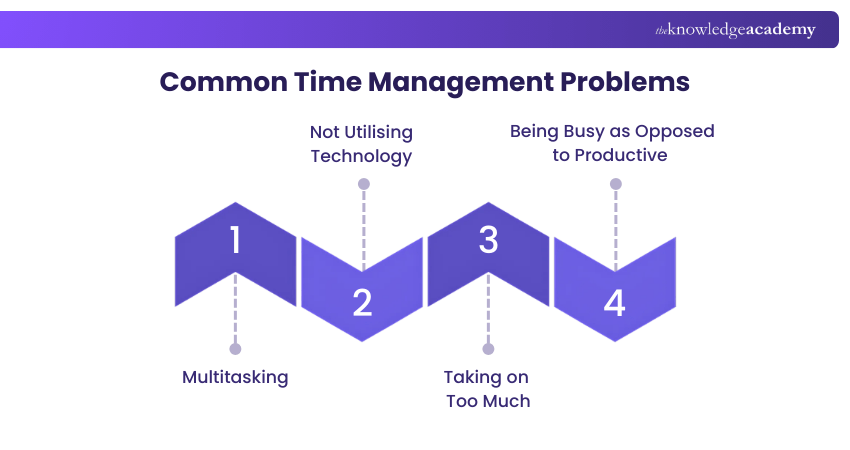
1) Multitasking
Multitasking may seem like an efficient way to complete tasks at once, but it rarely improves productivity. Constantly switching between tasks forces your brain to refocus repeatedly. As a result, none of the tasks receives full attention and the overall quality of work declines.
Solution: Focus on one task at a time. Take breaks, create clear task lists, and automate repetitive work where possible.
2) Not Utilising Technology
Many professionals use technology daily, but not always to its full potential. Spending hours writing emails manually, tracking projects in spreadsheets, or managing tasks without automation can consume valuable time and energy that could be used more productively.
Solution: Use integrated productivity tools to automate routine work, track progress, and manage tasks efficiently.
3) Taking on Too Much
Overcommitting is a common Time Management challenge. While a willingness to help others is a positive trait, taking on too many responsibilities leads to stress, missed deadlines, and burnout. This may happen because of difficulty saying no or a lack of delegation.
Solution: Learn to say no, delegate tasks when possible, and set clear boundaries to protect your time and energy.
4) Being Busy as Opposed to Productive
Being busy does not always mean making progress and being productive. You might spend an entire day responding to emails, organising files, or updating lists without completing work that moves you closer to your goals. This creates the illusion of productivity while slowing real progress.
Solution: Prioritise high-impact tasks using simple methods, such as the 80/20 rule or daily task planning.
Turn your ambitions into action and build unstoppable motivation with Motivation and Goal Setting Training now!
What are Three Examples of Time Management Skills?
Effective Time Management is crucial for minimising productivity and achieving both personal and professional goals. Here are three key examples of Time Management Skills:
1) Planning: This involves creating to-do lists and checklists to organise tasks and ensure nothing is overlooked. It also includes setting thoughtful deadlines and auditing workflows to improve efficiency.
2) Prioritising: This involves evaluating urgent tasks and determining which activities need immediate attention. By filtering notifications and focusing on high-priority tasks, individuals can avoid distractions and ensure critical work is completed on time.
3) Goal Setting: Setting both short-term and long-term goals provides direction and motivation. It involves using data to track progress, making adjustments as needed, and utilising automation and technology to streamline processes and reduce manual effort.
Conclusion
Learning how to take control of your time and day is about working smarter and making intentional choices about how you spend your time. Building strong Time Management Skills help you reduce stress, stay focused on what matters, and create balance between work and life. With practice and applying the right strategies, you can control your day, achieve your goals, and make every moment meaningful.
Strive to be the better version of yourself with our Personal Development Courses, Sign up today!
Frequently Asked Questions
What Are the Five Keys to Time Management?

The five keys to Time Management are prioritisation, goal setting, planning, delegation, and avoiding procrastination. Each carries its own set of importance. For instance, prioritisation involves focusing on the most critical tasks while avoiding procrastination, which helps to keep you focused and efficient.
What Is the List of Tools for Improving Time Management Habits?
The key list of tools for improving Time Management habits includes task managers like Todoist and Trello, calendar apps like Google Calendar, time trackers like Toggl, focus tools like Pomodoro timers, note-taking apps like Evernote, and goal-setting apps like Habitica.

The Knowledge Academy


Global Training Provider
The Knowledge Academy is a world-leading provider of professional training courses, offering globally recognised qualifications across a wide range of subjects. With expert trainers, up-to-date course material, and flexible learning options, we aim to empower professionals and organisations to achieve their goals through continuous learning.


 If you wish to make any changes to your course, please


