




We may not have the course you’re looking for. If you enquire or give us a call on 01344203999 and speak to our training experts, we may still be able to help with your training requirements.
Segmentation Fault in C: Causes and Solutions
ByThe Knowledge AcademyLast updated on: 22 September 2026
Understanding Segmentation Fault is crucial for building stable and reliable software. This blog explores the common causes of Segmentation Faults, how to debug them, and offers practical solutions to prevent them. Discover how to prevent Segmentation Fault in C by understanding the causes and learning effective debugging techniques.
Are you starting with C programming? If so, you might stumble upon a perplexing issue known as a Segmentation Fault. This error can leave even seasoned developers puzzled. Grasping the concept of Segmentation Fault in C is essential for crafting robust and error-free code.
In this blog, we’ll explain what causes Segmentation Fault in C and how to fix them. Let’s make your programming journey smoother by tackling this issue together!
Common Causes of Segmentation Fault in C
Segmentation faults are common in C, especially for beginners. They often result from errors in memory handling, which can be complex in C. Below are some of the most frequent causes of segmentation faults in C.
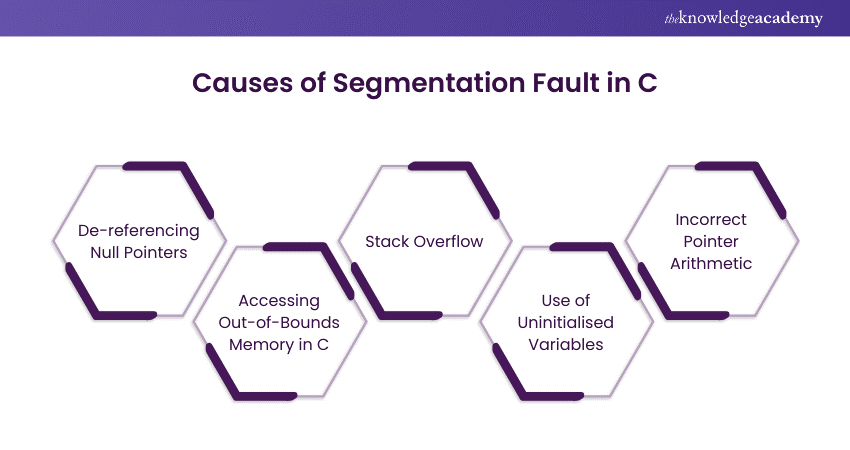
1) De-referencing Null Pointers
Dereferencing a null pointer is a common mistake in C programming. A null pointer does not point to any valid memory location. Attempting to access or modify the data it points to will cause the program to crash as it tries to interact with non-existent memory. To avoid this, always check whether a pointer is null before using it.
2) Accessing Out-of-Bounds Memory in C
Exceeding the bounds of an array in memory is another common cause of segmentation faults. Arrays in C have fixed sizes, and accessing an index outside this range leads to undefined behaviour, which can corrupt data, cause crashes, or both. Ensure that any loop or function accessing array elements remains within the array’s limits.

3) Stack Overflow
A stack overflow occurs when a program uses more stack space than what’s available. This often happens in cases of deep or infinite recursion, where function calls keep piling up on the stack. Since the stack has a limited size, exceeding this limit will result in a segmentation fault. Review recursive functions carefully to ensure they have a clear base case to prevent this.
4) Use of Uninitialised Variables
Uninitialised variables in C can lead to unpredictable behaviour, including segmentation faults. When a variable is declared but not initialised, it holds an undefined value. If this value is used as a memory address, especially with Pointers in C, it can cause a segmentation fault. Always initialise variables before use to prevent such issues.
5) Incorrect Pointer Arithmetic
Pointer arithmetic is powerful in C but is also a common source of errors. Miscalculating pointer offsets can lead to accessing invalid memory areas, causing segmentation faults. This often occurs when manipulating pointers without considering the size of the data types they point to. Ensure correct calculations and understand how pointers work to mitigate these errors.
Boost your career with our comprehensive C Programming Training. Sign up today and code like a pro!
How to Debug a Segmentation Fault in C?
Debugging segmentation faults can be challenging but is essential for resolving underlying issues. The first step is to use debugging tools like GDB (GNU Debugger). GDB allows you to run your program in a controlled environment, where you can inspect its state at the point of the crash.
By analysing the stack trace, you can identify the specific origin and cause of the segmentation fault. Additionally, using memory analysis tools like Valgrind can help detect invalid memory accesses, uninitialised memory usage, and memory leaks, making it easier to pinpoint the source of the fault.
Learn the Language that Powers the Tech World. Join our C programming Course and Code like a pro! - Register now.
Tips for Diagnosing and Resolving Segmentation Faults in C
Diagnosing and resolving Segmentation Faults requires a systematic approach. Here are some tips to help you effectively handle these errors:
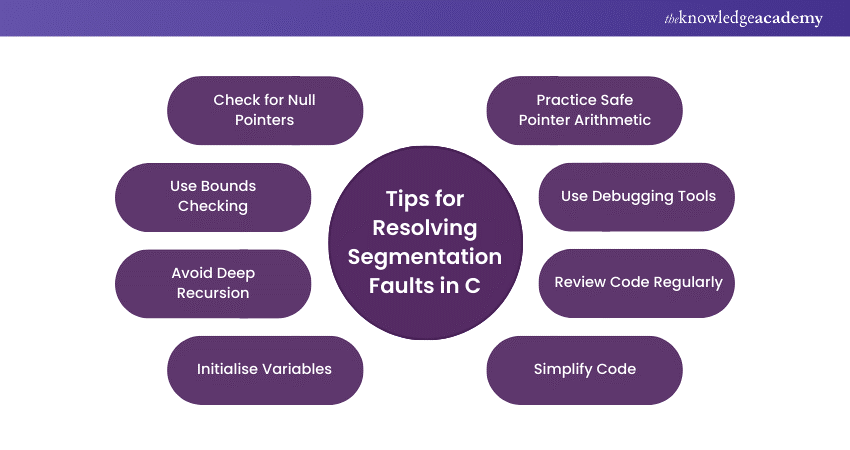
a) Check for Null Pointers: Always validate pointers before using them to prevent many segmentation faults.
b) Use Bounds Checking: Ensure all array accesses are within defined bounds. Consider using safe alternatives or manually checking indices.
c) Avoid Deep Recursion: Monitor recursive functions to ensure they don’t run indefinitely. Set limits on the depth of recursion if possible.
d) Initialise Variables: Always initialise your variables, especially pointers, before use. This practice prevents accessing random memory locations.
e) Practice Safe Pointer Arithmetic: Be aware of the data types involved and calculate offsets correctly when manipulating pointers.
f) Use Debugging Tools: Utilise debugging tools like GDB and Valgrind to gain insights into the location and cause of segmentation faults.
g) Review Code Regularly: Regular code reviews can help identify potential sources of segmentation faults before they cause problems.
h) Simplify Code: Simplifying complex code, especially when it involves pointer manipulation or recursion, can reduce the likelihood of segmentation faults.
Unlock your Coding Potential and Build Robust Applications with our Expert-led C# Programming (C Sharp) Course. Start today!

The Knowledge Academy develops accessible learning content across Project Management, IT, Cybersecurity, Data Science, Business Analysis, HR, Accounting and Finance, Leadership and Health and Safety. Its resources combine subject research with clear explanations to help professionals build practical knowledge across a wide range of disciplines.
View Detail

 If you wish to make any changes to your course, please


