


 Top Rated Course

We may not have the course you’re looking for. If you enquire or give us a call on 01344203999 and speak to our training experts, we may still be able to help with your training requirements.
What Is Research Methodology? Explained in Detail
The Knowledge Academy 16 July 2026Research methodology is the structured approach that uses tools and techniques to collect, analyse and interpret data to answer research questions effectively. It helps researchers choose the right methods for reliable results. A clear methodology also ensures consistency, accuracy, and transparency throughout the research process.

Training Outcomes Within Your Budget!
We ensure quality, budget-alignment, and timely delivery by our expert instructors.
Table of Contents

The methodology of research determines the way in which the research is prepared, carried out and assessed. It enables the practitioners of research to select the appropriate instruments for collecting and interpreting the data correctly. We will examine in this blog What is Research Methodology and the fact that it has an important role in producing clear, trustworthy, and significant research results.
Table of Contents
1) What is Research Methodology?
2) Why is Research Methodology Important?
3) Different Types of Research Methodology
4) Types of Sampling Designs in Research Methodology
5) What are Data Collection Methods?
6) What are Data Analysis Methods?
7) How to Write a Research Methodology?
8) Key Factors to Consider When Selecting a Research Methodology
9) Conclusion
What is Research Methodology?
Research methodology is a systematic and organised method that tells us how a certain research project will be carried out, what data will be gathered and processed, as well as the overall approach taken to ensure that the findings are both credible and trustworthy.

Why is Research Methodology Important?
The importance of Research Methodology is mentioned below:
a) It provides a clear and structured plan that others can follow or replicate to verify your study.
b) It explains and justifies the methods you choose, helping support your research decisions.
c) It ensures you select the right design, sampling approach, data collection and analysis techniques.
d) It increases the credibility and reliability of your findings by reducing bias and errors.
It helps you define clear research questions, hypotheses and objectives from the beginning.
Different Types of Research Methodology
When designing a Research Methodology, a researcher faces several important decisions. One crucial choice is whether to use Qualitative Research, quantitative, or a mixed-method approach. Regardless of the research type, data will be in the form of numbers or descriptions, and researchers can choose to focus on words, numbers, or both. Let’s explore the different Types of Research Methodology in detail.
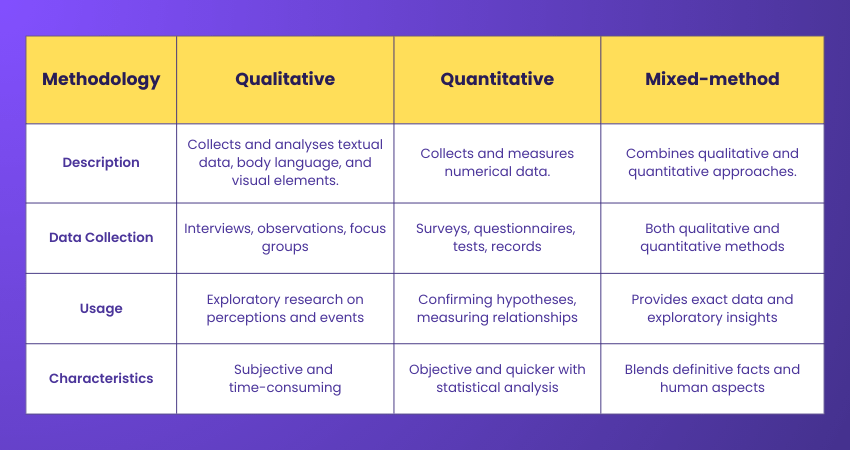
Qualitative
a) Description: Involves collecting and analysing written or spoken words and textual data. May include body language and visual elements to create detailed descriptions.
b) Data Collection: Interviews, observations, and focus groups with a few carefully selected participants.
c) Usage: Often used for exploratory research, such as understanding human perceptions of events, people, or products.
d) Characteristics: Subjective and time-consuming.
Quantitative
a) Description: Focuses on collecting, testing, and measuring numerical data from a large sample.
b) Data Collection: Surveys, questionnaires, tests, databases, and organisational records.
c) Usage: Used to confirm hypotheses or measure relationships between variables.
d) Characteristics: Objective and quicker, often using statistical software for analysis
Mixed-method
a) Description: Combines quantitative and qualitative approaches for additional perspectives and richer results.
b) Usage: Provides both exact data and exploratory insights.
c) Characteristics: Offers a blend of definitive facts and human aspects.
Types of Sampling Designs in Research Methodology
A sample design gives a detailed account of the sources of data and the methods used for selection. Sampling can either be random, which gives equal chances of selection, or non-random, where the subjects are chosen intentionally, and the results may not be representative of the entire population.
Learn how Emotional Intelligence can be applied in organisations with our Emotional Intelligence Training – Join today!
What are Data Collection Methods?
Once researchers have their population sample, they need to decide how to collect data. Here are some common methods:
a) Interviews: Can be formal or informal, based on the structure of the questions.
b) Surveys: Can be online or in-person, with free-answer or multiple-choice questions, or a mix.
c) Focus Groups: Small groups discuss specific topics, guided by a moderator.
d) Observations: Collect data from published reports, official documents, and internal records.
These methods help gather the necessary data for research studies.
What are Data Analysis Methods?
The data analysis techniques are the mainstay of every researcher for the purpose of organising and interpreting the collected data, which eventually leads to the discovery of patterns and answering the research queries. They are the ones who convert the raw data into clear and significant insights.
Numerical analysis, thematic exploration, or a mix of both may be used in the methods to obtain the desired outcome. The selection of the appropriate method guarantees the production of findings that are accurate, trustworthy, and well-supported.
How to Write a Research Methodology?
Your methodology plan should include:
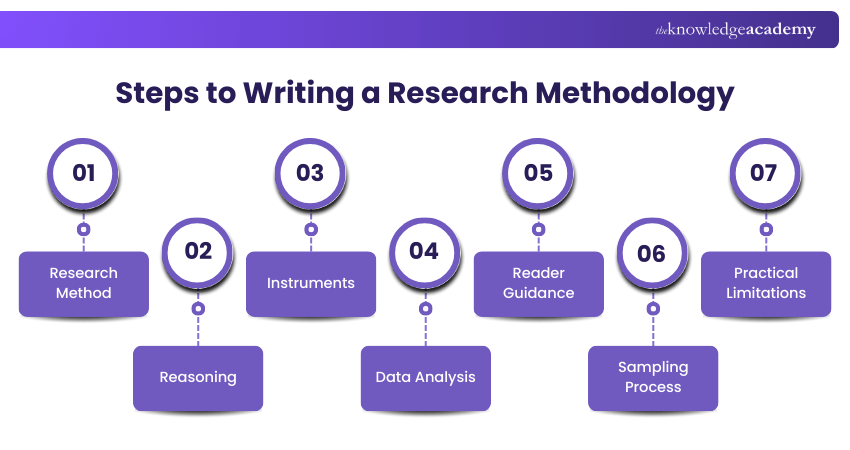
a) Research Method: Specify if you'll use quantitative, qualitative, or mixed-method research, based on your goals.
b) Reasoning: Explain why you chose this method and how it solves your research problem.
c) Instruments: List your data collection methods (e.g., interviews, surveys) and why you chose them.
d) Data Analysis: Describe how you'll analyse the data.
e) Reader Guidance: Provide background on your methods, especially if non-standard.
f) Sampling Process: Explain how you'll select your sample and why.
g) Practical Limitations: Discuss any potential limitations in your research.
This plan will help guide your research and ensure clarity and effectiveness.
Key Factors to Consider When Selecting a Research Methodology
When choosing a Research Methodology, consider these factors:
a) Research Objective: Determine what information you need to meet your project's goals, which helps select the right methodology and methods.
b) Significance of Statistics: Decide if you need precise, data-driven results and statistical answers or if you need to understand reasons, perceptions, opinions, and motivations.
c) Nature of Research: If your goals are exploratory, use qualitative methods. If you aim to measure or test something, use quantitative methods.
d) Sample Size: Consider how large the sample needs to be to answer your questions and meet your objectives. This can influence whether to use in-person interviews for smaller samples or online surveys for larger ones.
e) Time Available: If time is limited, use techniques like random or convenience sampling and methods that allow quick data collection. With more time, consider in-person interviews and observations.
Master effective communication with our Active Listening Training – Join today!
Conclusion
The research methodology lays down the necessary framework for carrying out research that is unambiguous, dependable, and significant. It aids the investigators in selecting the proper techniques and yielding results that are reliable. When you understand What is Research Methodology, you can tackle any research with assurance and transparency.
Learn to articulate ideas clearly with our Effective Communication Skills Course – Sign up now!
Frequently Asked Questions
What are the key Components of Research Methodology?

Key components include research design, methods of data collection, data analysis techniques, sampling strategy, and ethical considerations.
What is the Difference Between Methodology and Method?
The term methodology signifies the complete research design and reasoning of a particular study while the word ‘method’ is the particular technique employed to gather or scrutinise data.

The Knowledge Academy


Global Training Provider
The Knowledge Academy is a world-leading provider of professional training courses, offering globally recognised qualifications across a wide range of subjects. With expert trainers, up-to-date course material, and flexible learning options, we aim to empower professionals and organisations to achieve their goals through continuous learning.


 If you wish to make any changes to your course, please


