


 Top Rated Course

We may not have the course you’re looking for. If you enquire or give us a call on 01344203999 and speak to our training experts, we may still be able to help with your training requirements.
Python Enumerate(): Syntax, Used Cases and Benefits
The Knowledge Academy 05 August 2026The enumerate() function in Python lets you loop through lists, tuples, or strings while automatically accessing both the index and the element, saving extra work. It is often used with Python Dictionaries to easily pair keys and values or to manage nested data. Using Python enumerate simplifies the code and helps to handle data easily.

Training Outcomes Within Your Budget!
We ensure quality, budget-alignment, and timely delivery by our expert instructors.
Table of Contents

Writing loops is easy in Python, but things can get a little tricky when you need the index of an element along with it. In such situations, the enumerate() function is used. This function gives you the index of every element along with it, without manually counting.
Python Enumerate is a smart trick for beginners that makes the code simple and readable. Whether you are working with a list, a tuple, a string or a dictionary, enumerate makes your work fast and error-free. In this blog, we will see how Python Enumerate works and how to implement it with real examples.
Table of Contents
1) What is Enumerate in Python?
2) How do you Implement the Enumerate Function in Python?
3) Common Use Cases for enumerate in Python
4) How to Use Enumerate in Reverse Order in Python?
5) Benefits of Using Enumerate in Python
6) Drawbacks of Using Enumerate in Python
7) Why use Enumerate() Instead of Range()
8) Can you enumerate over dictionary keys?
9) Conclusion
What is Enumerate in Python?
In Python, enumerate() is a function which gives the index along with the value while applying the loop. You do not need to count manually, everything is obtained automatically.
When you loop over a list, string or tuple, normally only the value is obtained. But with the help of Python Enumerate, you can take both the index and the value together. This makes the code simple, short and easy to understand.

How do you Implement the Enumerate Function in Python?
Let’s explore some of the ways to apply the Enumerate function in Python for different data structures:
1) On a List With the Start Index
It would help if you pressed the ‘start’ parameter to ‘enumerate’ a list with a specific start index. For example:

2) Enumerate Python Sets
The use of ‘enumerate’ with a set does not ensure the order of elements due to sets being unordered collections. Nevertheless, matching each element with a corresponding index is still possible.

3) Enumerate Python Tuples
Listing the elements of a tuple follows the same process as listing the elements of a list. It matches each element with a corresponding index.

4) Enumerate Characters in a String
Utilise the ‘enumerate’ function to iterate over every character in a string and obtain its corresponding index.

5) Enumerate a Dictionary
Going through a dictionary usually includes iterating over its keys or items. Here is the method to accomplish it using the elements (key-value pairs):

All these instances show how enumerate enables accessing both the index and the value in different data structures, enhancing the efficiency and readability of your code.
Looking to kickstart your coding journey? Register now for our Programming Courses.
Common Use Cases for enumerate in Python
Python Enumerate is used when you need the index of an element in a loop along with the element inside it. This is very helpful when you are debugging, or need to follow real-world numbering, or need to match two lists.
Looping with Access to Index
Sometimes we also need an index in a loop, especially when creating parallel lists or finding bugs. With enumerate(), you can easily get the index of every item along with it.

With this, you get the number of each fruit along with it. The code becomes readable and is easy to understand.
Customised Starting Index
By default, enumerate() starts from zero, but you can change the start number if you wish. This is useful when you want to follow real-world numbering, such as starting from 1.

In this example, counting starts from 1, which gives a user-friendly output.
Pairing Indices with Values in ZIP-like Operations
When you are working with two parallel lists, enumerate() helps to track the index. You can easily match the values by using enumerate() with zip().

With this code, you can assign a letter to each season and also track the index of each pair.
How to Use Enumerate in Reverse Order in Python?
In Python, you can reverse the order of enumeration by combining the reversed function with the enumerate function. This technique works with any iterable that supports reverse iteration, such as lists, Python String, or other sequences. Here’s how you can achieve it:
1) Use Enumerate to Reverse a List
If you want to iterate a list in reverse order to get the index, you can utilise ‘reversed’ with ‘enumerate.’

This is the output
Index: 0, Fruit: cherry
Index: 1, Fruit: banana
Index: 2, Fruit: apple
2) Use a Custom Start Index for Reversing
You can iterate in reverse using a custom start index manually.

This is the output
Original Index: 2, Fruit: cherry
Original Index: 1, Fruit: banana
Original Index: 0, Fruit: apple
3) Use Enumerate to Reverse a String
It goes the same as just other iterable

This is the output
Index: 0, Character: o
Index: 1, Character: l
Index: 2, Character: l
Index: 3, Character: e
Index: 4, Character: h
By using ‘reversed’ and ‘enumerate,’ you can loop through an iterable in reverse order while tracking both the index and the value. This handy method processes elements in reverse sequence, allowing you to execute operations that rely on the reversed order.
Master Web Development with our Python Django Training and build solid applications- sign up today!
Benefits of Using Enumerate in Python
A Python Enumerate() makes the code maintainable and readable. It offers numerous benefits, which are as follows:
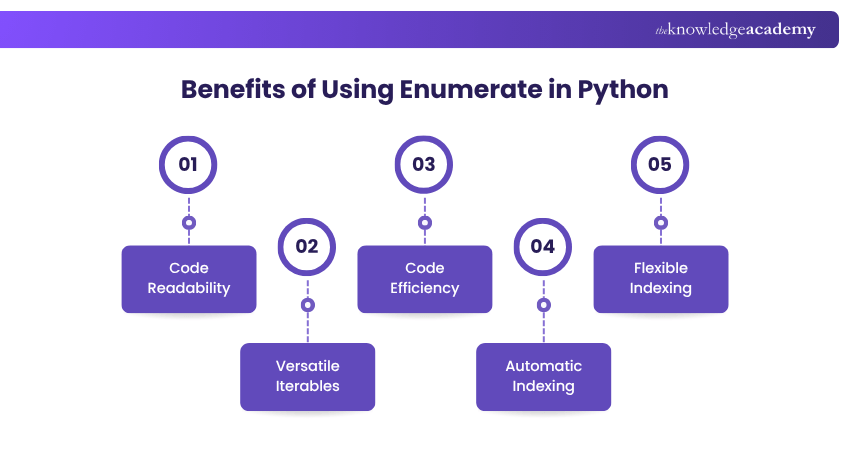
1) Code Readability: The ‘enumerate’ function boosts code readability and maintenance.
2) Versatile Iterables: It is used with iterables such as dictionaries, objects, strings, sets, and lists.
3) Code Efficiency: ‘Enumerate’ briefs your code by minimising the need for additional lines to record element count and index.
4) Automatic Indexing: It pairs each element with an index and eliminates separate counter-variables.
5) Flexible Indexing: You can state a custom starting index by offering an optional second parameter to add flexibility to coding.
Enhance your skills with our comprehensive R Programming Course - join now!
Drawbacks of Using Enumerate in Python
While ‘enumerate’ offers various advantages, it also has some limitations. Let’s explore some of the drawbacks here:

1) Memory Overhead: ‘Enumerate’ can use more memory because of the inclusion of extra counters.
2) Parallel Limitations: It is not fit for parallel computing as there is no guarantee of the output.
3) Performance Overhead: It is not perfect for handling large data sets because of the additional computational overhead.
Why use Enumerate() Instead of Range()?
If you want to print the index of a list along with its elements in Python, then using enumerate() is better than range(). With range(), you first have to get the length of the list, then access the value from the index, which seems a bit long and boring.
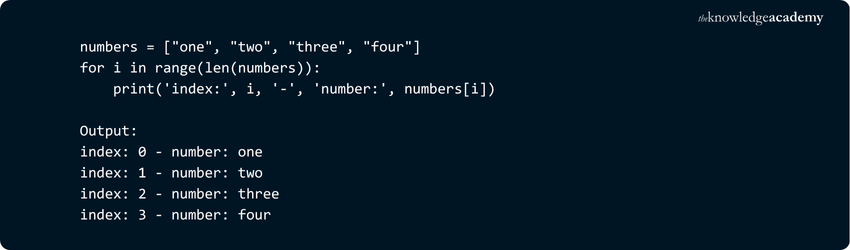
It works but takes more steps.
Same output using enumerate():
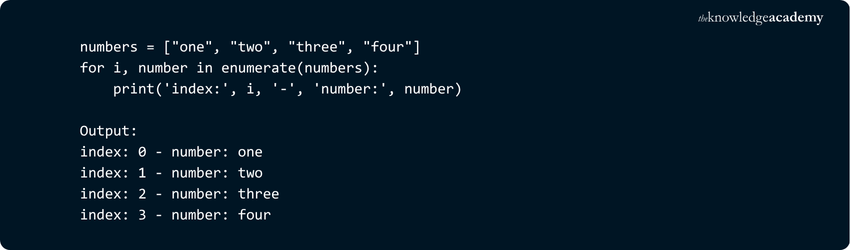
The code is short, readable, and easy to understand. When you need the index as well as the value, enumerate() is the cleanest solution.
Can you enumerate over dictionary keys?
Yes, you can apply enumerate() on dictionary keys in Python. When you need the index of keys along with the keys, then using enumerate() is quite helpful. Normally, you can extract keys with a for loop, but with enumerate(), you get the number of each key along with the key.
Example:

In this, along with the name of each student, its index is also printed.
You can also apply enumerate() to values using .values(), and if you need both key and value with index, use .items() with it.
Example with items():

If you want to create a new list or dictionary with an index, you can use list comprehension or dictionary comprehension. This method is short and clean, especially when you need to modify data.
Conclusion
In conclusion, Python Enumerate() is a powerful tool for enhancing code readability and efficiency. By pairing elements with their indices, it simplifies iteration and reduces the risk of errors. Dive into Python with confidence and let Enumerate be your guide to readable codes.
Transform your coding skills with our Object-Oriented Programming (OOPs) Course today!
Frequently Asked Questions
Is Enumerate Memory Efficient?

Enumerate takes in additional memory compared to simple methods of iteration as it forms a counter alongside each element.
Is Enumerate Zero-Based or One-Based?
Zero Based Budgeting can be conceptually linked to enumerate, which on its own is zero-based as it starts counting from zero. But you can always specify a desired starting index with the help of the ‘start’ parameter.

The Knowledge Academy


Global Training Provider
The Knowledge Academy is a world-leading provider of professional training courses, offering globally recognised qualifications across a wide range of subjects. With expert trainers, up-to-date course material, and flexible learning options, we aim to empower professionals and organisations to achieve their goals through continuous learning.


 If you wish to make any changes to your course, please


