




We may not have the course you’re looking for. If you enquire or give us a call on 01344203999 and speak to our training experts, we may still be able to help with your training requirements.
Python Data Structures Explained: A Complete Guide
ByNilotpal SarmahLast updated on: 22 September 2026
Python data structures help organize and store data efficiently. It offers built-in options and supports creating custom structures for different tasks. This guide helps you understand core and complex data types to improve your code’s performance, scalability, structure, and overall development efficiency.

Python, with its elegant syntax and extensive libraries, empowers developers to create efficient and expressive code. At its core, Python offers a rich variety of data structures, each serving a unique purpose. From the humble list to the intricate graph, these Python Data Structures enable us to organise, manipulate, and analyse data with finesse.
And here’s the exciting part: not only does mastering Python enhance your coding skills, but it also opens doors to lucrative opportunities. In the UK, Python Developers command an average annual salary of around £95,000. So, let’s explore Python Data Structure; the building blocks of Python -lists, tuples, dictionaries, sets, and more- -unleashing their potential in our code journey
What are Data Structures in Python
In programming, Data Structures are containers used to organise and store data in a way that facilitates efficient access and modification. Python provides several built-in Data Structures, each with its own unique characteristics and use cases. These Data Structures serve as the foundation for creating complex algorithms and solving computational problems effectively.
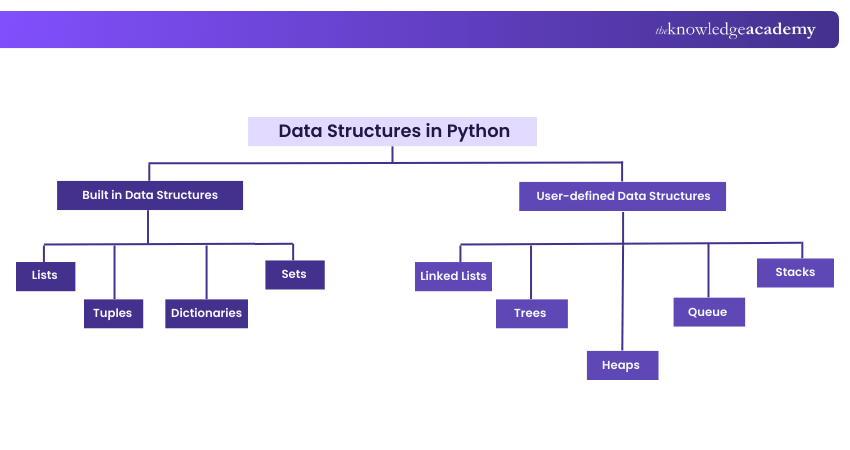
Python Data Structures play a crucial role in optimising code performance. By choosing the right Data Structure for a specific problem, developers can reduce time complexity and improve the overall efficiency of their programs. Understanding Data Structures enables programmers to make informed decisions while designing solutions, leading to more elegant and maintainable code.
The choice of Data Structure can greatly impact the performance of algorithms. For example, using a dictionary for fast key-value lookups or a set for eliminating duplicates in a list can result in faster execution times. In the context of Python Automation Testing, developers can understand the underlying principles of Data Structures and write code that runs more efficiently. This makes Python a popular choice for high-performance applications.

1) Lists: Versatile and Dynamic Arrays
1) Definition: Lists are ordered and mutable collections that can store items of different types, including other lists.
2) Syntax: my_list = [1, 2, 3, 'Python']
3) Use Case: Best for storing sequences of related data where modifications such as insertion, deletion, or updating are needed.
4) Features:
a) Maintains order of elements
b) Allows duplicates
c) Elements can be updated dynamically
d) Supports slicing, iteration, and built-in functions like append(), pop(), sort()
Example:

2) Tuples: Immutable Data Containers
1) Definition: Tuples are ordered collections like lists, but they cannot be changed after creation.
2) Syntax: coordinates = (40.7128, 74.0060)
3) Use Case: Ideal for representing fixed sets of data like geographic coordinates, RGB values, or constants.
4) Features:
a) Preserves order
b) Cannot be modified (immutable)
c) More memory-efficient than lists
d) Can be used as keys in dictionaries
Example:

3) Dictionaries: Efficient Key-value Pairs
1) Definition: Dictionaries (or dicts) store data in key-value format, making them ideal for fast lookups.
2) Syntax: person = {'name': 'Alice', 'age': 30}
3) Use Case: Great for when data needs to be retrieved based on a unique identifier or label.
4) Features:
a) Unordered (in versions before Python 3.7)
b) Keys must be unique and immutable
c) Values can be any data type
d) Mutable, so entries can be added, changed, or removed
Example:

4) Sets: Unordered Collection of Unique Elements
1) Definition: Sets are mutable collections that store unordered, unique elements.
2) Syntax: unique_values = {1, 2, 3}
3) Use Case: Perfect for eliminating duplicates and performing mathematical set operations like union, intersection, and difference.
4) Features:
a) Does not allow duplicates
b) Unordered and unindexed
c) Supports set operations
d) Mutable, but elements must be immutable
Example:

Unlock your coding potential by joining our Python Course!
User-defined Data Structures
User-defined Data Structures in Python allow developers to create custom data storage and manipulation solutions tailored to specific needs. Python Dataclasses are one such tool that simplifies the creation of data-focused classes. By defining custom classes, programmers get control over data organization and efficiency. This enables code reusability, abstraction, and modularity, highlighting the Difference Between Method overloading and method overriding for more effective and flexible programming.
1) Linked Lists: Building Blocks for Dynamic Data Structures
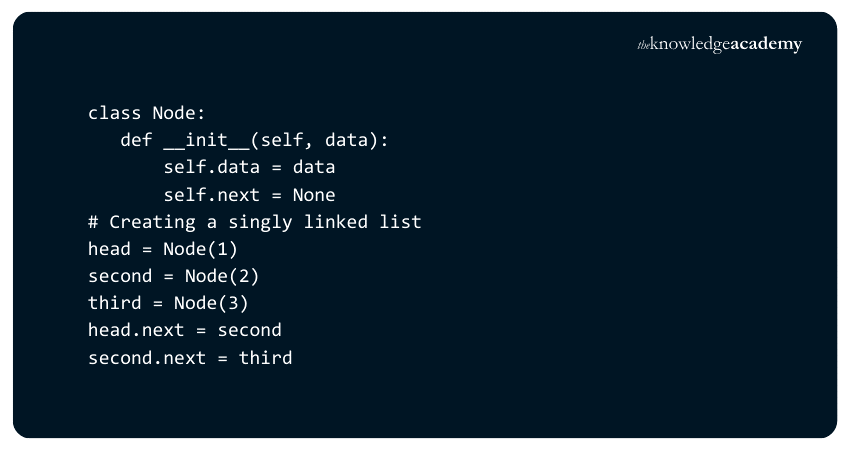
Linked lists are fundamental Data Structures composed of nodes, where each node contains data and a reference (pointer) to the next node in the sequence. Unlike arrays, linked lists do not require contiguous memory allocation, allowing for more flexibility and efficient memory usage, a key difference when considering Python List vs Array, as lists in Python provide greater ease of use but may lack the same memory efficiency and speed advantages as arrays.
There are different types of linked lists, with singly linked lists and doubly linked lists being the most common:
Singly Linked Lists: In a singly linked list, each node points to the following node in the sequence. The last node points to NULL (or None in Python), indicating the end of the list.
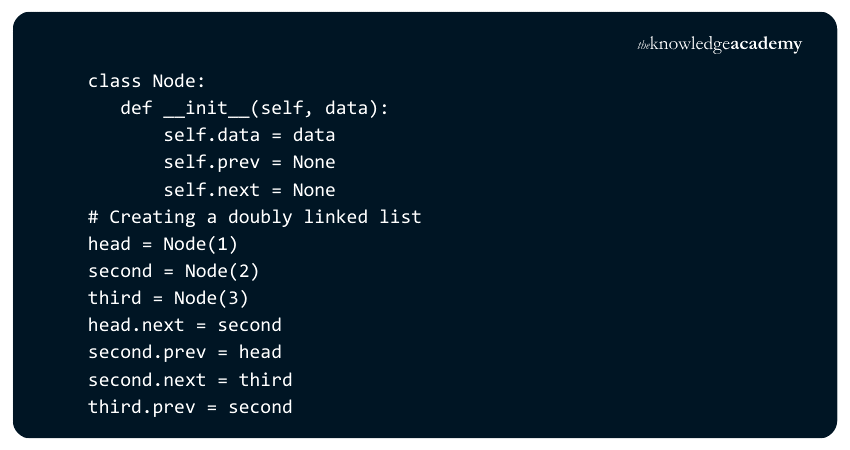
Doubly Linked Lists: A doubly linked list extends the concept of a singly linked list by having each node point to both the next and previous nodes.
In a circular linked list, the last node reroutes back to the first node, creating a circular structure. This can be useful in scenarios where continuous iteration is required, such as in game development or task scheduling.
Linked lists are valuable for implementing dynamic Data Structures, such as stacks and queues, and are used in various programming and algorithmic concepts. Linked lists offer several advantages, such as efficient insertion and deletion operations, as well as dynamic memory allocation. However, they have some drawbacks, including slower access time due to the need to traverse the list linearly.
2) Stacks: Last-in, First-Out Data Structures
Stacks are linear Data Structures following the Last In, First Out (LIFO) principle. Elements are added and removed from the same end, called the top. Python's built-in list type can act as a stack.
Creating a Stack

Push and Pop Operations
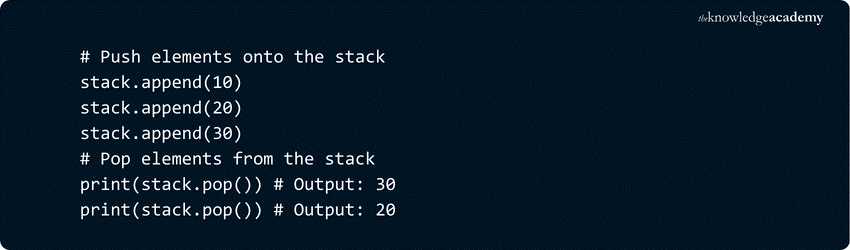
Stacks are widely used in programming for tasks like function call tracking, expression evaluation, and undo/redo functionality.
3) Queue: First-in, First-Out Data Management
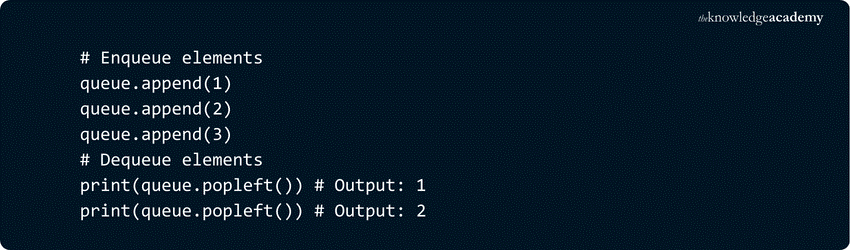
A Queue is a linear Data Structure in accordance with the First-In-First-Out (FIFO) principle. Elements are inserted at the rear and removed from the front. It models real-life scenarios like waiting in line. In Python, the deque class from the collections module provides a Queue implementation.
Creating a Queue
from collections import deque

Enqueue and Dequeue
4) Trees: Hierarchical Representations of Data
Trees are hierarchical Data Structures comprising nodes connected by edges. Each tree has a root node at the top, from which other nodes branch out. Trees are mostly used to represent hierarchical relationships, such as file systems, family trees, and organisation charts.
Binary Trees and Binary Search Trees (BST): Binary trees are trees where each node has two offspring, commonly referred to as the left child and right child. Binary search trees (BST) are a type of binary tree with a specific property. The value of a node's left child is less than or equal to the node's value. At the same time, the value of the right child is greater than the node's value.
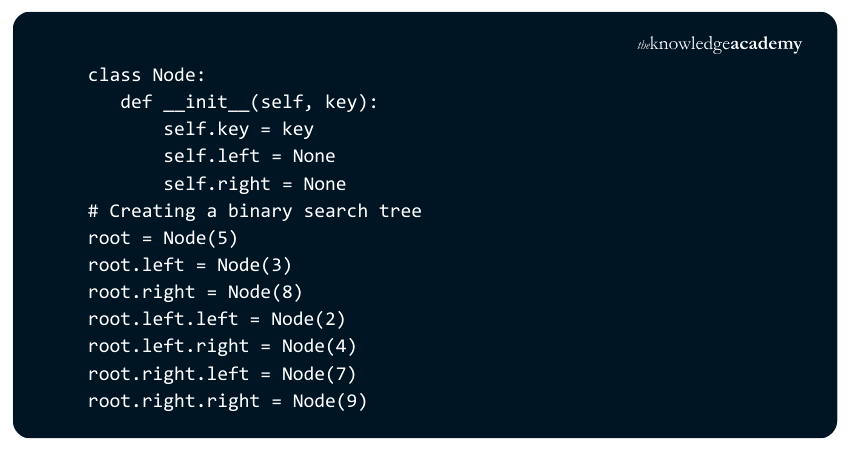
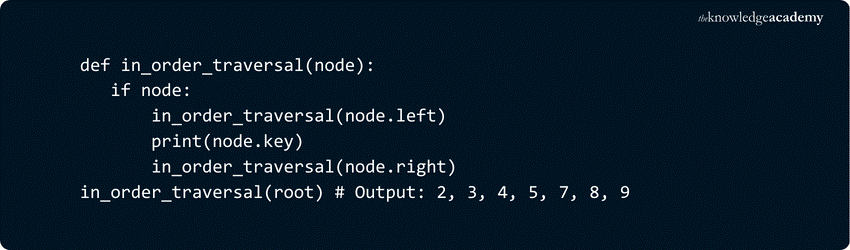
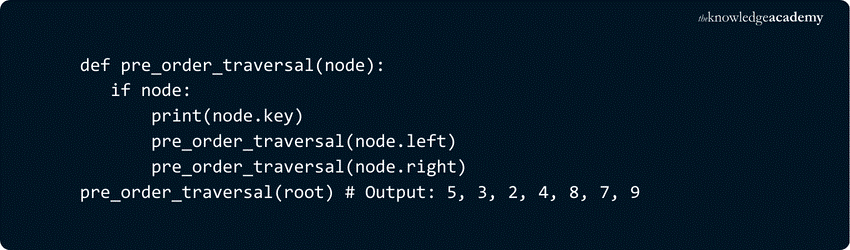
Tree traversal involves visiting all nodes in a tree in a specific order. There are three common techniques for tree traversal:
In-order Traversal: In in-order traversal, the left subtree is visited first, followed by the root node, and then the right subtree.
Pre-order Traversal: In pre-order traversal, the root node is visited first, followed by the left and right subtrees.
Post-order Traversal: In post-order traversal, the left and right subtrees are visited first, followed by the root node.
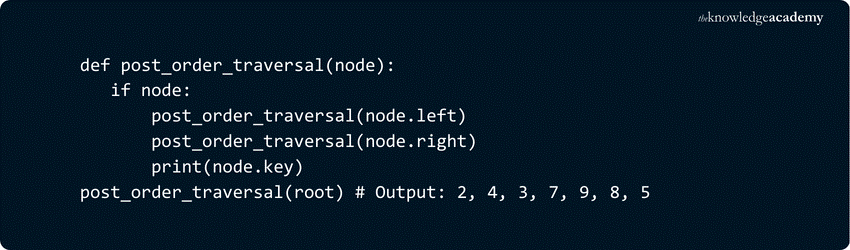
Balancing Binary Search Trees: Balancing a binary search tree ensures that its height is minimised, resulting in faster access times and more efficient tree operations. Common balancing techniques include AVL trees and red-black trees.
5) HashMaps: Efficient Key Value Storage
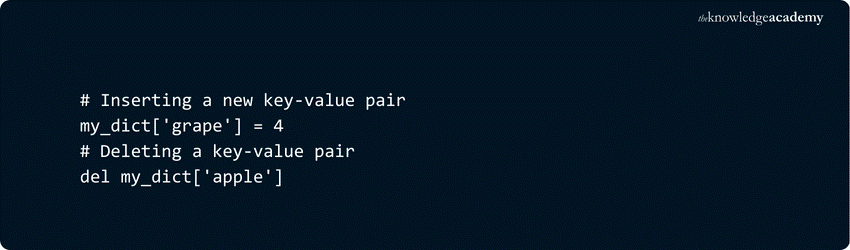
HashMaps are a Data Structure that stores key-value pairs and provides fast access to values based on their keys. In Python, the built-in dict type is a HashMap implementation. It allows efficient insertion, retrieval, and deletion of elements.
Creating a HashMap:

Accessing Values:

Inserting and Deleting:
6) Heaps: Priority Queues in Python
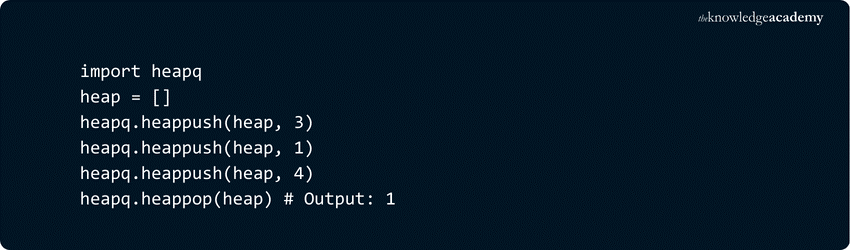
Heaps are specialised trees used to maintain a collection of elements, with each element having a priority associated with it. They are often used to implement priority queues, wherein the element with the highest (or lowest) priority is served first.
Min Heaps vs Max Heaps
Heaps can be either min heaps or max heaps. In a min heap, the parent node's value is less than or equal to its child nodes, making the minimum element the root. In a max heap, the parent node's value is greater than or equal to its child nodes, making the maximum element the root.
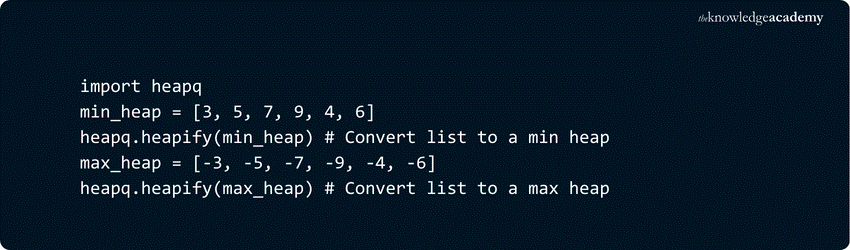
Heapsort is a sorting algorithm that uses a heap Data Structure to sort elements in ascending or descending order. Heapsort has a time complexity of O(n log n) and is particularly useful when a stable sort is not required.
Heaps are essential in various applications, including:
1) Job scheduling: Prioritising tasks based on their urgency or importance.
2) Dijkstra's algorithm: Finding the shortest path in a graph.
Python's heapq module provides functions for creating and manipulating heap Data Structures efficiently:
7) Graphs: Connecting the Dots in Data
Graphs are collections of nodes (vertices) connected by edges (lines). They are used to model relationships between objects. Graphs are widely used in various real-world scenarios, such as social networks, computer networks, and transportation systems.
In Python, you can represent graphs using various methods, such as adjacency lists and adjacency matrices.
Adjacency Lists: In an adjacency list representation, each node has a list of its neighbouring nodes.
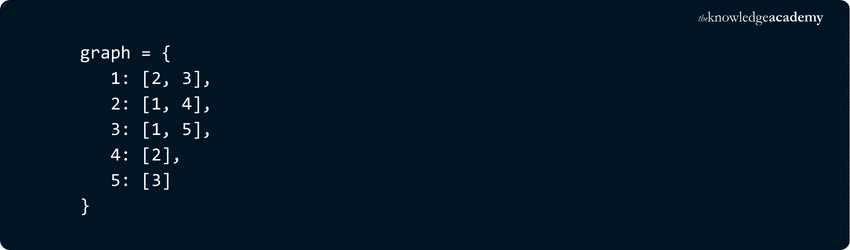
Adjacency matrices: In an adjacency matrix representation, a 2D array is used to indicate connections between nodes.
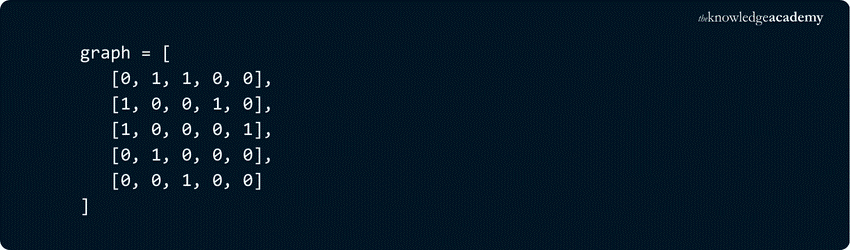
Graph traversal involves visiting all nodes in a graph in a specific order. Common graph traversal algorithms include depth-first search (DFS) and breadth-first search (BFS).
Depth-First Search (DFS): DFS explores each branch as much as possible before backtracking. It can be implemented using recursion or a stack.
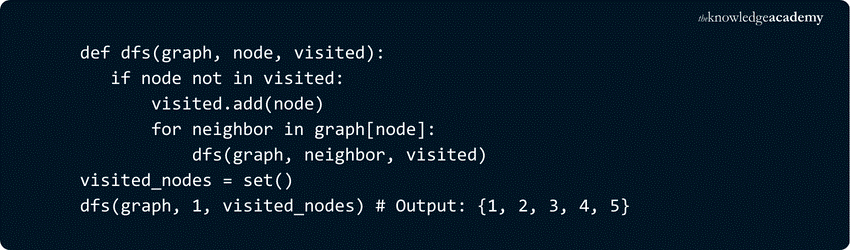
Breadth-First Search (BFS): BFS explores all neighbour nodes at a particular depth before moving on to nodes at the next depth level.. It can be implemented using a queue.
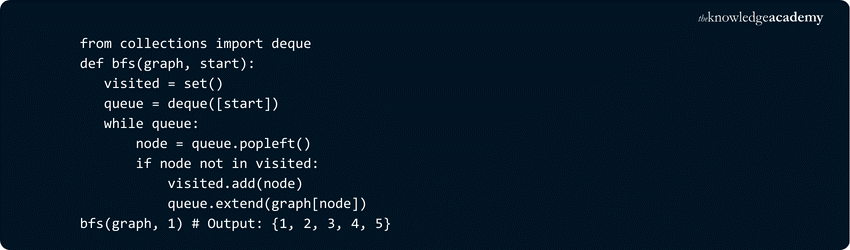
Graphs are widely used in real-life scenarios, such as:
1) Social Networks: Representing friends and connections between users.
2) Computer Networks: Modeling communication paths between devices.
3) Transportation Systems: Mapping routes and connections between cities.
Sets and Multisets
In this section, you'll learn how to implement mutable and immutable set and multiset (bag) Data Structures in Python using built-in data types and standard library classes.
Understanding Sets in Python
A set is an unordered collection of unique objects. Sets are typically used for:
a) Quickly test if a value is in the set.
b) Inserting or deleting values.
c) Computing the union or intersection of sets.
In Python, sets have O(1) time complexity for membership tests and O(n) time complexity for union, intersection, difference, and subset operations. The standard library’s set implementations follow these performance characteristics.
Creating Sets
Python provides syntactic sugar for creating sets using curly braces or set comprehensions:

To create an empty set, use the set() constructor. Using {} will create an empty dictionary instead:

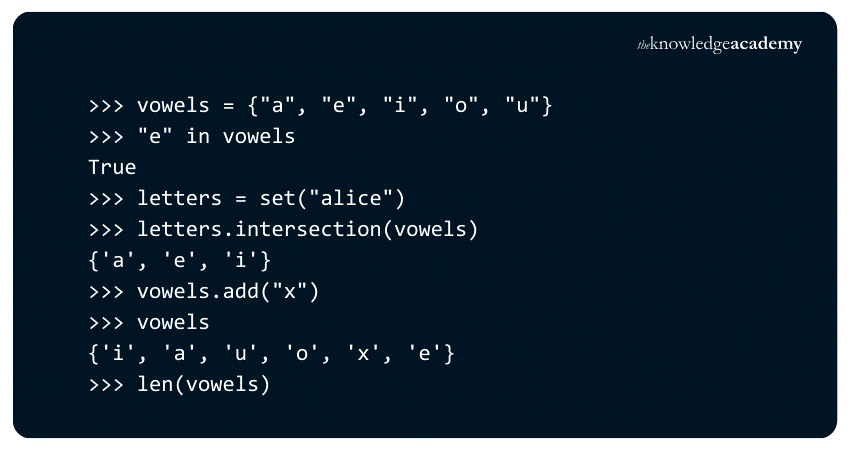
Mutable Sets: The set Type
The set type is Python’s built-in mutable set implementation, allowing dynamic insertion and deletion of elements. Sets in Python are backed by the dict data type and share its performance characteristics. Any hashable object can be stored in a set:
Immutable Sets: The frozenset Type
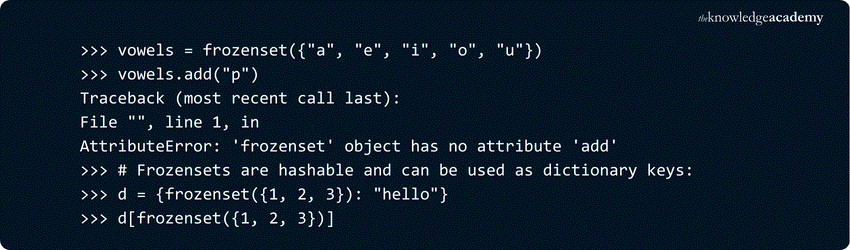
The frozenset class implements an immutable version of a set. Once constructed, it cannot be changed. This immutability allows frozenset objects to be used as dictionary keys or elements of another set:
Multisets: The collections.Counter Class
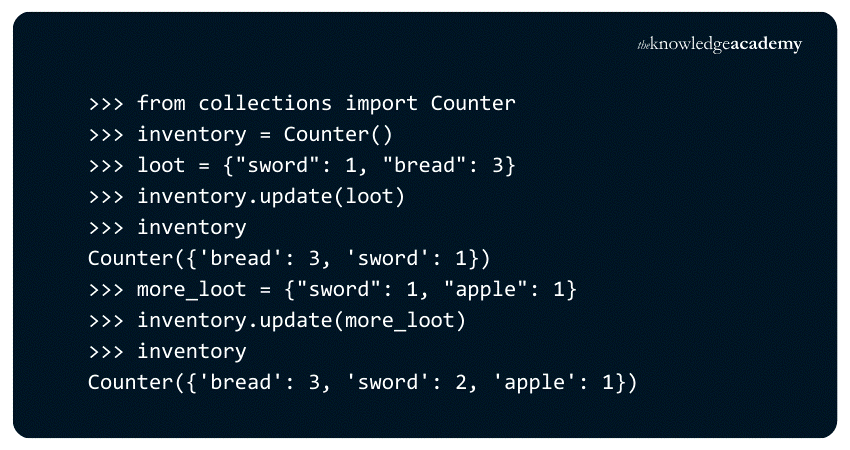
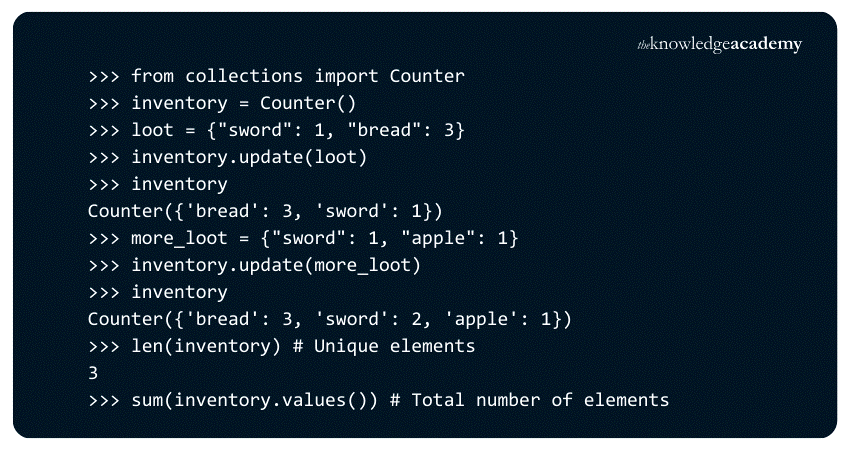
The collections.Counter class implements a multiset (or bag) that allows elements to have multiple occurrences. This is useful for tracking not just membership but also the count of each element:
One caveat with Counter is the distinction between the number of unique elements and the total count of elements. len() returns the number of unique elements, while sum() returns the total count:
By understanding and utilising these different types of sets and multisets, you can effectively manage collections of unique or repeated elements in Python.
Python Data Structures and Algorithms
Algorithms play an important role in Python Data Structures, which enables efficient data manipulation and retrieval. An algorithm is a set of instructions or step-by-step procedures designed to solve particular problems or perform tasks. When paired with appropriate Data Structures, algorithms optimise performance and enhance code efficiency.
Python offers a rich collection of built-in algorithms for various Data Structures. For instance, the sort() method uses the Timsort algorithm for sorting lists, and the search() method employs binary search in ordered data. These algorithms ensure that common operations on Data Structures are fast and reliable.
Additionally, developers can create their own custom algorithms to work with user-defined Data Structures. For example, when implementing a linked list, a custom algorithm can efficiently traverse the list to locate or modify elements. Similarly, when working with graphs, graph traversal algorithms like Depth-First Search (DFS) or Breadth-First Search (BFS) can help navigate through the nodes effectively.
Efficient algorithms are essential in handling large datasets and complex computational problems. As the volume of data increases, algorithms that scale well become crucial for maintaining acceptable performance levels. Python's versatility and extensibility enable developers to experiment with various algorithms and Data Structures to find the best solutions for their specific needs. For additional insights, you can also refer to the File Handling in Python guide.
Furthermore, considering the time complexity and space complexity of algorithms becomes important when dealing with significant datasets. Asymptotic notations, such as Big O notation, help measure the growth rate of an algorithm's resource consumption. This aids in selecting the most efficient solution. If you're preparing for a technical interview, reviewing Data Structure Interview Questions can help you gain a deeper understanding of how to analyse algorithms and improve your problem-solving skills for real-world scenarios.
By combining the right Data Structures with appropriate algorithms, Python empowers developers to tackle complex problems with elegance and effectiveness. This makes it a popular choice for various programming applications.
Want to become a professional Developer? Register for our Object-Oriented Programming (OOPs) Course - today!
Python Data Structures: Advantages and Disadvantages
Each Data Structure offers unique capabilities for tasks like sorting, inserting, and finding data, with efficiency varying based on the situation. No single Data Structure is inherently superior, but using the wrong one for a specific task can lead to inefficiency or skewed data.
Advantages of Python Data Structures
1) Efficiency: Data Structures like linked lists and binary search trees provide efficient insertion and deletion operations.
2) Memory Usage: Python Tuples use less memory compared to lists, making them more efficient for storing large amounts of data.
3) Quick Retrieval: Dictionaries allow for fast retrieval of values using keys, which is beneficial for handling unstructured data.
4) Existence Checking: Sets are excellent for checking the existence of a value and ensuring no duplicates are present.
5) Order Maintenance: Binary search trees maintain a sorted order of elements, facilitating quick access, sorting, and deletion.
Disadvantages of Python Data Structures
1) Sequential Access: Linked lists only provide sequential access, making searching and sorting operations challenging.
2) Immutability: Tuples do not support sorting, adding, replacing, or deleting elements, limiting their flexibility.
3) Limited Functionality: Sets have restricted functionality compared to other Data Structures.
4) Handling Large Data: Dictionaries are not suitable for handling large amounts of tabular data due to their structure.
5) Shifting Items: Arrays can be cumbersome for searching, sorting, inserting, and deleting since these operations often require shifting items.
Baster the pillar of GUI programming with Java Swing Development Training - sign up soon!
Best Practices for Selecting Data Structures
Choosing the right data structure is crucial for writing efficient and maintainable Python code. Start by understanding the nature of the data you're working with-consider factors like data size, access patterns, and the frequency of operations such as insertion, deletion, and lookup. For example, use lists for ordered collections, dictionaries for fast key-based retrieval, and sets when you need to eliminate duplicates.
Evaluate the time and space complexity of different data structures for your specific use case. Consider how the structure will scale as your application grows. Avoid overcomplicating your solution with advanced structures unless necessary; simpler structures often suffice. Lastly, always test edge cases and document your choices clearly, ensuring your code remains understandable and optimised for long-term use.
Pitfalls to avoid when using Data Structures in Python
Data structures are vital in computer science, but poor implementation can cause bugs, slowdowns, and maintenance issues. Understanding their common pitfalls across arrays, stacks, queues, trees, and graphs helps ensure your code remains efficient, reliable, and easy to manage.

1) Choosing the Wrong Data Structure
Selecting the right data structure is crucial. Each type offers distinct advantages and limitations in terms of memory usage, access speed, and operations such as insertion, deletion, and sorting. Always evaluate these trade-offs before making a decision. For instance, use arrays or hash tables for quick access, and linked lists or deques for frequent insertions and deletions at both ends. Using an inappropriate structure can result in slower performance and increased complexity.
2) Ignoring Edge Cases
Edge cases—like empty inputs, null values, or invalid data-are often overlooked during development. These can cause unexpected crashes or incorrect results. Always include tests for these scenarios and handle them gracefully. For example, ensure a stack isn't empty before popping, or validate that a binary tree is balanced during traversal.
3) Forgetting Big O Notation
Big O notation is vital in understanding how your code scales with input size. It helps you assess time and space complexity, allowing you to choose the most efficient algorithms. For example, while bubble sort operates at O(n²), merge sort is more efficient with O(n log n) complexity, especially for larger datasets.
4) Overcomplicating the Code
Overusing advanced data structures can make your code harder to read, debug, and maintain. Aim for clarity and simplicity—choose the most straightforward solution that meets your project’s needs. If a simple array suffices, avoid opting for a more complex structure like a heap or trie.
5) Neglecting Documentation
Poor or missing documentation can make your code difficult to understand and maintain. Always write meaningful comments and follow documentation standards, such as PEP 8 for Python. Clearly explain your choice of data structures and logic so that others (or your future self) can navigate the codebase with ease.
Build dynamic websites with our PHP Course- Join Now!
Why are Data Structures Import for Python Programming
Data structures play a vital role in Python programming by providing efficient ways to store, organise, and manage data. They allow developers to structure information logically, making programs easier to navigate and modify. Whether it's using lists to store sequences, dictionaries for key-value pairing, or sets for unique elements, each structure helps in solving specific types of problems more effectively.
In Python, choosing the right data structure enhances performance, reduces memory usage, and simplifies complex operations. From sorting algorithms to search functionality, the right data structure streamlines computation and supports clean, readable code. Ultimately, mastering data structures is essential for building scalable, high-performance Python applications.

Nilotpal Sarmah is a Senior Content Writer with 11+ years of overall experience spanning engineering, operations and content development. His technical knowledge and extensive writing experience enable him to simplify specialised topics across IT and Tech, Business Skills, Project Management, Health and Safety, and ISO and Compliance.
View Detail

 If you wish to make any changes to your course, please


