


We may not have the course you’re looking for. If you enquire or give us a call on 01344203999 and speak to our training experts, we may still be able to help with your training requirements.
Home
 Resources
Project Management
PMP® vs Scrum Certification: Making the Best Choice for Your Project
Resources
Project Management
PMP® vs Scrum Certification: Making the Best Choice for Your Project
PMP® vs Scrum Certification: Making the Best Choice for Your Project
ByGrace MitchellLast updated on: 07 October 2026
PMP® emphasises structured planning, scope, and budget control, while Scrum focuses on Agile teamwork, short sprints, and rapid adaptation to change. As a result, PMP suits projects with fixed requirements and long timelines, whereas Scrum works best for evolving products driven by speed, feedback, and continuous improvement.
The debate around PMP® vs Scrum has long captured the attention of project management professionals. Both certifications are built on different project management philosophies, which is why comparisons between PMP and Scrum continue to spark discussion across industries. Although both roles involve leading projects, they are not the same.
A Project Manager leads projects across industries, while a Scrum Master works specifically with Scrum teams. With over 1.7+ million PMP-certified professionals worldwide and an average £55K Scrum Master salary in the UK, both paths offer strong career value. This blog explains the key differences in roles, scope, and career prospects in PMP vs Scrum to help you choose the right certification. So, read on!
What is PMP®?
Project Management Professional (PMP®) is a globally recognised certification for Project Managers, awarded by the Project Management Institute (PMI), a U.S.-based professional association. It validates a professional’s ability to lead and manage projects effectively across different industries and business environments.
The PMP® Certification demonstrates expertise in leading teams, managing processes, and using predictive, Agile, and hybrid approaches. To earn the PMP® certification, individuals must meet the required education and project management experience criteria and successfully pass the PMP exam, demonstrating their knowledge and competence in managing projects.
What is Scrum Certification?
Scrum is a lightweight framework within the Agile methodology that helps teams deliver work in small, manageable cycles called sprints. Each sprint normally lasts between one and four weeks and ends with a usable product increment that provides value to stakeholders. This method allows teams to deliver results quickly and adapt to change easily.
Unlike traditional project management, Scrum shares responsibility across three key roles: the Product Owner, Scrum Master, and Developers. A Scrum certification demonstrates a professional’s understanding of Scrum principles, roles, events and practices. It can also show their ability to apply Scrum effectively within Agile teams and support collaborative, iterative project delivery.
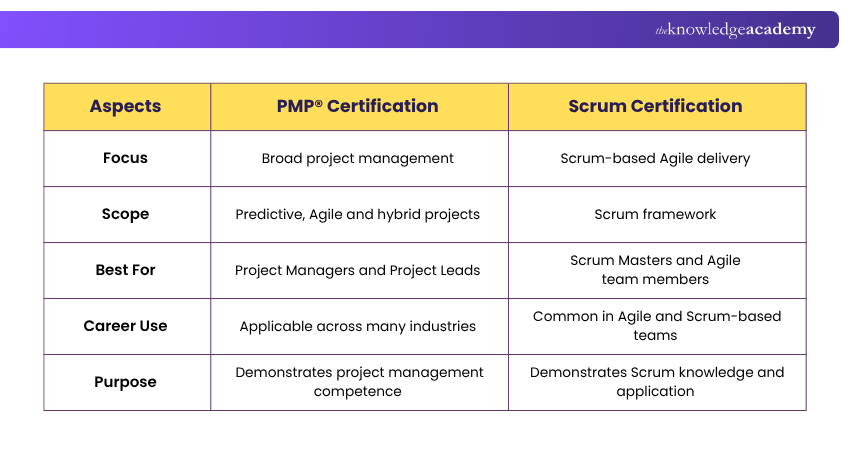
Key Differences Between PMP® and Scrum Certification
In project management, there has always been some ambiguity regarding the differences between the PMP® and Scrum certification. Many new project management credentials have developed over the past few decades, making it difficult for aspiring project management professionals to decide which one is appropriate for their professional goals.
It is not easy to give a single answer to this question, as each certification offers its own value by addressing different professional needs. The choice ultimately depends on an individual’s career goals and work environment. Both credentials are highly regarded, which is why PMP vs Scrum often becomes a key consideration for professionals. The following information will help you decide which certification to pursue.
a) PMP® vs Scrum: Pre-requisites
You must have previous experience in managing and leading projects, whether with a four-year degree or just a high school diploma.
PMP®: You must have project management experience. Here are the requirements and you will need one of the following:
1) A high school diploma, generally with five years of project management experience.
2) An associate’s degree or vocational trade school diploma with four years of project management experience.
3) A bachelor’s degree or higher with three years of project management experience.
4) A bachelor’s or postgraduate degree from a PMI GAC-accredited programme with two years of project management experience.
Scrum Master: The requirements can vary depending on the providers of a specific certification and certification level.
b) PMP® vs Scrum: Preparation
PMP®: Preparation for the PMP® exam usually requires a structured study plan covering PMI’s exam domains, project management principles, Agile and hybrid approaches, and scenario-based questions. Candidates often use the PMP Exam Content Outline to understand the areas assessed and use practice exams and mock questions to test their readiness.
Scrum: Preparation for Scrum certifications depends on the certification provider. It generally focuses on Scrum principles, accountabilities, events, artefacts and the practical application of the Scrum framework. Candidates may prepare through training, the Scrum Guide, practice questions and provider-specific study materials.
c) PMP® vs Scrum: Salary and Earning Power
The average annual salaries for Project Managers and Scrum Masters are outlined below. The figures provide a general market comparison:
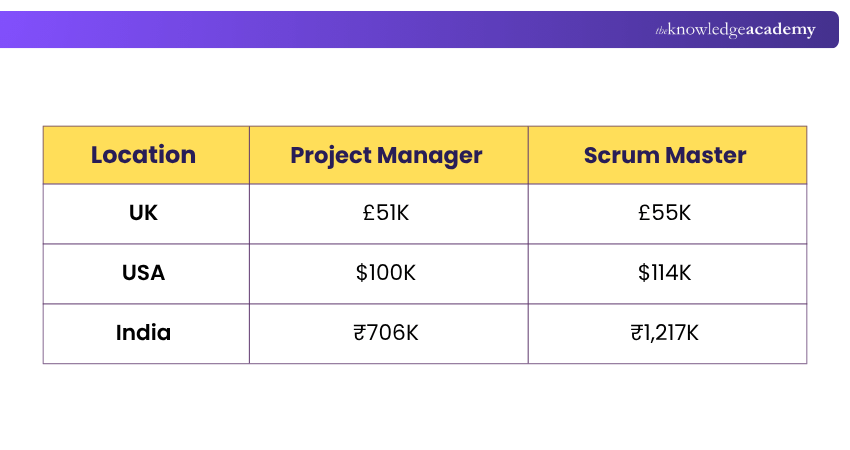
Source: Indeed
d) PMP® vs Scrum: Job Roles
The PMP® and Scrum certifications can open doors for more employment opportunities. These certifications demonstrate a person's dedication to continuing their education and staying current with Scrum and project management developments.
Frequently, Scrum Masters can become:
a) Coaches
b) Mentors
c) Product Owners
d) Managers
e) Continue as Scrum Masters in more challenging scenarios
After obtaining your PMP® certification, some of the PMP job profiles you can apply for are:
a) Project Managers
b) Associate/Asst. Project Manager
c) Team Leads/Managers
d) Project Executives/Engineers
e) Technical Project Managers
f) Project Delivery Manager
Learn Agile frameworks to lead projects with confidence and clarity with our Scrum Master Certification Training – Join now!
PMP® vs Scrum Certification: Which One to Choose?
Both PMP® and Scrum certifications will help you build your knowledge in project management practice and execute projects. You could frequently ponder whether PMP or Scrum is the better option, but everything relies on the goals you desire to accomplish.
1) The project management credential with the highest recognition is the PMP®. It evaluates applicants' knowledge of project management terminology, methodologies, and techniques.
2) A Project Manager focuses on projects and manages the accompanying timelines, whereas a Scrum Master directs and coaches their team. A Scrum Master Certification proves your proficiency with activities, artefacts, and roles and responsibilities.
Choose the option that will have the most significant positive effect on your career and future, if you have to pick between the two. The Scrum Master Certification can be helpful if you already work in Agile project management. On the other hand, PMP® certification may be suitable for experienced project professionals seeking to validate and broaden their project leadership capabilities.
Quick Check: Could Both Benefit You?
Consider developing both areas if:1. Your organisation uses Scrum within broader projects.2. You work across predictive, Agile or hybrid environments.3. Your role interacts regularly with Scrum Teams.4. You want broad project management capability alongside specialised Scrum knowledge.5. Your career goals may require both project leadership and Agile expertise.
Benefits of Having the PMP® Certification
The benefits of obtaining a PMP® certification are as follows for both individuals and organisations:
1) Industry Recognition
The PMP® Certification is widely recognised and accessible anywhere, making it applicable to any setting or business. So, regardless of your industry or professional background, adding this certification to your resume can be highly beneficial.
2) Facilitates Essential Project Management Skills
PMP® certification helps professionals strengthen essential project management skills such as planning, risk management, stakeholder engagement, communication and team leadership. It also develops knowledge of predictive, Agile and hybrid approaches, helping professionals choose and apply suitable methods across different project environments.
3) Contributes to Higher Paycheques
One of the key benefits of PMP® certification is a stronger earning potential. PMP-certified professionals report higher median salaries on average than non-PMP-certified professionals, although actual earnings vary by role, experience, industry and location. This makes PMP a valuable credential for long-term career and financial growth.
4) Demonstrates Your Commitment to the Profession
An employee who makes educational investments is valuable to the company. Your PMP® certification demonstrates your dedication to developing your professional abilities, knowledge, and competence. It also helps you gain the respect of your co-workers and supervisors.
Benefits of Obtaining a Scrum Certification
The following are the benefits you can get from earning a Scrum certification:
1) Enhances Your Mindset
Scrum certification helps professionals develop an Agile mindset focused on collaboration, adaptability, continuous improvement and delivering value. It encourages teams to respond constructively to change, learn from feedback and work more effectively through iterative and incremental practices.
2) Makes You an Asset at the Workplace
A Scrum certification can strengthen your ability to support Agile teams, facilitate collaboration and help remove obstacles that affect progress. It also demonstrates an understanding of Scrum principles and practices, which can make you more valuable in organisations that use Agile ways of working.
Pro Tip
When choosing a Scrum certification, first identify the capability you want to develop. A Scrum Master, Product Owner and general Scrum credential may support very different career goals.
3) Improves Teamwork and Collaboration
A Scrum certification helps professionals understand how to work effectively within cross-functional teams. It strengthens communication, shared responsibility and regular feedback, helping team members coordinate better, resolve issues faster and work together towards common goals.
Keep This in Mind
Before choosing between PMP® and a Scrum certification, consider the type of work you currently do and where you want your career to progress.1. Choose PMP® if you already have project management experience and want broader skills across predictive, Agile and hybrid environments.2. Consider a Scrum certification if you work in or want to move into Scrum-based teams and Agile product delivery.3. If your role involves both project leadership and Scrum practices, developing knowledge in both areas may be useful.
Learn backlog management, stakeholder communication, and Scrum roles from experts. Join our Scrum Product Owner Certification Training today!
Grace Mitchell creates practical Project Management content covering project delivery, governance, stakeholde engagement and programme coordination. Her knowledge of established methodologies helps readers understand complex project environments and approach project delivery with greater structure and confidence.
View Detail

 If you wish to make any changes to your course, please


