


 Top Rated Course

We may not have the course you’re looking for. If you enquire or give us a call on 01344203999 and speak to our training experts, we may still be able to help with your training requirements.
What is PMBOK® Guide in Project Management? Explained in Detail
Grace Mitchell 13 July 2026Want to know what a PMBOK Guide is? Read this blog to learn about the purpose, history, latest editions, and much more about the PMBOK Guide. The PMBOK® Guide by PMI provides globally recognised Project Management standards and best practices for improved planning, execution, control, consistency, and successful project delivery.

Training Outcomes Within Your Budget!
We ensure quality, budget-alignment, and timely delivery by our expert instructors.
Table of Contents
Projects are crucial business drivers; irrespective of size or scale, every organisation relies on Project Management Professionals (PMP) for success. The Project Management Body of Knowledge or PMBOK is defined as the complete set of procedures, best practices, terminologies, and recommendations. Globally, the demand for Project Management has been accelerating like never before. Project Management Institute (PMI), an industry leader in Project Management, says that by 2027, the demand for Project Management Professionals will increase to more than 88 million. According to research by PMI, 71% of projects achieve better results and deliver projects on time when Project Management is considered a top-most priority.
Table of Contents
1) What is PMBOK® Guide?
2) PMBOK History
3) What is the Purpose of PMBOK?
4) PMBOK Framework
5) PMBOK Fifth Edition
6) PMBOK Sixth Edition
7) PMBOK® Guide Seventh Edition
8) Conclusion
What is PMBOK Guide?
The Project Management Body of Knowledge (PMBOK) is a Project Management guide published by PMI. This body of knowledge has evolved and continues to be updated with newer standards as the industry is constantly growing and practitioners discover newer methods of Project Management. PMI recently added the latest version, the seventh edition of the PMBOK® Guide.
PMBOK® Guide is an instrumental book that provides foundational standards to PMP professionals to manage multiple projects. In PMBOK® Guide, PMI presents a set of principles, best practices, terminologies, guidelines, and Project Management standards relevant to every industry. These standards and guidelines are generally accepted and practised across industries.
PMBOK® Guide is an essential resource for anyone preparing for PMP certification and guides professionals already involved in Project Management. PMBOK is globally recognised and used for Project Management development techniques, using various training methods in Project Management from many globally recognised institutions. Project Management Institute (PMI) offers Certified Associate in Project Management (CAPM) and Project Management Professional (PMP). PMBOK® Guide serves as the fundamental resource for both CAPM and PMP exams. The PMBOK® Guide is valuable to companies across domains as it helps them standardise their practices, tailor their approach to each project differently and help them with the proper methods to even deal with project failure.
PMBOK History
The abbreviation PMBOK® stands for "Project Management Body of Knowledge." For PMP aspirants to study and get ready for the PMP Exam, this is by far the most significant publication from the PMI. PMI was first started in 1969 to provide a platform for Project Management professionals to share their knowledge and discuss their difficulties in managing their projects.
In 1987, PMI published the first PMBOK whitepaper, and the first draft of PMBOK followed in 1994. The first edition of PMBOK was published in 1996, while the latest edition (seventh) was published in 2021. Due to the constant introduction of new best practices and standards as well as the more methodical arrangement of the PMBOK® Guide, each new edition was released to replace the previous one. The PMBOK® Guide is currently in its seventh edition.
What is the Purpose of PMBOK?
The PMBOK® Guide assists businesses in maintaining the same level of project development. The sequential waterfall concept is highly supported by PMBOK. The framework used by PMBOK helps to cut down on errors. Through risk management, it promotes project success.
1) Firstly, what works are covered by PMBOK? Those that are unsure of how to approach risk management can get help from the techniques documented within the Project Management community. What doesn't work is also covered in the PMBOK. This avoids project failure.
2) Secondly, the reason PMBOK is useful is because it enables businesses to standardise procedures across departments. Accordingly, employees working in development manage projects in a similar way to those working in distribution.
3) Thirdly, Project Managers can operate with a uniform framework across businesses with the help of PMBOK. The same techniques can be applied by an employee of business x who later transfers to company y.
PMBOK Framework
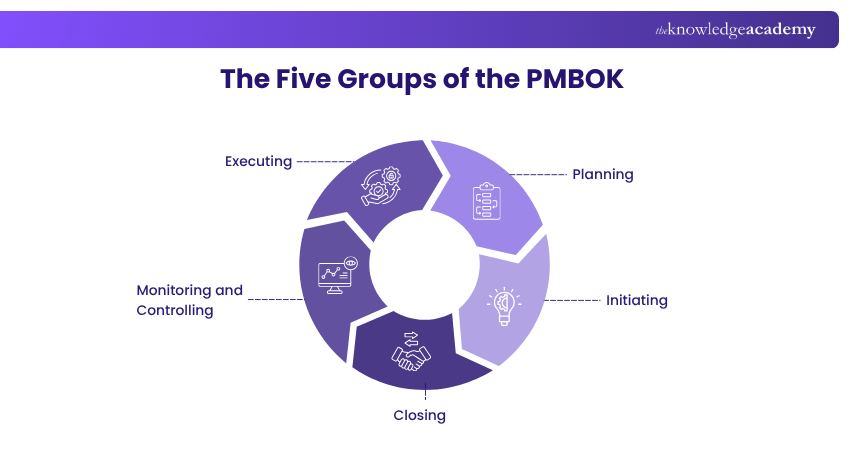
The field of Project Management is expanding quickly, and it is now acknowledged on a global scale as a strategic competency, a career path, and a topic for training and education. The PMBOK® Guide Sixth Edition included 49 Project Management processes, five process groups, and ten knowledge areas. The PM procedures are grouped by Project Management material in the knowledge areas.
1) Initiating
The processes, activities, and abilities required to precisely define a project's beginning are included in the initiating process category. The foundation for future success throughout all project stages is laid by putting all necessary permissions, authorisations, and initial work orders in place to ensure an efficient and logical development of initial project operations.
2) Planning
The Planning Process Group outlines the procedures required to establish the project's scope, create strategic plans to maximise workflow, start compiling priority lists, and determine team needs. This process group also deals with a more detailed description of all project expectations and goals, and it establishes the project infrastructure required to carry out those expectations within the restrictions of time and money. Follow the set of activities in the planning stage mentioned below:
a) Total scope of the project (limitations, future scope, summary and budget).
b) Progressive elaboration and project documents are developed.
c) The PMBOK® Guide includes twenty-four concrete processes that are involved in planning.
3) Executing
This stage includes activities such as:
a) Ensure smooth coordination with the vendor while working on contracts.
b) Managing communications along with stakeholder engagement, assuring product and project quality.
c) Managing the development team by performing team building exercises.
4) Monitoring and Controlling
The primary capabilities of the Monitoring Process Group include managing change orders, addressing ongoing budget concerns, and minimising unforeseen events that can prevent a team from meeting initial project goals. This stage includes tracking, reviewing and regulating the progress and performance of the project.
Activities include:
a) Determine any areas where the plan needs to be changed.
b) Start making the appropriate modifications.
c) To get back on track, where you assess variation, compare the plan to the reality, and take appropriate action.
5) Closing
This process group's primary task is to successfully complete the project, which includes doing it as per the schedule and within the allocated budget. The team may never fully reap the rewards of their highly strategic projects if they do not execute these process groups, despite the fact that doing so is not always simple.
Activities include:
a) By archiving records, conducting sessions, issuing final payments, concluding contracts, congratulating and releasing the team, the Project Manager should formally finish the project.
b) Lessons learnt and other historical data should be centrally maintained and used as input for upcoming initiatives to avoid having to start from scratch.
Gain the knowledge and confidence to master in diverse project environments with the PMP® Certification Training – Sign up now!
PMBOK® Fifth Edition
Stakeholder management was incorporated in the PMBOK® 5th edition, which was built on the initiating, planning, executing, monitoring and controlling, and closing process groups.
The Project Stakeholder Management principles were included in the PMBOK® 5th edition, which also added five processes over the previous edition for a total of 47 processes centered on the Process Groups and Knowledge Areas. The five process groups are matched to the ten knowledge areas:
1) Project Risk Management
2) Project Human Resource Management
3) Project Communications Management
4) Project Cost Management
5) Project Scope Management
6) Project Integration Management
7) Project Procurement Management
8) Project Time Management
9) Project Quality Management
10) Project Stakeholder Management
PMBOK® Sixth Edition
Early in 2016, the PMI committee got together to start working on the newest version of PMBOK's drafts. The organisation updated the manual in several ways, not the least of which is increasing the emphasis placed on the idea that people, not just systems, are responsible for carrying out projects.
The 6th edition of PMBOK includes the following updates:
Agile (Adaptive PM) Addition
These days, agile methodologies play a significant role in all initiatives. The fifth edition of the PMBOK® Guide introduced references to agile methodologies. Informed by Agile, Scrum, Kanban, Lean, XP, and other flexible, change-driven Project Management approaches, the most recent version has major additions.
Updated Processes
In the sixth edition, PMI included three new processes while eliminating one from the 47 in the fifth edition:
a) Control Resources
b) Knowledge Management
c) Risk Management
Revised Naming Protocol
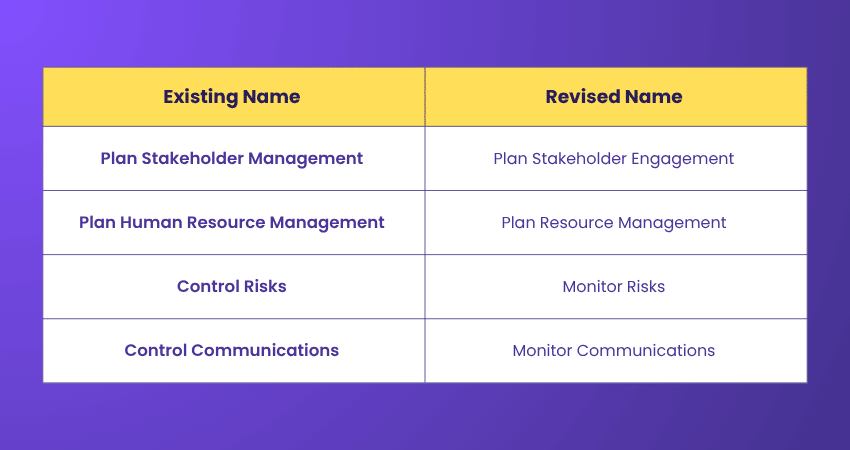
There are many other name changes, check out the PMBOK Sixth edition to know more.
Completion of the Procurement Process
Project Managers typically lack the authority to close contracts or procurements, according to the PMI. These tasks are now included in the Control Procurements and Close Project or Phase functions.
Project Manager’s Role
This section now addresses PMI's Talent Triangle to include the strategic, leadership, and technical Project Management competencies and skills that a modern Project Manager should possess in light of the constantly evolving role of the Project Manager and how leadership in Project Management is approached.
Enhance your Agile skills with this PMI-ACP® Certification Training – Register today!
PMBOK® Guide- Seventh Edition
The seventh edition of the (PMBOK® Guidebook) has been updated to address these issues, better reflect how people operate today, and support your ability to be proactive, inventive, and agile. The seventh edition of PMBOK® Guide includes:
a) reflects all available development philosophies (predictive, traditional, adaptive, agile, hybrid, etc.)
b) focuses not only on deliverables but also on project outcomes
c) consists of a section entirely devoted to customising the development methodology and procedures.
d) increases the list of instruments and methods in the "Models, Methods, and Artifacts" section.
Changes in the Seventh Edition of PMBOK
According to PMI, "the PMBOK® Guide seventh edition has been updated to meet upcoming challenges, align with how people work today and for them be more proactive, innovative and noble in their job." The current edition of PMBOK will be much shorter than the earlier editions of the guide.
The seventh edition of PMBOK will majorly focus on the principles of Project Management, unlike the earlier version, where the main focus was on the process of Project Management Standards which is product based rather than process based. There are sections devoted to PMBOK Knowledge areas in both current and older versions of the guide, where each knowledge area is divided into processes, PMP tools, techniques, inputs, and outputs. These processes are absent in the seventh edition of the book. Instead, there will be principles that are widely practised and accepted by experts in the industry.
In the current edition, the Standards Plus' interactive digital content platform' will be linked in the Models, Methods and Artifacts section. This will answer the 'how to...' of various Project Management aspects. This edition will focus on agile and holistic project delivery methods rather than the waterfall Project Management methodology.
Conclusion
If you want to rise above the normal, secure your future with PMBOK. The field has increasing opportunities by the day, and we are sure that the PMBOK Guide® will help you ace your journey to expert Project Management, especially when considering the difference between PMBOK and PRINCE2. We have provided you with all the information about the PMBOK® Guide and how you can leverage it to prepare for the updated PMP exam. Now, you must ensure that you couple all this information with an enormous amount of hard work and dedication.
Get an understanding of the work breakdown structure used in Project Management with the CAPM® Certification Training – Join now!
Frequently Asked Questions
Which Version of the PMBOK® Guide is Currently Used?

The PMBOK® Guide 7th Edition (published in 2021) is the currently used version, shifting from process-based to principle-based Project Management. It is used alongside the PMIstandards+ digital platform, which provides additional practice guides and resources.
Is the PMBOK® Guide Required for PMP Exam Preparation?
The PMBOK® Guide is not the sole resource required for PMP exam preparation, as the exam is now based on the Examination Content Outline (ECO) covering predictive, agile, and hybrid approaches. It is recommended as a reference guide alongside other resources like the Agile Practice Guide, online courses, and practice exams.

Grace Mitchell


Senior Project Management Consultant and Author
Grace Mitchell is a highly experienced project management professional with over 15 years of expertise in leading large-scale projects across industries, including construction, IT, and finance. With qualifications in PRINCE2®, PMP®, AgilePM®, and MSP®, Grace specialises in delivering complex programmes with precision and clarity. Her writing is grounded in real-world application and focuses on helping learners build confidence in project delivery and stakeholder management.
View Detail

 If you wish to make any changes to your course, please


