




We may not have the course you’re looking for. If you enquire or give us a call on 01344203999 and speak to our training experts, we may still be able to help with your training requirements.
PMBOK vs PRINCE2®: Comparison and Differences
ByNilotpal SarmahLast updated on: 30 September 2026
The PMBOK vs PRINCE2® comparison highlights two distinct approaches to project management: one providing broad project management standards and guidance, and the other offering a structured project management method. You'll explore how they differ in structure, governance, processes, flexibility, and project management guidance.
Every Project Manager wants their project to be completed efficiently and effectively. However, success can elude you if proper plans and frameworks are not followed. Using an appropriate project management approach can help provide structure and direction, but which one should you choose for your project?
There are numerous project management frameworks, methods, and approaches, making it impractical to compare all of them. Project Management Body of Knowledge (PMBOK) and Projects IN Controlled Environments (PRINCE2) are two widely recognised approaches to project management. In this blog, you can explore the differences between PMBOK and PRINCE2® with a detailed comparison. So, let's dive in!
What is PMBOK?
The Project Management Institute (PMI), one of the pioneers in Project Management, developed the PMBOK. It is a standard that provides guidelines for project management processes, principles, guidance, practices, terminology, and approaches for managing projects. It benefits organisations as it helps organisations improve consistency, decision-making, and project management practices. Above all, it can help these organisations to standardise procedures throughout.
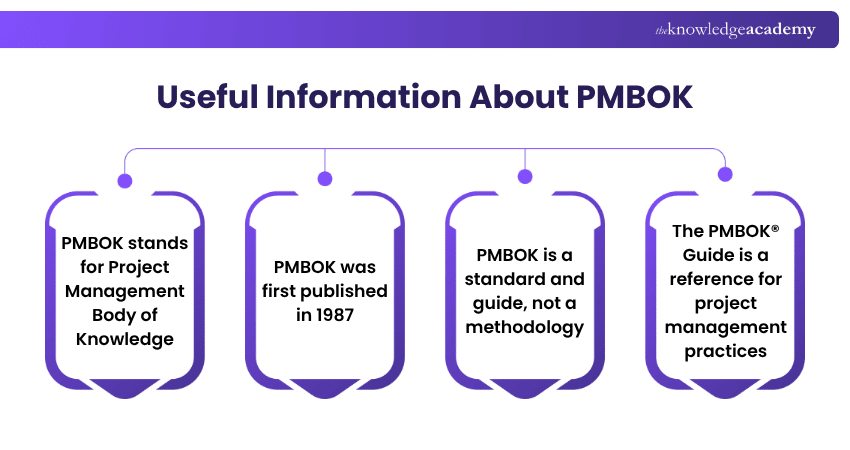
The PMBOK® Guide provides guidance that helps project professionals apply recognised project management practices. It supports predictive, adaptive, and hybrid approaches, depending on the needs of the project. It is also versatile and can be tailored for different industries, projects, and team sizes.

What is PRINCE2®?
PRINCE2® (PRojects IN Controlled Environments) is a structured project management method that provides clear processes, roles, responsibilities, and controls for managing projects from start to finish. It focuses on maintaining a strong business justification, defining accountability, managing risks, and ensuring that projects remain aligned with organisational objectives.
This method helps project teams plan, monitor, and control work effectively while supporting informed decision-making, consistent governance, and the delivery of intended project outcomes.
What is the Difference Between PMBOK and PRINCE2®?
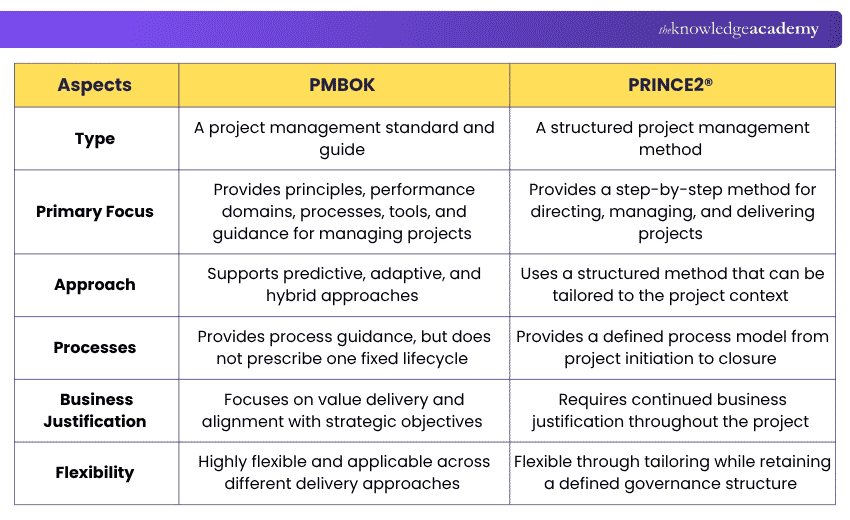
Although both PMBOK and PRINCE2® deal with project management, they differ greatly. Now let's compare PMBOK and PRINCE2 and look at the differences between them:
1) Approach
PMBOK takes a broad, knowledge-based approach to project management. It provides principles, guidance, performance domains, processes, tools, and techniques that Project Managers can select and tailor according to the needs of a project.
PRINCE2®, on the other hand, follows a more structured project management method. It defines clear principles, practices, processes, roles, and responsibilities that guide how a project should be initiated, directed, managed, controlled, and closed. Although it is structured, PRINCE2® can still be tailored to suit the project's size, complexity, environment, and organisational requirements.
2) Structure and Prescriptiveness
PMBOK provides broad project management guidance that practitioners can tailor according to the needs, complexity, and delivery approach of a project. It does not prescribe a single fixed way to manage every project, giving organisations flexibility in how they apply its principles, processes, tools, and techniques.
PRINCE2®, in comparison, follows a more structured method with defined principles, practices, processes, roles, and responsibilities. However, it is not rigid, as the method can be tailored to suit the size, complexity, risk, and environment of a project while retaining its core governance structure.
3) Skills and Capabilities
PMBOK helps Project Managers build a broad range of capabilities that can be applied across industries, project types, and delivery environments. Its guidance supports areas such as planning, stakeholder engagement, team management, delivery, measurement, uncertainty, governance, and value creation.
On the other hand, PRINCE2® develops the ability to manage projects using a clearly defined governance and control structure. It helps practitioners understand how to assign responsibilities, manage by stages, maintain business justification, control risks and issues, and monitor project progress.
Turn theory into successful project execution with the PRINCE2® Practitioner Training – Join now!
4) Depth
PMBOK offers considerable depth across the wider discipline of project management. It covers multiple aspects of managing projects, including principles, performance domains, process guidance, tools, techniques, tailoring, and different delivery approaches.
PRINCE2® provides greater depth in the structured governance and management of an individual project. It explains how decisions should be made, how authority should be distributed, how project stages should be controlled, and how progress should be monitored. Its depth therefore lies more in project governance, control, accountability, and structured management practices.
5) Primary Focus
The primary focus of PMBOK is to provide comprehensive guidance and recognised good practices for managing projects effectively. PRINCE2 primarily focuses on structured project governance, continued business justification, defined responsibilities, and controlled delivery throughout the project lifecycle.
6) Domains
The PMBOK Guide Eighth Edition uses seven performance domains that represent key areas of project management practice: governance, scope, schedule, finance, stakeholders, resources, and risk. These domains help practitioners consider the major areas that contribute to effective project delivery.
PRINCE2® does not use performance domains in the same way. Instead, it is structured around principles, practices, and processes. Its practices address areas such as the business case, organisation, plans, quality, risk, issues, and progress, while its processes guide the project from preparation and initiation through delivery and closure.
7) Governance and Control
PMBOK provides guidance that organisations and Project Managers can use to establish appropriate governance, decision-making, oversight, and control mechanisms according to the needs of the project.
PRINCE2® places greater emphasis on a defined governance and control structure. It establishes clear roles and responsibilities, stage-based management, tolerances, escalation paths, and regular progress reviews to help maintain accountability and keep the project within agreed boundaries.
Learn how to manage structured projects with confidence and precision by registering for the PRINCE2® Practitioner Course now.
PMBOK or PRINCE2®: Which One Should You Choose?
Choosing between PMBOK and PRINCE2® depends on how your organisation manages projects, the level of structure required, and the type of guidance your team needs.
1) Choose PMBOK® for Flexible Guidance: It may be more suitable when you need a broad set of principles, practices, tools, and techniques that can be adapted to different industries, project types, and delivery approaches.
2) Choose PRINCE2® for Structured Governance: It may be more appropriate when your organisation requires clearly defined roles, stage-based control, continued business justification, and a consistent method for managing projects.
3) Consider Using Both: Organisations can use PMBOK for wider project management knowledge and PRINCE2® for a structured governance and delivery method. This combination can provide both flexibility and control.
Keep This in Mind
PMBOK and PRINCE2 are not direct substitutes. PMBOK provides broad, adaptable project management guidance, while PRINCE2 offers a structured method with defined principles, practices, processes, and roles. The most suitable approach depends on the project environment, governance needs, and level of flexibility required.
Become more effective in managing Agile project lifecycles with PRINCE2 Agile® Practitioner (Version 2) Training - Sign up now!

Nilotpal Sarmah is a Senior Content Writer with 11+ years of overall experience spanning engineering, operations and content development. His technical knowledge and extensive writing experience enable him to simplify specialised topics across IT and Tech, Business Skills, Project Management, Health and Safety, and ISO and Compliance.
View Detail

 If you wish to make any changes to your course, please


