


We may not have the course you’re looking for. If you enquire or give us a call on 01344203999 and speak to our training experts, we may still be able to help with your training requirements.
Office Manager vs Executive Assistant: Which One is Better?
ByShristi RoyLast updated on: 12 October 2026
Understand the distinction between an Office Manager and an Executive Assistant, two roles that support organisations in different ways. This blog compares their responsibilities, skills, scope, authority and career paths to help you determine which role better suits your goals.
Key Takeaways
1. Office Managers generally focus on day-to-day workplace operations, while Executive Assistants primarily support senior leaders.2. Both roles require strong organisation, communication, prioritisation and problem-solving skills.3. Office Managers typically coordinate office-wide resources, processes and administrative activities.4. Executive Assistants often manage executive schedules, communications, meetings and sensitive information.5. The right career depends on whether you prefer broader operational coordination or focused executive support.
In many workplaces, the positions of Office Manager and Executive Assistant may appear similar, but their focus differs. Office Managers generally coordinate broader workplace operations, while Executive Assistants provide focused administrative support to senior leaders.
Although both Office Manager and Executive Assistant are essential roles within a company, they have different responsibilities and levels of authority. In this regard, read this blog further to understand the differences between Office Manager vs Executive Assistant and the benefits of pursuing these career paths in detail.
Who is an Office Manager?
Office Managers are usually individuals who look after the everyday operations in an office. This includes staff management, finances, ordering supplies, taking care of events and maintaining office supplies. They can also be responsible for Human Resources (HR) work, like onboarding of employees, payroll processing and employee records management.
Office Managers play a crucial role in organisations, overseeing administrative tasks and ensuring the smooth functioning of the office. In larger organisations, they may manage a team of administration staff, while in smaller organisations, they may handle all administrative duties themselves. These managers must have excellent multitasking and prioritisation skills to manage their workload effectively.
Picture This
Two problems arise at the same time:
The office needs supplies and a new employee requires administrative support.→ An Office Manager may coordinate the response.A senior executive's meeting changes and their schedule needs rearranging.→ An Executive Assistant may handle the situation.

Who is an Executive Assistant?
Executive Assistants are crucial in providing administrative support to company leaders to ensure efficient completion of priority tasks and goals. They manage the executive's communications, allowing them to access important information while filtering out low-priority items easily. These Executive Assistants are also responsible for screening visitors and providing professional customer service.
Additionally, they manage the senior's daily calendar, which includes scheduling meetings, confirming appointments, and arranging itineraries and transportation. Depending on the role, Executive Assistants may also train or supervise other administrative staff. Their responsibilities can overlap with those of Administrative Assistants, but Executive Assistants typically provide higher-level support to senior leaders.
Difference Between Executive Assistant and Office Manager
Here are the differences between Executive Assistant and Office Manager at a glance:
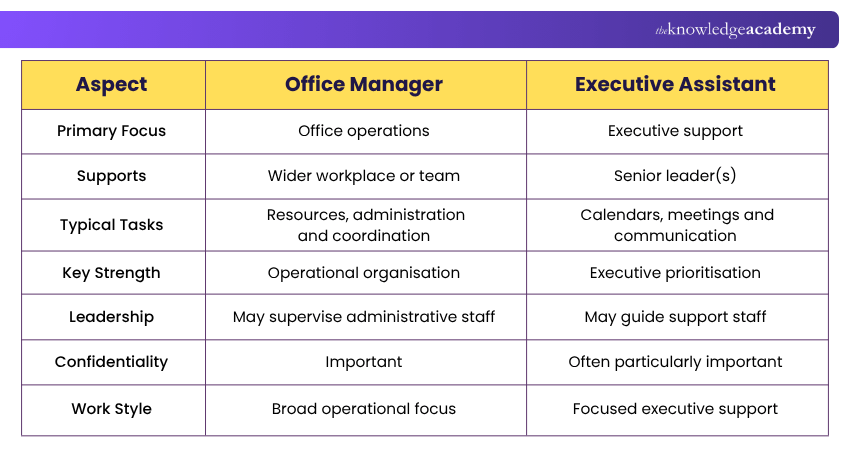
Now let’s explore the differences in detail:
1) Responsibilities
An Executive Assistant typically handles priority administrative work for a senior leader. This can include scheduling meetings, managing communications and coordinating appointments. An Office Manager generally focuses on the wider workplace, ensuring employees have the administrative resources and support required for daily operations. Depending on the organisation, they may also hire, train or delegate responsibilities.
Trainer's Insight
Job titles do not always tell the full story. An Office Manager in one organisation may perform tasks handled by an Executive Assistant in another, so compare the actual responsibilities and reporting structure.
2) Scope of Support
Office Managers usually support the broader workplace or administrative function. Their attention may be divided across teams, resources and operational requirements. Executive Assistants typically provide more focused support to one or more senior leaders, helping them manage priorities and administrative demands.
3) Reporting Structure
An Office Manager may work with different departments and supervise administrative staff depending on the size and structure of the organisation. An Executive Assistant generally works closely with a senior leader or leadership team. The exact reporting arrangement varies between organisations.
4) Skills
Both positions require organisation and communication, but their priorities differ. Here’s a quick look at the necessary skills and how they differ for each role:
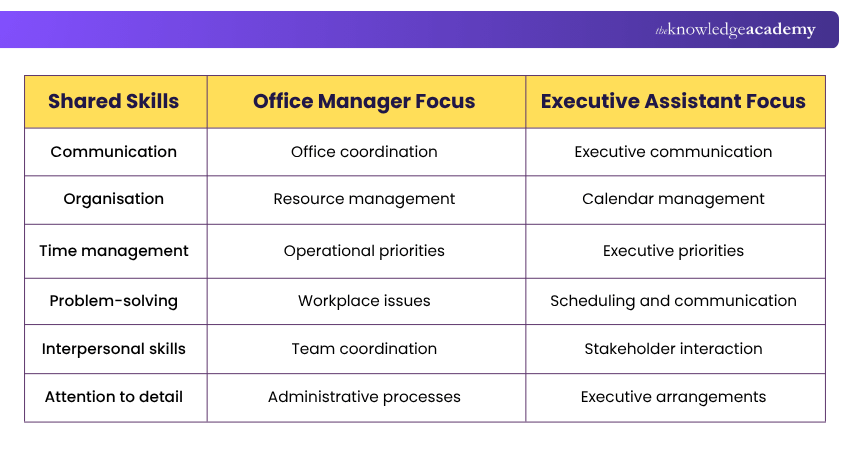
5) Qualifications and Experience
Qualifications and experience requirements vary by employer and role. Relevant administrative experience, strong IT skills, organisation and communication are commonly valued, while routes into these careers can include office support experience, apprenticeships, business or administration qualifications and on-the-job progression.
For either career, relevant administrative experience and strong workplace skills can help candidates prepare for greater responsibilities.
6) Work Environment
Both roles commonly operate in office-based environments, although their working patterns may differ. Executive Assistants may accompany senior leaders to meetings or events, while Office Managers typically focus on coordinating daily workplace operations.
7) Decision-making and Authority
Office Managers may make decisions relating to administrative operations, workplace resources and the coordination of office activities. Executive Assistants may make day-to-day decisions relating to scheduling, prioritisation and executive support. The level of authority for either position ultimately depends on the organisation.
Determining the Right Path for Your Career
Reflecting deeply on your long-term goals before choosing a career path is important. Both roles can lead to more senior administrative, operations or executive-support positions, depending on experience, responsibilities, organisation size and individual career goals.
If you prefer coordinating office-wide operations, resources and administrative processes, an Office Manager role may suit you. If you prefer focused support for senior leaders involving complex scheduling, communication, prioritisation and discretion, an Executive Assistant role may be a better fit.
Career Progression for Office Managers and Executive Assistants
Progression depends on factors such as experience, responsibilities, organisation size and individual career goals.
Office Manager Career PathAdministrative role↓Office Manager↓Senior office or operations management rolesExecutive Assistant Career PathAdministrative support role↓Executive Assistant↓Senior executive support or administrative leadership roles
So, Office Managers and Executive Assistants share several administrative and organisational skills, but their priorities differ. Choosing between the two comes down to your preferred working style and career goals. Consider the responsibilities rather than the job title alone, as the scope of either role can vary considerably between organisations.
Unlock the future of office management with the Administrative Assistant Course – Sign up today!
Keep This in Mind
Neither an Office Manager nor an Executive Assistant role is universally better; the right choice depends on the type of work and responsibility you prefer. When comparing opportunities, consider the scope of support, decision-making authority, confidentiality, daily responsibilities, and progression opportunities to find the role that best matches your career goals.

Shristi Roy is a Content Writer with experience in journalism, article writing and web content development. Her experience researching and writing about Business Skills and Accounting and Finance enables her to communicate specialised information through clear, engaging narratives.
View Detail

 If you wish to make any changes to your course, please


