




We may not have the course you’re looking for. If you enquire or give us a call on 01344203999 and speak to our training experts, we may still be able to help with your training requirements.
Models of Organisational Behaviour: An Ultimate Guide
ByAkhil KLast updated on: 21 September 2026
Feeling lost in workplace dynamics? Explore the models of organisational behaviour & unlock the secrets to a productive and successful work environment. Organisational behaviour models are conceptual frameworks that aim to explain and predict how individuals, groups and organisations act within a workplace setting.
The Big Picture
1. Organisational Behaviour (OB) examines how people behave and interact within organisations.2. Workplace behaviour can be studied at individual, group and organisational levels.3. OB models represent different approaches to management and employee relationships.4. These approaches can influence motivation, communication, teamwork and performance.5. Different workplace situations may require different management approaches.
Feeling lost in the maze of human dynamics at work? Confused about how to navigate conflict, boost employee engagement, and achieve optimal team performance? Understanding models of organisational behaviour is the key. These frameworks act as powerful tools to analyse individual and group behaviour within a company setting.
By unpacking the core principles of each model, you'll gain valuable insights into employee motivation, leadership styles, communication strategies, and group dynamics. Get ready to unlock the secrets of building a more productive, collaborative, and successful work environment through the models of organisational behaviour!
Various Models of Organisational Behaviour
Now that we've grasped the immense significance of organisational behaviour, let's delve deeper into the practical tools that help us understand and influence it. Here are certain models of organisational behaviour that act as a roadmap to navigate workplace dynamics:
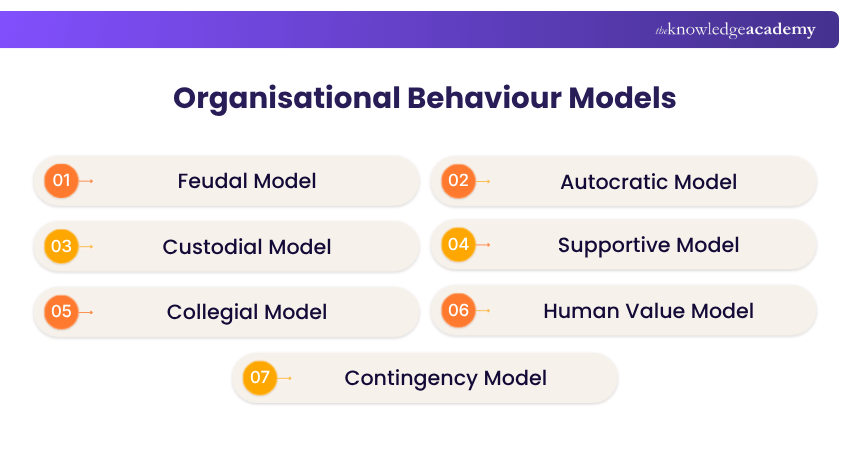
1) Feudal Model
The feudal model is characterised by a hierarchical structure where power and authority are concentrated at the top. Employees are expected to follow orders without question, much like a feudal lord and serfs. For example, traditional military organisations often exhibit this model with strict command and control.

2) Autocratic Model
The autocratic model places emphasis on authority and command. Managers make decisions unilaterally, and employees are expected to comply. This model can allow quick decisions in some crisis situations. For instance, early 20th-century factories often used this model, with strict supervision and clear directives.
3) Custodial Model
The custodial model focuses on providing economic security and benefits to employees. Organisations offer generous benefits and job security to foster loyalty and satisfaction. An example is a company offering comprehensive health benefits and retirement plans, aiming to keep employees content and reduce turnover.
4) Supportive Model
The supportive model emphasises participation and support from managers who encourage and assist employees. This approach aims to enhance job satisfaction and motivation through supportive behaviours. For example, a tech company fosters innovation by providing resources and guidance to help employees develop new ideas.
5) Collegial Model
The collegial model promotes a partnership between employees and management. This model encourages teamwork and a sense of shared responsibility. For instance, many modern startups adopt this model, where employees and managers collaborate closely, share ideas, and work together towards common goals.
6) Human Value Model
The human value model focuses on the intrinsic value and potential of employees. It promotes personal growth, self-actualisation, and respect for individuality. An example is a non-profit organisation that prioritises employee well-being, personal development, and work-life balance to achieve a motivated and engaged workforce.
7) Contingency Model
The contingency model asserts that there is no one-size-fits-all approach to organisational behaviour. It suggests that the best management style depends on the specific situation, environment, and workforce. For instance, a multinational company may adapt different management styles for its diverse global branches based on local cultures and conditions.
Pro Tip
Instead of asking, "Which organisational behaviour model is best?", consider, "Which approach fits the situation, workforce and organisational environment?"
Objectives of Organisational Behaviour
The main aims and objectives of organisational behaviour are to understand, predict, and control human behaviour at work to improve organisational effectiveness. Organisational behaviour is critical in understanding how an organisation can strengthen productivity and increase employee satisfaction through motivation, culture, and leadership styles.
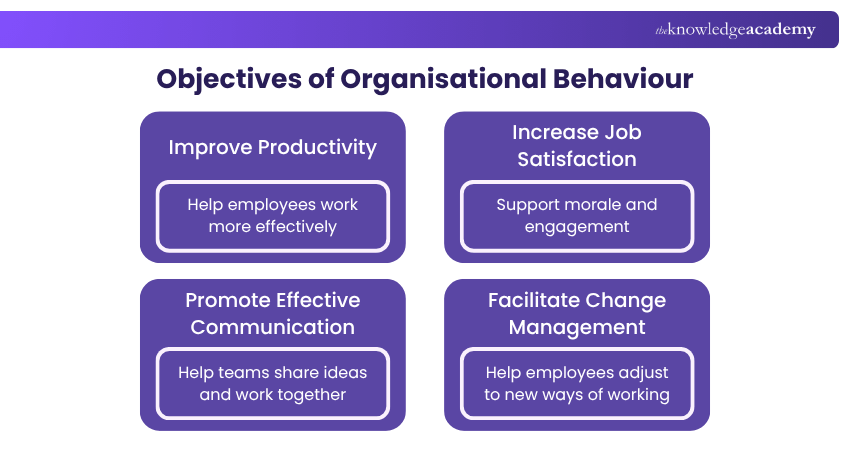
Another objective is to enhance organisational communication. Effective communication strategies ensure the smooth flow of information and help align employees with organisational goals. Organisational behaviour also seeks to foster effective teamwork by understanding group dynamics and improving collaboration.
Additionally, organisational behaviour focuses on managing and resolving workplace conflicts by identifying their sources and implementing effective conflict resolution techniques. A better understanding of organisational behaviour aids in managing change more effectively. Leaders who understand how employees respond to change can apply strategies to minimise resistance and ensure a smoother transition.
Three Levels of Organisational Behaviour
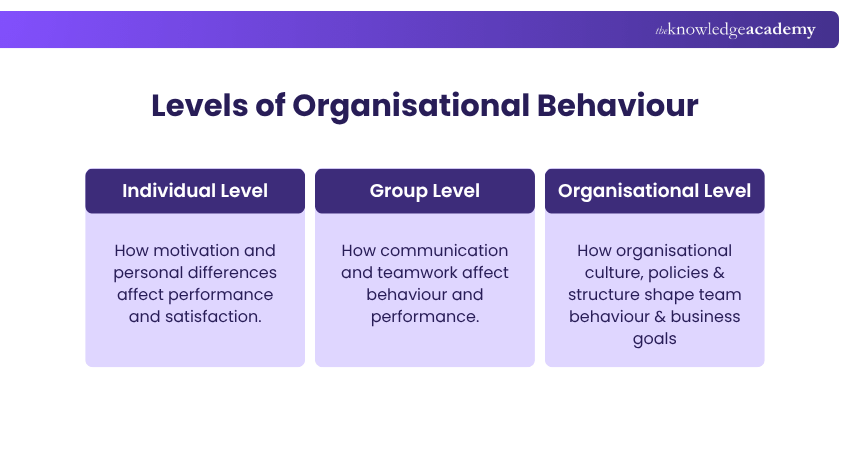
Organisational behaviour analyses individuals, groups, and the entire organisation as a system. Let us look at the various levels at which this analysis takes place:
1) Individual Level
The individual level of organisational behaviour focuses on personal attributes and behaviours, including motivation, personality, perceptions, and learning styles. It examines how individual differences affect work performance and job satisfaction. For example, understanding an employee's strengths can help tailor their role to make better use of those strengths.
2) Group Level
The group level explores dynamics within teams and workgroups, such as communication, leadership, teamwork, and conflict. It analyses how group interactions influence individual behaviour and overall performance. For instance, effective team collaboration can lead to higher innovation and problem-solving capabilities within the organisation.
3) Organisational Level
The organisational level examines the broader system and structure, including organisational culture, policies, and overall environment. It focuses on how organisational design, leadership, and culture impact performance and employee behaviour. For example, a strong organisational culture can enhance employee loyalty, motivation, and alignment with company goals.
Trainer Insight
Workplace challenges may involve more than one level. A performance problem, for example, could involve individual motivation, team relationships and wider organisational practices.
Benefits of Organisational Behaviour
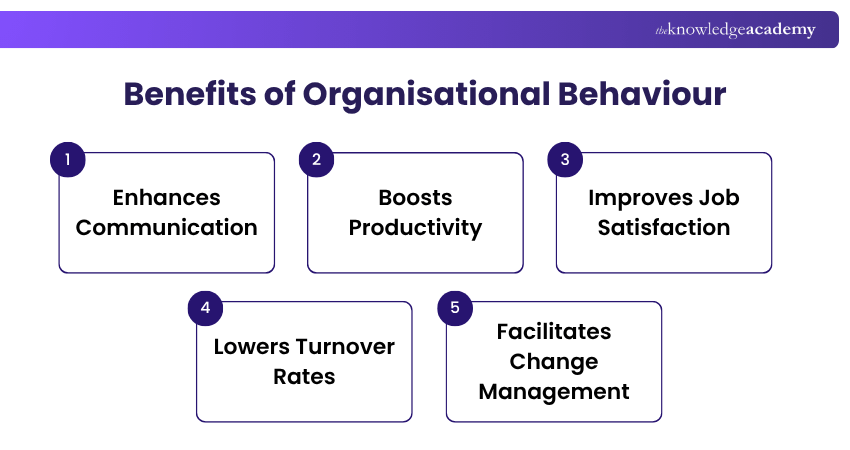
Let us now explore the significance of organisational behaviour in building successful teams, fostering motivation, and achieving peak organisational performance:
1) Enhances Communication
Organisational behaviour enhances the communication process by fostering an appreciation of interpersonal dynamics and communication styles. Effective communication strategies ensure that information is accurately conveyed and received, reducing misunderstandings and promoting a cohesive work environment. This leads to more effective teamwork, clearer expectations, and a more engaged workforce.
2) Boosts Productivity
Understanding organisational behaviour helps pinpoint important factors that motivate employees and drive performance. By applying motivational theories and creating favourable work conditions, organisations may improve employee productivity. Efficient team dynamics, clear goal setting, and recognition systems contribute to improved performance and the achievement of organisational objectives.
3) Improves Job Satisfaction
Organisational behaviour works to create a work environment that meets employees' psychological and social needs through factors such as job design, work-life balance, and recognition. These practices lead to increased job satisfaction. Satisfied workers contribute a maximum level of engagement, motivation, and loyalty needed for organisational success.
4) Lowers Turnover Rates
Organisational behaviour enables organisations to manage causes of discontent and low commitment, which in turn leads to high turnover. Promoting onboarding, skill development, and organisational culture helps employees to remain within the organisation and contribute to incremental recruitment fees and maintain valuable resources.
5) Facilitates Change Management
Organisational behaviour assists leaders in understanding how employees behave when undergoing change, helping in managing change. By addressing organisational behaviour resistance and engaging employees in the change process, change efforts are managed, disruption is reduced, and organisational change is effectively implemented and maintained.
The Organisational Culture Change Training helps you build a workplace culture that inspires innovation and success. Sign up now!
Checklist: Understanding Organisational Behaviour Models
Before you finish, check whether you can:
□ Explain what organisational behaviour models represent□ Distinguish between individual, group and organisational levels□ Identify the main focus of each organisational behaviour model□ Differentiate autocratic, custodial, supportive and collegial models□ Explain how the human value model focuses on employee growth and potential□ Recognise why the contingency model depends on workplace context□ Distinguish organisational behaviour models from theories□ Relate different models to appropriate workplace situations
Theories in Organisational Behaviour
Theories in organisational behaviour explore different lenses to understand employee motivation, leadership styles, communication, and decision-making within a company. Let's learn about them below:
1) Scientific Management Theory
Scientific management theory, developed by Frederick Taylor, emphasises efficiency and productivity through the systematic study and standardisation of work processes. It advocates breaking down tasks into smaller, measurable components and using time and motion studies to optimise performance. This approach often involves close supervision and incentive-based pay structures.
Trainer Insight
Models and theories are closely related, but they serve different purposes. Models provide frameworks for representing workplace relationships, while theories offer explanations and assumptions that can help interpret organisational behaviour.
2) Human Relations Organisational Theory
Human relations organisational theory, pioneered by Elton Mayo, focuses on the importance of social factors in the workplace. It highlights the impact of interpersonal relationships, employee morale, and job satisfaction on productivity. This theory suggests that supportive management and positive work environments lead to better performance and employee well-being.
3) X and Y Theories of Organisational Behaviour
Douglas McGregor's X and Y theories contrast two managerial views on employee motivation. Theory X assumes the employees are inherently lazy and need strict supervision, while theory Y assumes that employees can be self-directed and accept responsibility under suitable conditions. Managers adopting theory Y tend to foster a more participative and empowering work environment.
4) Theory Z
Theory Z, proposed by William Ouchi, integrates American and Japanese management practices. It emphasises long-term employment, collective decision-making, and holistic concern for employees' well-being. Theory Z promotes a strong company culture, job security, and employee involvement, aiming to create a stable and committed workforce with high productivity.
Make sure change drives your organisation forward, not disrupt it. Sign up for the Managing Organisational Change Effectively Training now!

Akhil K is a Copywriter and Video Editor with experience in content creation, visual storytelling, advertising and brand communication. His background in journalism, research and audience-focused communication strengthens his ability to create clear and engaging Business Skills content.
View Detail

 If you wish to make any changes to your course, please


