


We may not have the course you’re looking for. If you enquire or give us a call on 01344203999 and speak to our training experts, we may still be able to help with your training requirements.
Key Challenges in Change Management That You Need to Know
ByThe Knowledge AcademyLast updated on: 10 October 2026
Discover the key challenges in change management in our latest blog. Change is inevitable, but navigating it effectively can be a daunting task. Explore the critical obstacles organisations face when implementing change initiatives. Gain insights on how to overcome these hurdles and ensure a smooth transition in your business or project.
Key Topics Covered
1. Change management helps organisations guide people and processes through organisational change.2. Common challenges include resistance, weak leadership, poor communication, and unclear objectives.3. Employee engagement and adequate resources play a key role in successful change adoption.4. Change fatigue and lack of accountability can reduce momentum and weaken implementation.5. Clear goals, strong communication, and structured best practices improve change management outcomes.
Change management is essential to organisational success because it helps employees adapt to change, reduces disruption, and supports smoother transitions. However, the key challenges in change management have to be considered before committing to a significant change.
Many organisations face challenges when introducing and sustaining change management practices. Learn eight key challenges you may face in change management and how to handle them to bring a successful change to your organisation.
Key Challenges in Change Management
Change management practitioners often face various obstacles and difficulties that hinder their efforts and affect outcomes. Some of the key challenges of change management are:
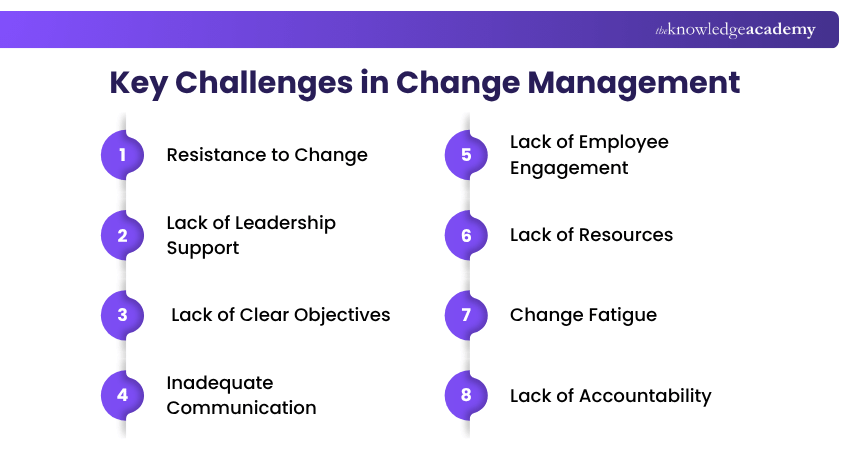
1) Resistance to Change
One of the biggest challenges in change management is resistance from employees. Employees can resist change due to uncertainty, limited involvement, unclear communication, or concerns about how the change will affect their roles and responsibilities. To overcome resistance to change, it is important to communicate the reasons for the change and the benefits it will bring. Involve employees in the change process by taking their input and addressing their concerns. Provide training and support to help employees adapt to the change.
From Resistance to Readiness
Resistance: Uncertainty | Low involvement | Poor communicationReadiness: Clarity | Engagement | Support | Confidence

2) Lack of Leadership Support
Effective change management requires strong leadership support to succeed. Without it, employees may struggle to recognise the importance of the transition. A lack of leadership backing can result in resistance, low motivation, and reluctance to adapt to new processes. To overcome this challenge, it is important to secure support from leaders at all levels of the organisation. Leaders should demonstrate their commitment to the change and actively communicate the importance of it to employees, as outlined in the change management plan.
Change Champion Tip
Visible leadership matters most when teams are uncertain. Leaders should explain the purpose of the change, reinforce priorities, and respond consistently to concerns.
3) Lack of Clear Objectives
Clear objectives make it easier to measure the success of the change and align everyone towards a common goal. To overcome this challenge, it is important to clearly define the objectives of the change and communicate them to all stakeholders. Objectives should be Specific, Measurable, Achievable, Relevant, and Time-bound (SMART). Regularly reviewing and updating the objectives as needed ensures progress.
Change Domino Effect
Unclear Goal → Confused Teams → Poor Decisions → Low Adoption → Weak Results
One unclear starting point can create problems throughout the entire change process.
4) Inadequate Communication
Inadequate or ineffective communication can lead to confusion, rumours, and resistance. Thus, communication is an essential component of change management. It is important to establish a clear and consistent communication plan to overcome this challenge. Use multiple channels to communicate the change, such as emails, meetings, and the intranet. Provide regular updates on the progress of the change and manage any concerns or questions raised by employees to maintain transparency and build trust.
5) Lack of Employee Engagement
Employee engagement is important for successful change management. Engaged employees are more likely to accept change and contribute positively to its implementation. To overcome this challenge, involve employees in the change process from the beginning. Seek their input, address their concerns, and provide opportunities for them to contribute to the change. Recognise and celebrate employees’ achievements, while providing ongoing support and training throughout the change process.
Change Temperature Check
Cold: Low awarenessWarming Up: Growing understandingReady: Active engagementHot: Strong adoption and support
6) Lack of Resources
A change often requires additional resources, such as staff, budget, and technology. However, organisations may face the challenge of limited resources, which can be problematic during the implementation of the change. To address this challenge, organisations should evaluate the resources required for the change and secure the necessary staff, budget, and technology. Allocate resources according to their importance to the change and consider alternatives, such as outsourcing or partnering with other organisations, where appropriate.
7) Change Fatigue
Change fatigue occurs when employees become overwhelmed by frequent, overlapping or prolonged organisational changes, particularly when the demands of change exceed their capacity to adapt. This can lead to resistance, burnout, and decreased productivity. To overcome this challenge, organisations should carefully plan the timing and sequencing of changes while considering employees' workloads and capacity to adapt.
Avoid implementing too many changes at once and provide sufficient time for employees to adapt to each change. Observe and manage the impact of changes on employees and provide support and resources to help them cope.
8) Lack of Accountability
Change management requires clear roles and responsibilities to make sure that everyone is accountable for their actions and contributions. However, organisations may face the challenge of unclear or overlapping roles, which can lead to confusion and inefficiency. To overcome this challenge, it is important to clearly define change management roles and responsibilities for each person involved in the change.
Set expectations and hold people accountable for their performance. Provide training and support to help individuals understand their roles and responsibilities within the change management strategy.
Change Risk Radar
People Risk: Resistance and low engagementLeadership Risk: Weak sponsorship or unclear directionResource Risk: Limited time, budget, or capabilityCommunication Risk: Confusion, mixed messages, or poor visibility
Best Practices in Change Management
Here are some practices in change management to make change initiatives go smoothly, incorporating change management best practices.
1) To Define the End Goal Clearly
It's essential to lay the foundations for change, which involves these steps:
a) Define the state of your organisation to find out what changes your organisation needs and what to avoid.
b) Create a clear case for change by explaining why the organisation needs the change and how it will affect employees, customers and shareholders.
c) Lastly, determine the end goal of your change initiatives.
2) To Adopt a Change Management Framework
Choose a framework that offers a systematic approach to planning, managing and supporting organisational change. Change management frameworks can improve the likelihood of successful change implementation.
3) To Create a Team of Experienced Change Agents
Depending on the size and complexity of the initiative, organisations can appoint experienced change agents or change champions to guide, motivate and support the organisation's members during the change initiative.
4) To Support People to Accept Change
Communicate with employees throughout the change implementation process to facilitate the acceptance of change.
5) To Prioritise Change Initiatives
Every change initiative should be thoroughly analysed regarding its feasibility, value and risks.
Change Management Roadmap
Define the Goal → Communicate Clearly → Engage Employees → Support the Change → Review Progress
Ready to lead and drive success? Join the Change Management Certification Training to gain the skills and credentials you need!

The Knowledge Academy develops accessible learning content across Project Management, IT, Cybersecurity, Data Science, Business Analysis, HR, Accounting and Finance, Leadership and Health and Safety. Its resources combine subject research with clear explanations to help professionals build practical knowledge across a wide range of disciplines.
View Detail

 If you wish to make any changes to your course, please


