




We may not have the course you’re looking for. If you enquire or give us a call on 01344203999 and speak to our training experts, we may still be able to help with your training requirements.
Key Features of Organisational Behaviour: A Comprehensive Guide
ByNaveena VenkatesanLast updated on: 18 September 2026
Join us on a journey through the world of Organisational Behaviour (OB) and discover its impact on organisational effectiveness. We'll explore the essential Features of Organisational Behaviour and how they shape the way organisations function. Let’s dive in deeper and learn more about Organisational Behaviour!
Imagine navigating the complex maze of a bustling city where each street represents a unique behavioural pattern, and every crossroad signifies an interaction between culture and management practices. The Features of Organisational Behaviour are as diverse and intricate as the city's network of roads. It is a dynamic landscape where psychological insights merge with strategic operations to steer organisations towards effectiveness and growth.
Just as an urban planner uses a blueprint to understand city dynamics and enhance liveability, managers and leaders use OB to sculpt productive and adaptive environments in the workplace. Join us as we delve deeper into how understanding these Features of Organisational Behaviour transforms organisational frameworks and achieves success!
What is Organisational Behaviour?
The study of Organisational Behaviour looks into the dynamics of behaviour in human organisations. It explores how people communicate and are impacted by groups, individuals, and organisational structures. OB tries to understand the complexities of human behaviour in work situations through studying factors such as motivation, communication, leadership, and decision-making.
Through pattern recognition, relationship analysis, and the use of strategies that advance the best interests of the organisation and its members, this field aims to increase the effectiveness of organisations.
Ultimately, OB serves as a crucial lens through which to explore and improve the functioning of organisations in today's dynamic and interconnected world.

Importance of Organisational Behaviour
Organisational Behaviour is important because it has a immediate effect on employee happiness, teamwork, and efficiency. Organisations can learn more about staff behaviour, modes of communication, and motivating elements by exploring Organisational Behaviour.
This understanding enables them to pinpoint areas for enhancement and implement strategies to cultivate a supportive and engaging work environment, ultimately driving organisational success and effectiveness.
Enhance your understanding of Organisational Behaviour with the BCS Foundation Certificate in Organisational Behaviour!
Features of Organisational Behaviour
Here are the Features of Organisational Behaviour that clarify its importance in understanding and managing human behaviour within organisational contexts.
1) Embracing Interdisciplinary Perspectives
Organisational Behaviour draws on insights from psychology, sociology, anthropology, and management to offer a comprehensive understanding of organisational dynamics. By integrating knowledge from diverse fields, OB provides holistic insights into how individuals, groups, and structures interact within organisations, facilitating informed decision-making and effective management practices.
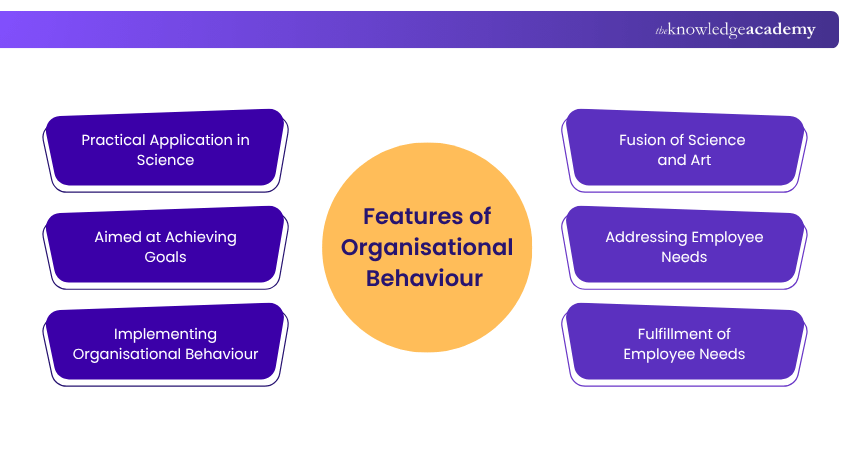
2) Practical Application in Science
Beyond theory, OB offers useful applications in management, economics, psychology, and sociology, among other subjects. Understanding the Challenges and Opportunities of Organisational Behaviour allows organisations to efficiently accomplish their objectives, improve employee satisfaction, and cultivate a positive work environment by implementing these components.
Learn behaviour, understand people, and transform workplace culture with the BCS Foundation Certificate In Organisational Behaviour – Sign up today!
3) Ethical Framework in Science
Ethics play a crucial role in OB, guiding organisations to conduct business in a socially responsible and sustainable manner. By adhering to ethical principles, organisations build trust and credibility with stakeholders, fostering long-term relationships and contributing to the greater good of society.
4) Holistic Approach to Systems
Organisations are considered by OB as complex systems with interconnected fragments, taking a holistic point of view. Organisational Behaviour facilitates the understanding of connections within a system and the implementation of methods that improve efficiency and harmony by considering a variety of elements, including culture, structure, and environment.
5) Analytical Levels
OB analyses behaviour on a variety of levels, including the individual, communal, and organisational levels. This enables specific measures and strategic decisions to promote desired results by enabling an in-depth knowledge of how elements at each level affect organisational performance.
6) Aimed at Achieving Goals
The primary objective of OB is to help organisations achieve their goals by understanding and managing human behaviour effectively. By aligning individual and organisational goals, OB ensures that efforts are directed towards common objectives, driving organisational success and sustainability.
Accelerate your knowledge of Agile principles with the BCS Foundation Certificate in Agile. Join today and embark on a journey towards mastering Agile methodologies!
7) Implementing Organisational Behaviour
Implementing OB involves applying theories and principles to real-world situations. Effective leadership, communication, and change management strategies are essential to create a positive organisational culture and facilitate the adoption of OB practices throughout the organisation. In this context, understanding Leadership in Organisational Behaviour is crucial, as it directly impacts how these strategies are executed and embraced within the company.
8) Human Resource Management Tool
OB serves as a valuable tool for Human Resource Management (HRM), providing insights into employee behaviour, motivation, and performance. By understanding these dynamics, HR professionals can develop strategies to attract, retain, and develop talent, enhancing organisational effectiveness and competitiveness.
9) Fusion of Science and Art
OB combines scientific rigour with artistic creativity to address complex organisational challenges. By fostering innovation, experimentation, and adaptation, OB encourages organisations to explore new possibilities and find creative solutions to dynamic and evolving environments.
Turn complex processes into clear workflows with the BCS Practitioner Certificate In Modelling Business Processes – Sign up today!
10) Addressing Employee Needs
OB emphasises the importance of understanding and addressing the diverse needs of employees. Organisations can boost employee happiness, participation, and general well-being by providing a positive work environment and opportunities for growth.
11) Human-Cantered Perspective
OB recognises employees as the most important asset of an organisation and places a strong emphasis on their well-being and empowerment. Managers can foster a healthy workplace culture that respects and appreciates individuals by implementing a people-cantered strategy, which can result in increased levels of commitment, motivation, and performance.
12) Fulfilment of Employee Needs
OB seeks to create conditions where employees feel valued, motivated, and fulfilled in their work. By aligning organisational goals with individual needs and aspirations, organisations can create a positive and productive workplace culture that promotes employee satisfaction, retention, and organisational success.
Discover the essentials of modelling business processes with the BCS Practitioner Certificate in Modelling Business Processes Training!

Naveena Venkatesan is a Content Editor with 2+ years of experience in content writing, editing and linguistic quality assurance. Her research, fact-checking and editorial experience enable her to develop accurate, accessible resources across Business Skills, Human Resources, and Accounting and Finance.
View Detail

 If you wish to make any changes to your course, please


