




We may not have the course you’re looking for. If you enquire or give us a call on +44 1344 203 999 and speak to our training experts, we may still be able to help with your training requirements.
Top Features of Microsoft Word for Smarter Document Creation
ByThe Knowledge AcademyLast updated on: 10 October 2026
Explore the top features of Microsoft Word for creating, formatting, reviewing and managing documents. Discover how these features can help you work efficiently, collaborate seamlessly and create polished, professional documents.
Are you a student, a professional, or someone who frequently works with written content? If yes, then understanding the key features of Microsoft Word can help you work efficiently. It can also help streamline your document creation process.
But do you know what these features are? Worry no more. Read this blog to learn various features of Microsoft Word. Also, explore how to make the most of its feature-rich interface and unleash your creativity while working on documents. Let’s begin!
What are Microsoft Word Features?
Microsoft Word features are built-in tools and capabilities that help users create, edit, format, organise, review and share documents. They range from basic text-formatting and page-layout tools to collaboration, advanced editing and automation features.
These features support different stages of working with a document. Some help improve its appearance and structure, while others support reviewing, collaboration, navigation or repetitive tasks.

Document Creation and Formatting Features
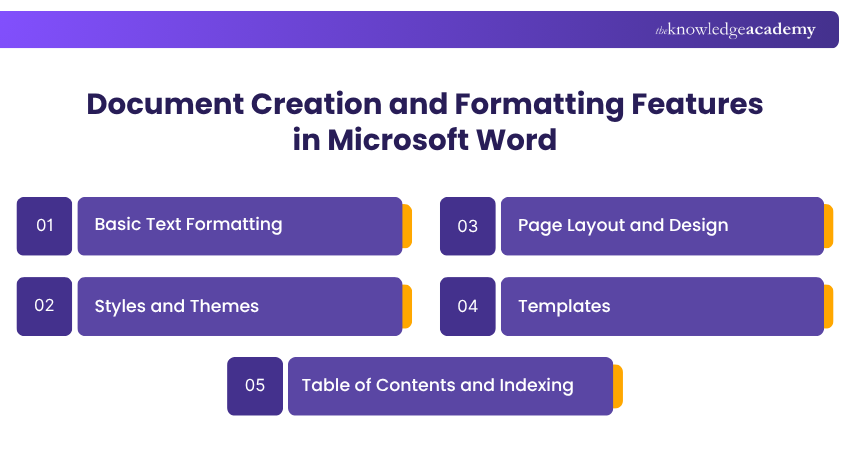
Document creation and formatting features of Microsoft Word enable users to craft visually appealing and professional documents. Let’s also explore some key document creation and formatting features that Microsoft Word offers:
1) Basic Text Formatting
Microsoft Word enables you to format text, giving you control over font type, size, colour, and style. You can apply bold, italic, underline, and strikethrough formatting to emphasise or highlight specific content. These basic formatting options help create visually engaging documents.
2) Styles and Themes
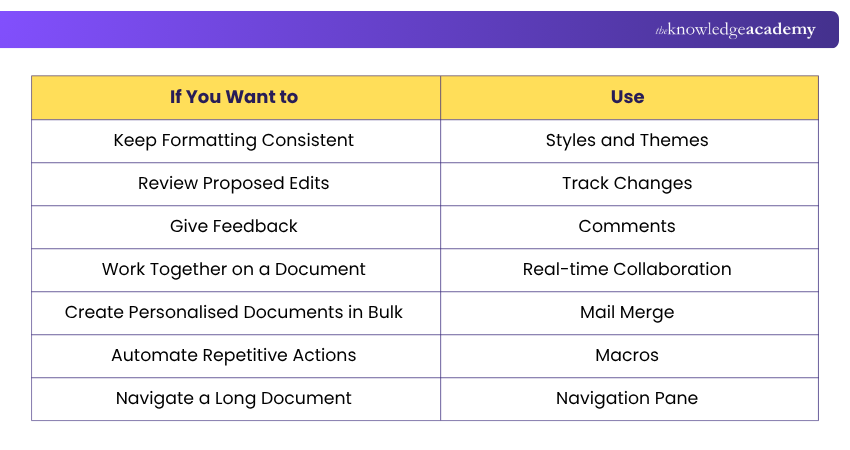
With styles and themes, Microsoft Word enables you to maintain consistency throughout your document. You can apply predefined styles to headings, paragraphs, and other elements, ensuring a uniform appearance. Themes offer a fast way to change the look and feel of your document, providing a professional and polished finish.
3) Page Layout and Design
Microsoft Word offers a range of page layout and design options to upgrade the visual appeal of your document. You can customise margins, choose between portrait and landscape orientations, add page borders, and control the placement of text and images.
4) Templates
Microsoft Word provides a variety of templates that offer pre-designed layouts for different document types. These templates can save you effort and time, as they come with preset formatting, styles, and placeholders for your content.
5) Table of Contents and Indexing
Word allows you to create a table of contents for longer documents with multiple sections based on headings and subheadings. This feature makes it easier for readers to navigate through your document. You can also generate an index to list important terms and their corresponding page numbers, making it convenient for readers.
Take your productivity beyond the desktop with the Microsoft Office 365 Training now!
Collaboration and Reviewing Microsoft Word Features
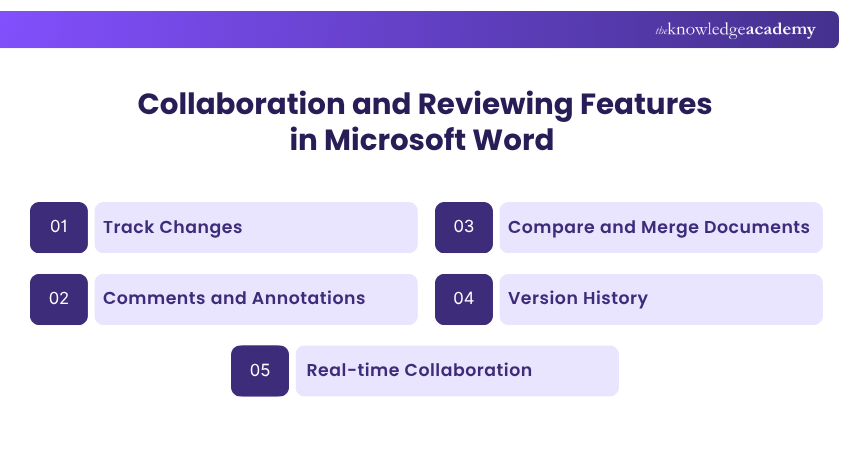
Collaboration and reviewing are essential aspects of document creation. Word offers a range of features that facilitate collaboration, making it easier for teams to work together seamlessly. Let's explore some of the collaboration and reviewing features in Microsoft Word:
1) Track Changes
The track changes feature in Microsoft Word enables you to keep track of all modifications made to a document. Each addition, deletion, or formatting change is highlighted, making it easy to review and accept or reject revisions. This feature is particularly useful when multiple individuals are collaborating on a document.
2) Comments and Annotations
Microsoft Word allows you to add comments and annotations to specific parts of a document. Also, comments can be used to provide feedback, ask questions, or engage in discussions with collaborators, enhancing the reviewing and collaboration process.
Trainer’s Insight
Use Track Changes when you want proposed edits to remain visible for review. Use Comments when you want to ask questions, explain feedback or discuss a particular part of the document.
3) Compare and Merge Documents
When working with different versions of a document or merging content from multiple files, Microsoft Word's compare and merge documents feature comes in handy. It can help identify differences between versions and bring revisions together for review.
4) Version History
When a Word document is stored in a supported Microsoft cloud location such as OneDrive or SharePoint, version history can allow you to view and restore previous versions if needed. This makes it easier to review earlier versions or recover from unintended changes.
5) Real-time Collaboration
With real-time collaboration in Microsoft Word, multiple users can work on a document simultaneously when the file is stored and shared in a supported location. Changes made by collaborators can appear while users are working, reducing the need for back-and-forth exchanges of separate document copies.
Advanced Editing and Formatting Microsoft Word Features
The advanced features in Microsoft Word include editing and formatting features that enable users to fine-tune their documents and create visually appealing layouts. These features in Microsoft Word go beyond basic text formatting and offer advanced tools for data organisation. Let’s explore some of the key advanced editing and formatting features in Microsoft Word:
1) Tables and Charts
Microsoft Word allows you to create and customise tables and charts effortlessly. You can insert tables to organise data in rows and columns, apply formatting to cells, and perform calculations. Similarly, you can create visually appealing charts to represent numerical data, making it easier for readers to grasp complex information.
Trainer’s Insight
Use tables when information needs to be compared or organised into clear rows and columns. For more complex calculations or data analysis, consider preparing the data in Excel and then bringing the relevant results into Word.
2) Headers and Footers
Headers and footers are an important aspect of document design. Microsoft Word enables you to add headers and footers to your document, providing consistent information such as page numbers, document titles, or relevant chapter headings. This feature is particularly useful for longer documents, reports, or academic papers.
3) Captions and Cross-references
Word allows you to add numbered captions to tables, figures and other document elements. Cross-references can then direct readers to headings, figures, tables or numbered items elsewhere in the document, which is particularly useful in long reports.
4) Equations and Symbols
Microsoft Word provides built-in tools for inserting mathematical equations and special symbols into documents. Users can create equations using predefined structures, mathematical operators and symbols or build customised equations for specific needs. This feature is particularly useful for academic, scientific and technical documents that require mathematical expressions or specialised characters.
Pro Tip
Use headers and footers for information that readers may need across multiple pages, such as page numbers, document titles or section information. Keep them concise so they support the document without distracting from the main content.
Which Microsoft Word Feature Should You Use?
Automation and Productivity Microsoft Word Features
Microsoft Word goes beyond basic word processing and offers a range of automation and productivity features that can streamline tasks and improve efficiency. Let’s explore some of the key automation and productivity features in Microsoft Word:
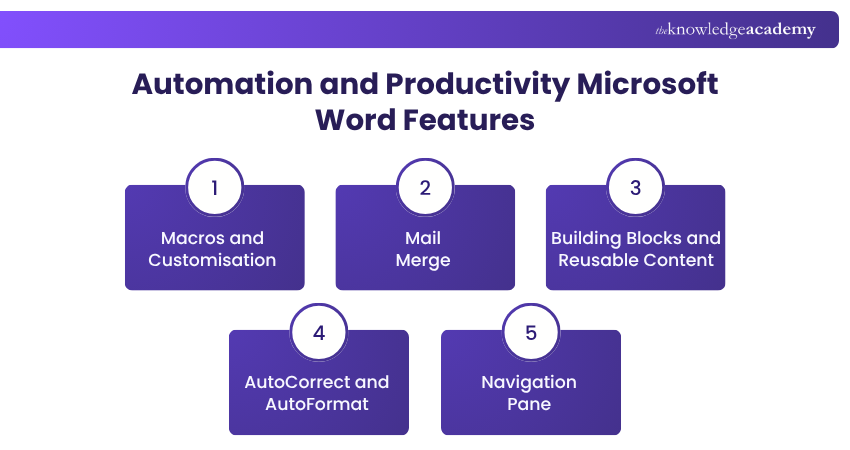
1) Macros and Customisation
Microsoft Word allows you to automate repetitive tasks using macros. You can record a sequence of supported actions as a macro and run it again when needed. This feature is especially useful for tasks such as formatting, inserting boilerplate text, or performing complex actions, allowing you to automate and simplify your workflow.
Furthermore, you can customise the Microsoft Word interface by adding frequently used commands to the toolbar, creating a personalised and efficient working environment.
2) Mail Merge
The mail merge feature in Microsoft Word simplifies the process of creating personalised documents, such as letters or envelopes. You can merge data from an external source, such as a spreadsheet or database, into your document. This allows you to create customised content for multiple recipients, saving time when producing documents in bulk.
3) Building Blocks and Reusable Content
Microsoft Word's Building Blocks allow users to save and reuse content such as text, headers, footers and other document elements. This can save time when the same content needs to appear across multiple documents.
4) AutoCorrect and AutoFormat
Microsoft Word’s AutoCorrect feature automatically corrects common spelling and typing errors as you type, saving you from manual corrections. AutoFormat can apply certain formatting automatically based on Word's settings and AutoFormat/AutoFormat As You Type options, such as list formatting and other automatic formatting behaviours.
5) Navigation Pane
The navigation pane in Microsoft Word provides a convenient way to navigate your document. You can quickly jump to specific sections, headings, or pages, making navigating and editing large documents or locating specific content easier.
Make Microsoft Office your productivity powerhouse by registering for the Microsoft Office Training today!

The Knowledge Academy develops accessible learning content across Project Management, IT, Cybersecurity, Data Science, Business Analysis, HR, Accounting and Finance, Leadership and Health and Safety. Its resources combine subject research with clear explanations to help professionals build practical knowledge across a wide range of disciplines.
View Detail

 If you wish to make any changes to your course, please


