




We may not have the course you’re looking for. If you enquire or give us a call on 01344203999 and speak to our training experts, we may still be able to help with your training requirements.
Factors Affecting Organisational Behaviour: A Complete Guide
ByNaveena VenkatesanLast updated on: 02 October 2026
Explore the key factors affecting organisational behaviour, including people, structure, technology and the workplace environment.
Picture a perfectly normal Monday morning.
Your team is working well, deadlines are under control, and everyone seems to know exactly what they're doing. Then a new reporting structure is announced, a different digital system goes live, and suddenly the way people communicate, make decisions and get work done begins to shift.
Same people. Same organisation. So, what changed?
This is where the factors affecting organisational behaviour come into play.
Workplace behaviour isn't shaped by people alone. The structure around them, the technology they use and the environment they work in can all influence how they respond, collaborate and perform.
Understanding the factors affecting organisational behaviour helps us look beyond what people are doing at work and ask the more useful question: what is influencing them to behave that way? Let's learn about it!
What is Organisational Behaviour?
Organisational Behaviour (OB) is the study of how individuals and groups behave within organisations and how workplace conditions influence their actions and interactions. It draws on fields such as psychology, sociology and management to understand areas including personality, perception, motivation, communication, leadership and decision-making.
OB examines behaviour at individual, group and organisational levels, helping organisations understand how people work, interact and respond to different workplace situations. This understanding can support better management practices, employee experiences and overall organisational effectiveness.

Key Factors Affecting Organisational Behaviour
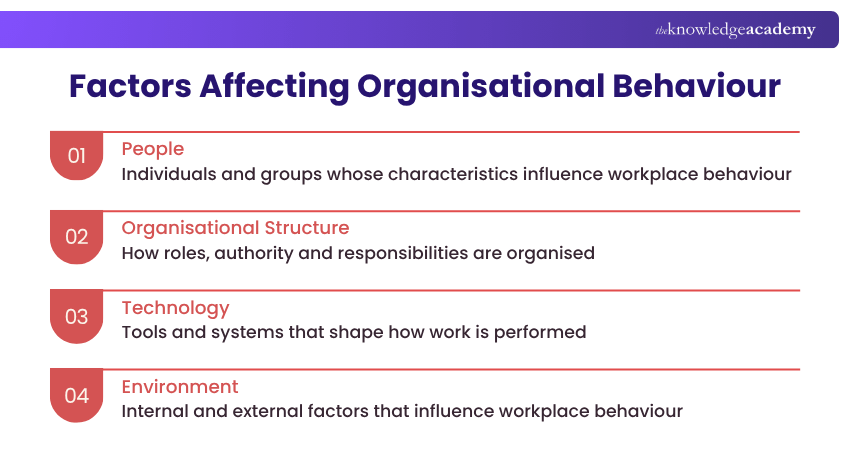
There are factors affecting organisational behaviour. These include people, organisational structure, technology and environment. Let's learn about them below:
1) People
In any organisation, the behaviour of its people significantly shapes its culture and dynamics. Every individual contributes their unique personality, values, and communication style. Interactions between employees and their engagement with their work are crucial components of the workplace environment.
People operate both individually and in groups. Their behaviour can therefore be influenced by personal characteristics as well as relationships, team dynamics and wider workplace conditions. Some important individual characteristics include:
a) Personality: Personality influences how individuals communicate, collaborate and respond to workplace situations.
b) Perception: Perception shapes how employees interpret situations and others' behaviour, influencing their reactions, decisions and interactions.
c) Values: Values are personal beliefs and principles that influence workplace behaviour, decisions and responses to organisational expectations.
d) Experience: Professional and personal experiences shape employees' knowledge, expectations, problem-solving and responses to new situations.
Trainer's Insight
Avoid explaining workplace behaviour through personality alone. The same employee may behave differently when their responsibilities, management, technology or working conditions change. Consider both the individual and their workplace situation before deciding what may be influencing their behaviour.
2) Organisational Structure
The structure of a company is how it organises its people into different roles and how these roles interact with each other. Some companies have a strict hierarchy where the roles and responsibilities of each level are clearly defined, making it clear who oversees whom. Other companies use flatter or more decentralised structures.
Organisational structure establishes formal relationships between roles and helps determine how responsibilities and authority are distributed. Some important aspects of organisational structure that can affect organisational behaviour include:
a) Roles and Responsibilities: Clear roles define employee expectations and accountability, reducing confusion, duplicated work and responsibility gaps.
b) Hierarchy and Authority: Hierarchy determines how authority and supervision are distributed across organisational levels.
c) Communication: Organisational structure shapes how information flows between employees, teams and management.
d) Decision-making: Centralised structures concentrate decision-making at higher levels, while decentralised structures distribute authority more widely.
Pro Tip
If employees are accountable for results but repeatedly must wait for approval before acting, check whether responsibility and authority are properly aligned. Clear responsibilities work best when employees also understand which decisions they are authorised to make and when escalation is required.
3) Technology
The way a company uses technology can greatly influence how it behaves. For example, in some companies, employees mostly communicate through digital channels, while others rely more heavily on face-to-face interaction.
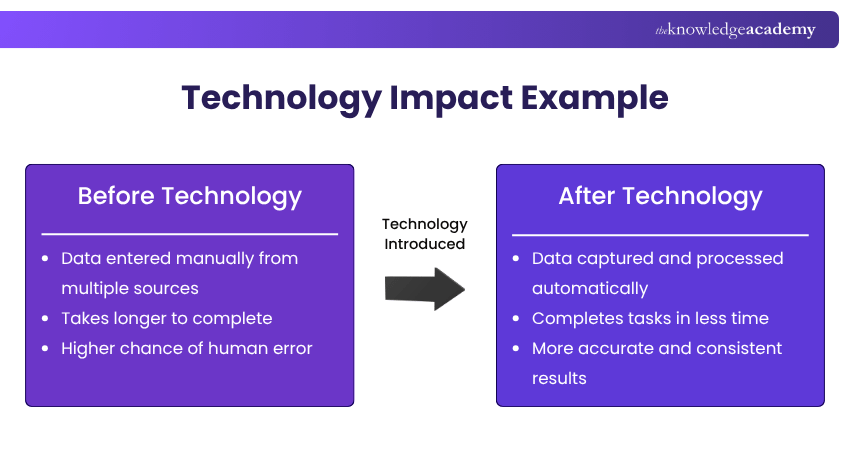
Technology also influences how work itself is performed. In organisational behaviour, workplace technology includes not only digital communication tools but also the tools, systems, techniques and processes through which employees complete their work. Technology can affect:
a) Communication: Messaging platforms, email and video conferencing change how quickly and through which channels employees communicate.
b) Collaboration: Digital tools can enable employees in different locations to work together.
c) Work Arrangements: Technology can make remote and hybrid working possible for suitable roles.
d) Tasks and Skills: Automation, software and other technological changes can alter job tasks and create requirements for employees to develop new skills.
e) Employee Interactions: Greater reliance on digital communication may change how colleagues build relationships and share information.
4) Environment
The internal and external environment of a company plays a critical role in shaping organisational behaviour. This environment includes various factors that influence how the company operates and how its employees behave. Let's learn about it below:
1) Internal Environment
The internal environment refers to conditions within the organisation that can influence employees, processes and workplace behaviour. It includes:
a) Organisational Culture: Shared values, assumptions and ways of working shape employee behaviour and workplace experiences.
b) Management and Leadership Style: How managers communicate, delegate and make decisions can influence employee behaviour and workplace relationships.
c) Resource Availability: Access to suitable technology, information, staffing and financial resources affects employees' ability to perform effectively.
d) Workplace Conditions: Safety, equipment, workspace design and other working conditions can influence employee experience and behaviour.
2) External Environment
The external environment includes factors outside the organisation that can influence its operations and, indirectly, the behaviour of people within it. It includes:
a) Economic Conditions: Inflation, labour-market trends and economic growth can affect recruitment, pay, investment and workforce planning.
b) Regulatory Environment: Laws and regulations can require changes to organisational policies, processes and employee responsibilities.
c) Market Conditions: Competition, customer preferences and supply and demand can influence workloads, priorities and organisational change.
d) Social and Political Factors: Social expectations and political developments can influence workplace policies, employee expectations and operating conditions.
Turn business challenges into smarter solutions by registering for the Business Analysis Courses now!

Naveena Venkatesan is a Content Editor with 2+ years of experience in content writing, editing and linguistic quality assurance. Her research, fact-checking and editorial experience enable her to develop accurate, accessible resources across Business Skills, Human Resources, and Accounting and Finance.
View Detail

 If you wish to make any changes to your course, please


