


 Top Rated Course

We may not have the course you’re looking for. If you enquire or give us a call on +44 1344 203 999 and speak to our training experts, we may still be able to help with your training requirements.
What Is ERP (Enterprise Resource Planning)?
Charlotte Wilson 16 July 2026ERP (Enterprise Resource Planning) is a business software solution that connects functions like finance, HR, sales, and supply chain into one unified system. It enhances workflow efficiency and ensures overall organisational performance. Explore What is ERP and discover how this central system helps businesses work smarter.

Training Outcomes Within Your Budget!
We ensure quality, budget-alignment, and timely delivery by our expert instructors.
Table of Contents
Today’s businesses are often integrated systems to effectively handle data, processes, and operations. Understanding What is ERP gives the companies a clearer view of how various functions are linked in one platform. Let’s delve into the functioning of ERP systems and their necessity for growing companies that want to scale up.
Table of Contents
1) What is Enterprise Resource Planning (ERP)?
2) The History and Evolution of ERP
3) Why is Enterprise Resource Planning Important?
4) How Do ERP Systems Work?
5) Different Types of ERP Deployment Models
6) Benefits of Implementing an ERP System
7) ERP Examples by Industry
8) Key Considerations When Choosing an ERP System
9) Conclusion
What is Enterprise Resource Planning (ERP)?
Enterprise Resource Planning (ERP) is a unified suite of software applications that helps organisations manage core functions such as accounting, procurement, project management, risk, compliance, and supply chain operations.
By using a shared central database, ERP connects departments, streamlines processes, and supports accurate, data-driven decision-making.

The History and Evolution of ERP
ERP systems didn't just appear out of nowhere; it took years for them to develop.
1) 1960s-1970s: ERP systems originally consisted of Material Requirements Planning (MRP) systems aimed at enhancing production workflows and inventory control. These primitive mechanisms were restricted to production-focused operations only.
2) 1980s: The MRP expanded into MRP II, which added modules for finances, contracts, schedules and other management requirements. This was the beginning of integrated business solutions.
3) 1990s: At this time, the term “ERP” was coined as the software offered to combine already existing functions of various departments into one platform. These were very early implementations on the premises, with extreme customisation and complicated setups.
4) 2000s: Internet technologies made the ERP system an indispensable tool for linking processes and data across worldwide operations. However, a lot of them still remained isolated, thus preventing the organisations from becoming truly agile.
5) Present: ERP systems are cloud-based and AI-powered, allowing the automatic exchange of data between applications and customer experiences. They also offer real-time alerts and monitoring, are easily scalable, and highly secure.
Why is Enterprise Resource Planning Important?
One of the major features of an ERP system is the centralisation of organisational data, if not all, to guarantee that there is one reliable source of truth throughout the entire company. For example:
a) ERP helps finance close accounts in a shorter time and have proper financial records.
b) Sales depends on ERP in order to handle customer orders and to monitor money generated effectively.
c) ERP systems are relied upon by logistics to deliver products and services in a timely and correct manner.
d) ERP is used in procurement to source products, deal with suppliers, and control procurement.
e) Accounts Payable uses ERP to make correct supplier payments at the right time.
f) The management needs real-time ERP information to track its performance and make decisions.
g) Banks and Shareholders rely on the data and analysis created by ERP in order to have a transparent and reliable financial report.
Understand how to measure, manage, and analyse sales performance with our Sales Analytics Training – Join now!
How Do ERP Systems Work?
ERP systems are designed to provide a single solution with a common database for all the main business functions like finance, human resources, purchasing, and operations to interact. Hence, data in real time can be shared without any barriers between departments.
Companies can choose the necessary modules and then add more as their needs change with time. These days, having information stored in one location has many advantages such as smooth-running workflows, reliable reports, and better-maked decisions, which are among the advantages of ERP systems.
Different Types of ERP Deployment Models
Choosing the right ERP deployment model is crucial for success. Platforms like Oracle and Salesforce offer various ERP deployment options to match different operational needs. Let’s break down the main types so you can find the one that fits your business best.
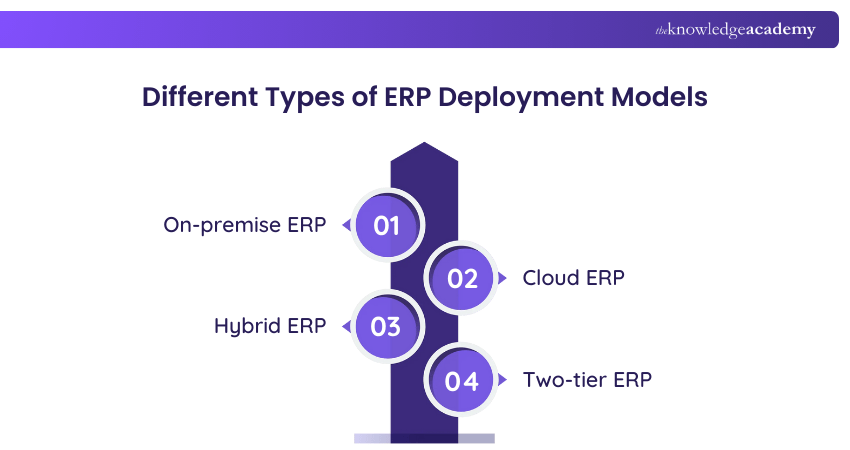
1) On-premise ERP
On-premise ERP is installed locally on a company’s own servers, offering complete control over data, system customisation, and security. However, it requires substantial upfront investment in hardware and ongoing maintenance from an internal IT team.
2) Cloud ERP
Cloud ERP is hosted on external servers and accessed via the internet, giving businesses flexibility, scalability, and the ability to access systems from anywhere. With subscription-based pricing, it lowers upfront costs and shifts much of the maintenance burden to the vendor.
3) Hybrid ERP
Hybrid ERP combines on-premise and cloud elements, allowing organisations to maintain sensitive data in-house while using cloud solutions for less critical functions. This model offers flexibility but requires careful integration to ensure smooth operations.
4) Two-tier ERP
Two-tier ERP technology uses one system at headquarters and another, often simpler, system at subsidiary locations or business units. This approach provides local teams with the agility they need while ensuring alignment and data flow with the central system.
Join Value Based Selling Training to strengthen customer conversations and drive meaningful, value-focused sales outcomes!
Benefits of Implementing an ERP System
A very good way to get tangible value from implementing an ERP system is to unify data and automate business processes for the whole organisation, no matter its size. Below are the main benefits that help to increase performance and provide support for growth:
1) Improved Efficiency and Productivity
Automating repetitive tasks with ERP and, at the same time, streamlining workflows, the employees are released to take part in strategic work while the chances of manual errors are reduced. Thus, operations are faster, and departments output more.
2) Real-time Insights
The access to up-to-date data and also to analytics is provided by the ERP systems. Thus, managers are able to not only track but also react to the situation very quickly. Real-time reporting supports the making of better-informed and quicker decisions.
3) Enhanced Data Accuracy
The ERP system, through the centralisation of data into one single system, ensures that the information is uniform and thus, in all departments, is trustworthy. This, to a large extent, reduces differences and at the same time, improves business data quality.
4) Cost Savings
By means of the above-mentioned process of streamlining, manual labor reduction, and resource allocation optimisation, ERP systems reduce operational costs. Gradually, this can lead to more efficiency and a decrease in waste.
5) Better Collaboration
Departments are able to very easily share information among themselves thanks to the common platform. This not only breaks down the barriers but also facilitates the emergence of joint actions. Thus, communication improves, and the teams around the common objectives are aligned.
6) Scalability
ERP systems are created in such a way that they go hand in hand with the evolution of your business. That is why you can always add new functionalities if your needs change. In this way, the system is always in a position to continue the support of the upgrade without any disruption.
ERP Examples by Industry
ERP systems have become a necessity in all sectors because they are capable of solving specific problems and providing the necessary operational support. The following industries utilise ERP in different ways in order to enhance their efficiency, visibility, and control.
1) Manufacturers
Manufacturers implement the ERP system to achieve product quality goals, manage assets, and control costs while allowing production and procurement to possess the ultimate inventory visibility.
2) Retailers
Retailers take advantage of the ERP system to blend physically with online sales, always have consistent stock, and get better customer service along with higher conversion rates.
3) Service-centric Companies
Professional service organisations employ ERP for instantaneous project visibility, mapping out resource usage, keeping track of profit, and assuring financial soundness over client engagements.
4) Utilities
The ERP system has become a very important tool for utility companies in managing their capital assets, planning replacements, and projecting spare part requirements, thus ensuring service reliability and cost control.
5) Wholesalers
Wholesalers, importers, and logistics companies are using ERP systems to lower distribution costs, boost inventory turnover, and accelerate the order-to-cash cycle through seamless processes.
Key Considerations When Choosing an ERP System
Choosing the right ERP system requires careful evaluation to ensure it aligns with your business goals, processes, and future growth needs. Below are the key considerations when choosing an ERP system.
a) Identify Your Business Requirements: Firstly, take the time to enumerate the precise challenges and objectives that the ERP should tackle so that you can elect a solution that is in line with your priorities.
b) Scalability: Go for an ERP that is capable of evolving along with your business and is capable of handling greater data, more users, and additional functionality in the future.
c) Integration Capabilities: Make sure the ERP can work nicely with your current systems like CRM or even specialised tools for your industry, thus avoiding the creation of data silos.
d) User-friendly Design: Search for easy-to-use interfaces and excellent usability since they will help the teams to quickly adopt the system and also cut down on training time.
e) Cloud vs On-premise: Make up your mind about whether a cloud-based or on-premises deployment is the best one for your organisation, depending on flexibility, access, and infrastructure requirements.
Conclusion
Knowing What is ERP is not only about technology, but about how businesses are relating data and people, processes to move forward in a clear and controlled way. With appropriate utilisation, ERP is a platform for smarter decisions, operational effectiveness, and long-term growth in a competitive environment.
Understand customer behaviour and streamline your sales journey with our Sales Training - Join now!
Frequently Asked Questions
Is SAP an ERP System?

Yes, SAP is one of the world’s leading ERP systems. It provides integrated solutions for finance, supply chain, human resources, and more, helping businesses streamline operations, improve data accuracy, and make informed decisions across departments.
What is the Difference Between ERP and CRM?
ERP manages internal processes like finance, HR, and supply chain, ensuring all departments work together efficiently. CRM focuses on managing customer relationships, sales, and marketing activities to improve customer satisfaction and drive revenue.

Charlotte Wilson


Soft Skills and Business Training Manager
Charlotte Wilson is an expert in soft skills development, with over 14 years of experience helping individuals and teams improve communication, productivity and emotional intelligence in the workplace. Her training content is focused on enhancing interpersonal effectiveness and fostering positive, collaborative environments across all levels of an organisation.
View Detail

 If you wish to make any changes to your course, please


