


 Top Rated Course

We may not have the course you’re looking for. If you enquire or give us a call on 01344203999 and speak to our training experts, we may still be able to help with your training requirements.
What is Data Driven Testing? Complete Guide
Richard Harris 16 July 2026Data Driven Testing uses external test data stored outside scripts to execute automated test cases with multiple input sets efficiently. This is valuable for making testing more efficient, consistent, and easier to maintain. This reduces duplication of effort, improves test coverage, and helps teams identify defects proactively.

Training Outcomes Within Your Budget!
We ensure quality, budget-alignment, and timely delivery by our expert instructors.
Table of Contents
Are you tired of manual testing that's time-consuming and prone to human error? Imagine a testing process that's automated, reliable, and provides valuable insights into your application's quality. Data-Driven Testing is the solution you've been looking for. By leveraging Data-Driven Testing, you can significantly improve your testing efficiency and effectiveness.
It allows the same test scripts to run against multiple data sets stored in external sources, such as spreadsheets or databases. This helps teams to identify defects, reduce effort, improve accuracy, and support faster release cycles. In this blog, you will learn about Data Driven Testing, its pros, real-world applications, and more. Explore how this innovative approach can revolutionise your testing process and deliver higher-quality software.
Table of Contents
1) What is Data Driven Testing?
2) Why is Data Driven Testing Important?
3) How Does Dat Driven Testing Work?
4) How to Practice Data Driven Testing?
5) Benefits of Data Driven Testing
6) Drawbacks of Data Driven Testing
7) Real-world Applications of Data Driven Testing
8) Types of Data Driven Testing
9) What is Data Driven Testing in Agile?
10) Conclusion
What is Data Driven Testing?
Data Driven Testing is a type of framework in which, for Test Design and Execution Process, all the data needed is read from input files. Rather than writing multiple test case for all input scenarios, one testcase will be written, and data is supplied externally via Excel sheets, CSV files, DB tables etc. This method of testing helps to validate a software application against wide range inputs, making it more stable and accurate in different conditions.

Data Driven Testing separates logic from input data, enabling the same script to run with multiple data sets. This reduces testing time, improves accuracy, and minimises manual errors. It is commonly used for scenarios that involve multiple input combinations, such as form submissions, login credentials, and transaction data.

Why is Data Driven Testing Important?
Data Driven Testing is important because it brings efficiency, accuracy, and scalability in software testing. It separates logic from test data, enabling the same test scripts to run with multiple datasets. This makes tests simpler to update, reducing maintenance effort and ensuring test cases remain reusable and flexible.
Also, Data Driven Testing can detect defects caused by data variations. This is valuable in complex applications where the number of possible input combinations is high and manual testing becomes impractical. This helps teams to deliver reliable and user-focused software.
How Does Data Driven Testing Work?
Data-Driven Testing (DDT) works through driving the execution of tests using a set of input data and validating that outputs are what we expect. Data-Driven Testing consists of below key components.
a) Test Scripts: These are the automation scripts which carry out the logic of a Test Case. The scripts will expect inputs from External Data Sources.
b) Sources: How/where the data in tests is stored externally, typically like Excel, CSV or databases and XML stand forked. It contains the data that is needed as input for testing and what results can be expected at outputs.
c) Test Frameworks: Some of the common test frameworks used in Data-Driven Testing are Selenium, JUnit, TestNG etc. These are helpful in reading data from any external sources and then executing the test scripts based on it.
d) Test Execution: During execution, framework read the data from external source and pass it to Test Scripts. The scripts work with the inputs you feed them, then check if those algorithms match a known result (expected) to determine if that test has passed/failed.
Transform your data analytics prowess with Google Analytics Certification!
How to Practice Data Driven Testing?
To start with Data-Driven Testing follow the below steps:
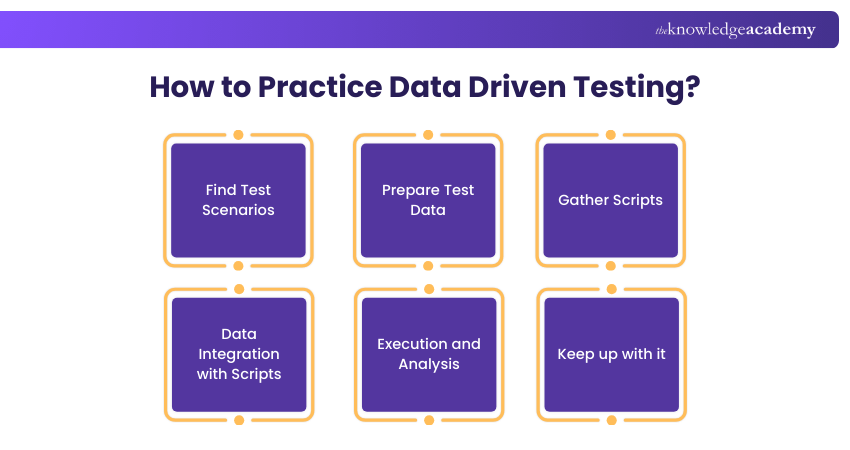
a) Find Test Scenarios: Figure out which test scenarios can be achieved from Data-Driven Testing. Find Cases with Repeated Steps & Variable Data inputs.
b) Prepare Test Data: Develop data sets which consist necessary inputs and expected results. Keep these in external locations such as spreadsheets, CSV folders or databases.
c) Gather Scripts: Create scripts that can fetch external data. Utilise some testing framework where you can perform data-driven approach (eg- Selenium + TestNG/JUnit ).
d) Data Integration with Scripts: Change your test scripts to read data from external sources. It would require wiring the test framework to get data and looping through each dataset during the execution of a specific suite.
e) Execution and Analysis: Execute the test scripts with the data sets, analyse their results. Ensure that there are no differences between the actual and expected results and refine your test data or scripts accordingly.
f) Keep up with it: Get in the habit of keeping your data sets and trough-ware current as the application changes. Because of the inherent design, it is easy to add new test cases in raining day by only updating some data files and making no adjustment on also a piece of testing logic.
Harness data to optimise marketing with Data Analytics for Marketing Professional Course!
Benefits of Data Driven Testing
Here are some key benefits of Data Driven Testing:
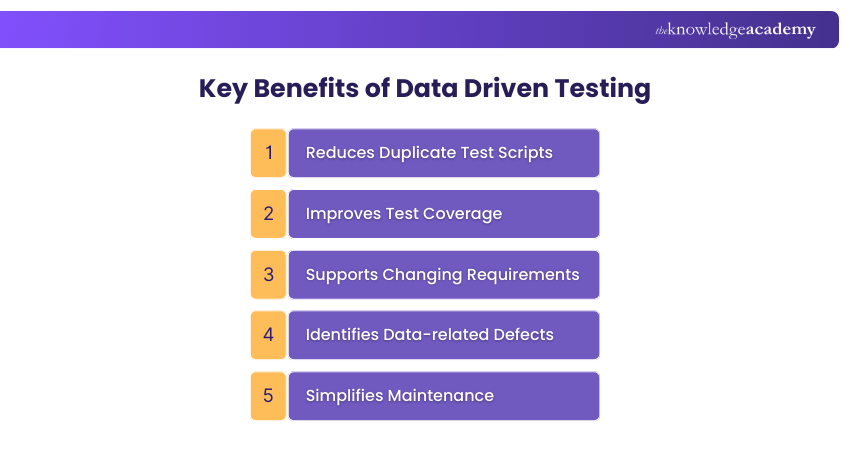
a) Reduces Duplicate Test Scripts: A single test script can be reused with multiple data sets. This saves time and effort compared to writing separate scripts for each input scenario.
b) Improves Test Coverage: It allows testing large volumes of input data, helping teams to validate how the application behaves under different conditions.
c) Supports Changing Requirements: When requirements change, testers can update the data source instead of modifying the test script. This makes the process more flexible and efficient.
d) Identifies Data-related Defects: Running tests with varied inputs helps to uncover issues, such as boundary value errors and unexpected input behaviour that might be missed in limited testing.
e) Simplifies Maintenance: Separating test logic from test data makes updates easier and keeps test cases organised. This makes it easier to manage over time.
Drawbacks of Data Driven Testing
a) Let's look at some of the drawbacks of Dat Driven Testing: Time-consuming Data Preparation: Creating, validating, and maintaining large volumes of data sets requires careful planning and extra effort.
b) Technical Expertise Required: Testers must understand the automation framework and how it handles external data sources to implement Data Driven Testing.
c) Longer Execution Times: Testing with extensive data sets can slow down execution, especially if the test environment is not optimised.
d) Risk of Inconsistency: Without standardised practices, different teams may use varied approaches, leading to inefficiencies.
Analyse, optimise, dominate markets with Marketing Analytics Training – register today!
Real-world Applications of Data Driven Testing
Data Driven Testing is an approach to validate the application under test using multiple sets of data. This approach can be applied wherever DDT is suitable, such as Compliance Validation or Edge case scenarios, across various industries. Similarly, the concept of Data-Driven Marketing is utilised to make informed decisions by analysing customer data, highlighting the importance of data in driving strategies. Here are two examples:
Example 1: Loan Application System
In a loan application, there are many such input fields; applicant income, credit score (risk level), loan amount, and repayment terms. With the help of Data-Driven Testing, testers can test a number of combinations for input and evaluate how well this system calculates loan eligibility (and repayment schedules) to various applicants.
Example 2: Web shop
Data Driven Testing is commonly used to test the shopping cart and checkout process. Different combinations of product quantities, discount codes, shipping options, and payment methods can be stored in external data source. This approach ensures all possible scenarios are tested without rewriting the test scripts.
Example 3: Patient Database
For example, in healthcare applications patient management systems will need to process & store a multitude of data elements like Patient Demographics and their medical history and treatment plans. Data-Driven Testing can be used to ascertain whether this information is read, written and stored by the system accurately, test how different data types are handled and that correct outputs for patient admissions/ discharge / billing etc. are produced under variety of circumstances.
Boost ROI with Social Analytics Training- kickstart your career now!
Types of Data Driven Testing
Data Driven Testing can be implemented in different ways based on how data is created, stored, and utilised. Let's look at its different types:
a) Keyword-driven Testing: Uses predefined keywords to represent actions, while the input data and expected results are stored separately, making maintenance easier.
b) Excel-driven Testing: Test data is stored in Excel spreadsheets and read by scripts during execution. It is simple to manage and allows the same test to run with multiple data sets.
c) Negative Testing: Focuses on testing the system with invalid data. It helps to verify how effectively the application manages errors and incorrect inputs.
d) XML-driven Testing: Used by test scripts during implementation. It is suitable for complex data structures and commonly used for Data Driven applications.
What is Data Driven Testing in Agile?
Data Driven Testing in Agile is a testing approach where a single automated test script is executed multiple times using externally stored data sets. This approach fits naturally into Agile since it supports frequent changes, fast feedback, and continuous integration. This enables teams to adapt tests to evolving requirements without the necessity to rewrite scripts.
Conclusion
Data-Driven Testing is a powerful approach for validating software applications across a wide range of input scenarios. By separating test data from test scripts, this method enhances reusability, maintainability, and test coverage. While it requires careful setup and data management, the benefits of improved efficiency and comprehensive testing make it a valuable practice for testers.
Learn practical Digital Marketing strategies and develop skills in modern tools with Digital Marketing Courses – Join now!
Frequently Asked Questions
What is Data-Driven API Testing?

Data-driven API testing involves testing APIs with various data sets to ensure they respond correctly to different inputs. This method verifies that APIs handle all expected scenarios, including edge cases, by feeding different data inputs during testing.
Can Data-Driven Testing be automated?
Yes, Data-Driven Testing can be automated using test automation frameworks like Selenium, TestNG, JUnit, and others. These frameworks support reading data from external sources and executing test scripts automatically, improving efficiency and reducing manual effort.
How is Data-Driven Testing achieved?
Data-Driven Testing is achieved using test automation tools and frameworks that support external data integration. The test scripts are designed to read input values from data sources like Excel, CSV files, or databases, allowing the same script to be executed with different data sets.

Richard Harris


Senior Full Stack Developer and Technology Educator
Richard Harris is a highly experienced full-stack developer with deep expertise in both frontend and backend technologies. Over his 12-year career, he has built scalable web applications for startups, enterprises and government organisations. Richard’s writing combines technical depth with clear explanations, ideal for developers looking to grow in modern frameworks and tools.


 If you wish to make any changes to your course, please


