


 Top Rated Course

We may not have the course you’re looking for. If you enquire or give us a call on 01344203999 and speak to our training experts, we may still be able to help with your training requirements.
What is Cost-Benefit Analysis, and When to Use it?
The Knowledge Academy 16 July 2026Cost-Benefit Analysis (CBA) is a technique used to compare the costs and benefits of a decision to determine its feasibility and overall economic value. It makes objective choices, strengthens stakeholder confidence, and ensures wise resource usage. Overall, it supports better planning, reduces risks, and guides confident decision-making.

Training Outcomes Within Your Budget!
We ensure quality, budget-alignment, and timely delivery by our expert instructors.
Table of Contents

Making the right business decision is rarely simple. A new idea might be attractive at first, but without a reliable way to assess its true value, organisations risk spending time and money on something that may not deliver meaningful benefits. That's where Cost-Benefit Analysis offers a simple yet powerful way to compare what you will gain with what you will spend.
It helps teams avoid uncertainty, compare choices with clarity, and choose the path that offers the greatest value. In this blog, we’ll break down what Cost-Benefit Analysis is, how it works, and why it is such a dependable tool for informed business decisions.
Table of Contents
1) What is Cost-Benefit Analysis?
2) Features of Cost-Benefit Analysis
3) Steps of Cost-Benefit Analysis
4) When to Use a Cost-Benefit Analysis (CBA)?
5) Cost-Benefit Analysis (CBA) Example With Formulas
6) Benefits of Using CBA in Project Management
7) Limitations of Cost-Benefit Analysis
8) What Tools and Methods are Used in Cost-Benefit Analysis?
9) Conclusion
What is Cost-Benefit Analysis?
A Cost-Benefit Analysis is a method used to decide whether a project or decision is worth moving forward with by comparing the expected benefits to the expected costs. It considers both measurable factors such as money, time and resources, as well as non-measurable factors such as customer satisfaction or improved efficiency.
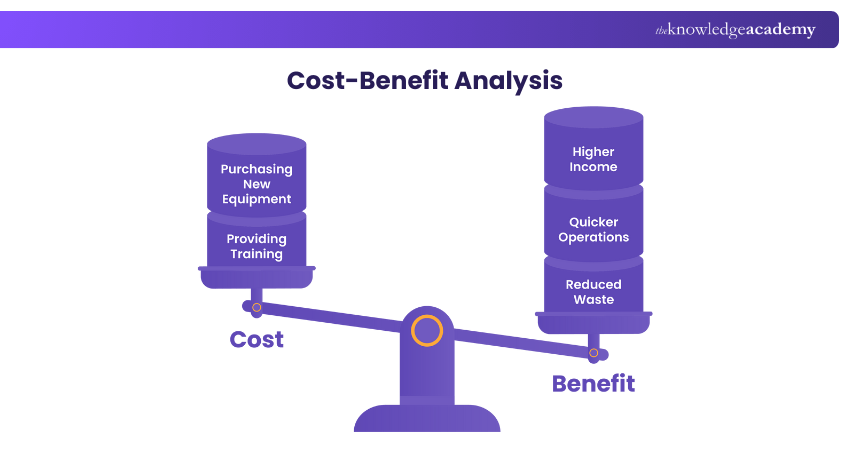
Its idea is simple. If the benefits outweigh the costs, the project is likely worth pursuing. By examining each factor closely, organisations can see the real impact of a decision and use these insights to plan strategically, minimise risks, and support informed choices.

Features of Cost-Benefit Analysis
Cost-Benefit Analysis has several key features that make it a trusted tool for making decisions. These features help organisations compare options more easily and make sure all important factors are considered before choosing a way forward.
1) Quantitative Evaluation: All costs and benefits are turned into numbers, so they can be compared easily.
2) Objective Comparison: Because everything is measured, decisions are based on facts instead of personal opinions.
3) Value of Money Over Time: Future costs and benefits are adjusted to today’s value to give a fair comparison.
4) Comprehensive Scope: CBA includes all types of impacts, such as financial, operational, social, and environmental.
5) Risk Assessment: Possible risks and uncertainties are considered to give a more realistic picture of the outcome.
Steps of Cost-Benefit Analysis
Cost-Benefit Analysis follows a set of steps that help businesses evaluate a project or decision clearly. Here are the steps involved:
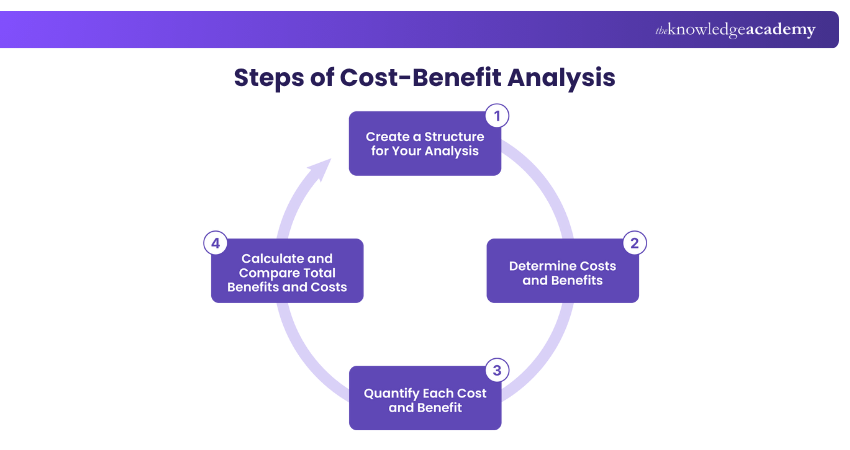
1) Create a Structure for Your Analysis
The first step is to create a clear framework for your analysis. This means defining the purpose of the project and what you want to achieve. Make sure all costs and benefits are measured in the same way, usually in money. You also need to decide how you will measure and compare costs and benefits.
2) Determine Costs and Benefits
Next, list all the costs and benefits linked to the project. Begin with direct costs like labour, materials, and equipment, and indirect costs like utilities and overheads. Add intangible and opportunity costs, such as reduced productivity or missed alternatives. Then identify benefits, including financial gains, reputation, morale, and competitive advantages.
3) Quantify Each Cost and Benefit
Once your lists are ready, the next step is to assign a value to every cost and benefit. This process turns abstract ideas into measurable amounts that can be compared accurately. Direct costs and benefits are usually easy to calculate, while indirect or intangible ones may require careful estimation or specialised evaluation methods.
4) Calculate and Compare Total Benefits and Costs
After assigning values, add up the total benefits and total costs. A project is generally worth pursuing if the benefits are greater than the costs. If the costs are higher, the project may not be the best option. This final review helps ensure your decision is supported by both numbers and strategic thinking.
Explore how to deliver real value in any project with our Managing Benefits™ Foundation Training – Register today!
When to Use a Cost-Benefit Analysis (CBA)?
Cost-Benefit Analysis is not limited only to financial decisions and cost savings. The following are common situations when a CBA can be used:
1) Assessing the Viability of a New Project
Before investing time or money in a new idea, a CBA helps determine whether the benefits outweigh the costs. For example, a tech company may use a CBA to decide if building a new software product will generate enough revenue to justify development and marketing expenses.
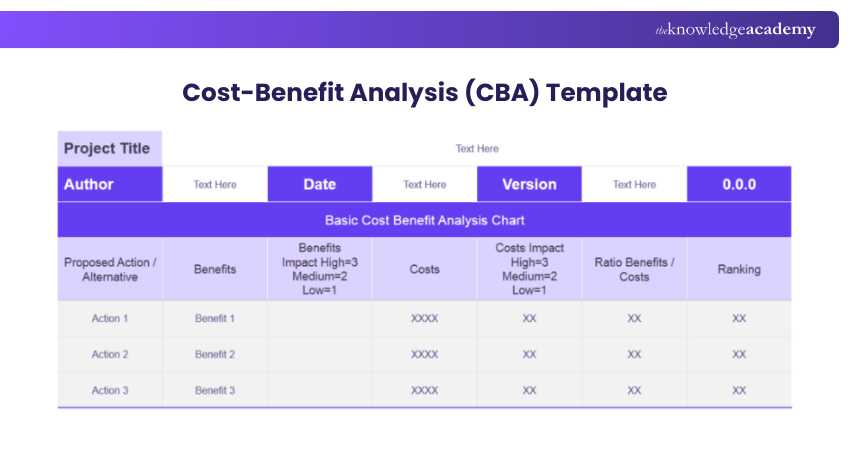
2) Designing a New Business Process or Strategy
A CBA can help you compare different ways of improving how your business works. For example, a manufacturer might compare the costs and benefits of switching to a Just-in-Time inventory system versus keeping their current process.
3) Comparing Investment Options
When you have multiple investment choices, a CBA allows you to evaluate returns and associated risks. For example, a company may compare the cost of two potential factory locations and calculate which site is likely to provide greater long-term value.
4) Making Significant Purchases
Regarding big purchases, such as new equipment or buildings, a CBA can provide you with the proper way to decide if it is worth it. For example, a manufacturer might see whether the purchase of a new machine will lead to a good saving in time and money.
5) Reviewing Potential Policy Changes
CBA can be used by both businesses and governments to analyse policy changes. For instance, a municipality could use CBA to determine whether the starting of a new recycling programme is worth the cost of purchasing new bins and establishing new infrastructure.
Cost-Benefit Analysis (CBA) Example With Formulas
The following is an easy example where a firm uses Cost-Benefit Analysis as a tool to make a decision about investing in a warehouse automation system.
Project:
Buy a warehouse automation system
Given Data:
1) Initial Purchase Price: £420,000
2) Useful Life: Five years
3) Annual Maintenance: £15,000
4) Annual Labour Hours Saved: 6,000 hours
5) Average Labour Cost per Hour: £20
6) Additional Annual Savings From Scrap Reduction and Energy Efficiency: £23,000
7) Discount Rate: 8%
Step 1: Calculate Potential Annual Financial Benefits
Labour Savings:
6,000 hours × £20 = £120,000
Other Savings:
Scrap reduction and energy savings = £23,000
Total annual benefit = £120,000 + £23,000 = £143,000 per year
Step 2: Calculate Present Value of Financial Benefits
Use the discounting formula for each year:

where r = discount rate and n = year
PV of benefits per year with a discount rate of 8%:
1) Year 1: 143,000 ÷ 1.08¹ = £132,407.41
2) Year 2: 143,000 ÷ 1.08² = £122,599.45
3) Year 3: 143,000 ÷ 1.08³ = £113,518.01
4) Year 4: 143,000 ÷ 1.08⁴ = £105,109.27
5) Year 5: 143,000 ÷ 1.08⁵ = £97,323.40
Total PV of benefits = £570,957.54
(Shortcut: treat £143,000 as a 5-year annuity and use the annuity PV factor at 8%)
Step 3: Calculate Present Value of Costs
Here, the costs include the upfront purchase and the PV of annual maintenance.
PV of £15,000 maintenance per year:
1) Year 1: 15,000 ÷ 1.08¹ = £13,888.89
2) Year 2: 15,000 ÷ 1.08² = £12,860.08
3) Year 3: 15,000 ÷ 1.08³ = £11,907.48
4) Year 4: 15,000 ÷ 1.08⁴ = £11,025.45
5) Year 5: 15,000 ÷ 1.08⁵ = £10,208.75
Total PV of maintenance costs = £59,890.65
Total PV of Costs = Initial cost + maintenance cost
Therefore, the total PV of costs = £420,000 + £59,890.65 = £479,890.65
Step 4: Calculate NPV and CBA Ratio
Net Present Value (NPV):

= £570,957.54 − £479,890.65
= £91,066.88
Cost-Benefit Ratio (CBA Ratio):

= £570,957.54 ÷ £479,890.65
= 1.19
Become equipped to drive benefits-focused decisions with our Managing Benefits™ Practitioner Course – Sign up soon!
Benefits of Using CBA in Project Management
CBA plays an important role in modern Project Management. It can change your perspective when you are thinking about starting something new. Here are its benefits that you need to consider:
1) Making Objective Decisions
1) Helps teams make decisions based on real facts
2) Makes it easy to compare different options
3) Reduces personal opinions or bias
4) Keeps the process clear and honest
5) Helps choose the option that gives the best value
2) Building Stakeholder Confidence
1) Shows decisions are based on proper analysis
2) Makes it easier to explain project plans
3) Helps stakeholders feel confident in the project
4) Improves communication with leaders and clients
5) Builds trust in the project team
3) Reducing Risks
1) Spots possible problems early
2) Shows where costs or delays might happen
3) Helps predict issues with resources or the market
4) Makes the team decide if the project is too risky
5) Helps avoid costly mistakes
4) Optimising Resource Allocation
1) Shows where time or money might be wasted
2) Helps compare different ways to use resources
3) Finds hidden or unexpected costs
4) Helps choose the most cost-effective option
5) Makes sure resources are used wisely
Limitations of Cost-Benefit Analysis
Although CBA is a useful decision-making tool, it has some limitations. Those include:
1) Difficult to Predict all Variables
1) Prices of materials and labour may go up or down
2) Outside events can affect results
3) Long-term predictions are often unsure
4) Some important factors might be missed
2) Incorrect Data can Skew Results
1) If the data is wrong, the results will be wrong
2) Old information can give false results
3) Missing costs or benefits makes the analysis incomplete
4) Wrong assumptions can mislead decisions
3) Better Suited to Short and Mid-length Projects
1) Inflation can change over time
2) Customer needs may shift in the future
3) New technology may affect the project
4) Longer projects have more uncertainty
4) Removes the Human Element
1) Mainly focuses on money and numbers
2) Hard to measure feelings or social benefits
3) Cultural or community impacts may be ignored
4) Employee well-being may not be clearly shown
What Tools and Methods are Used in Cost-Benefit Analysis?
Cost-Benefit Analysis can be quite easier if you use a variety of tools. Teams normally use spreadsheets like Microsoft Excel or Google Sheets because they help with data organisation, calculations, and check possible outcomes very fast.
Other than this, the methods used in CBA might include:
1) Net Present Value (NPV): Shows whether a project will make money by converting future cash flows into today’s value.
2) Benefit-Cost Ratio (BCR): Compares total benefits to total costs to see if a project is worth doing.
3) Forecasting Techniques: Help predict future costs, sales, or performance based on trends or estimates.
4) Regression Analysis: Identifies relationships between variables to improve the accuracy of predictions.
Conclusion
Cost-Benefit Analysis remains one of the most useful tools for making confident business decisions. By comparing what you will gain with what you will spend, it helps organisations choose projects that offer real value and avoid those that may lead to unnecessary cost or risk. When combined with thoughtful analysis and practical judgement, it can guide you towards better planning and long-term success.
Gain tools to improve outcomes in your organisation with our Managing Benefits™ Training – Explore now!
Frequently Asked Questions
What is the Theory of Cost-Benefit Analysis?

The theory behind CBA comes from Economics. It states that decisions should be made by comparing costs and benefits. If the benefits are greater, the decision is valuable. CBA helps measure these values clearly so the best choice can be made.
What is an Alternative to Cost-Benefit Analysis?
Alternatives to CBA include:
1) Cost-Effectiveness Analysis (CEA): Helps choose the option that achieves the best results for the least cost.
2) Multi-Criteria Decision Analysis (MCDA): Helps compare choices using different factors other than money.

The Knowledge Academy


Global Training Provider
The Knowledge Academy is a world-leading provider of professional training courses, offering globally recognised qualifications across a wide range of subjects. With expert trainers, up-to-date course material, and flexible learning options, we aim to empower professionals and organisations to achieve their goals through continuous learning.


 If you wish to make any changes to your course, please


