


 Top Rated Course

We may not have the course you’re looking for. If you enquire or give us a call on +1 7204454674 and speak to our training experts, we may still be able to help with your training requirements.
What is Resource Forecasting and Why is it Important?
Sophia Ellis 16 July 2026Resource Forecasting is the process of predicting and planning for future project resource requirements well in advance to ensure successful delivery. It helps organisations allocate the right people, tools, and time for upcoming tasks, reduce project delays, and optimise costs through better planning and visibility.

Training Outcomes Within Your Budget!
We ensure quality, budget-alignment, and timely delivery by our expert instructors.
Table of Contents

Before Google launches a new product, they don’t just hit “go” and hope for the best. They plan ahead by assigning developers, preparing test devices, and setting up support teams. Without this preparation, a product like Google Maps could face major setbacks, and even a minor issue could affect millions of users. That’s why Google uses Resource Forecasting, as it ensures everything is ready before the launch.
In this blog, you’ll learn what Resource Forecasting is, why it’s so useful, and how you can use it too. Whether you lead a big project, manage a small team or run your own business, this simple skill can help you plan better, save time and avoid last-minute surprises.
Table of Contents
1) What is Resource Forecasting?
2) Why Resource Forecasting is Important?
3) Steps of the Resource Forecasting Process
4) Resource Forecasting Techniques in Project Management
5) Benefits of Resource Forecasting in Project Management
6) Challenges of Resource Forecasting
7) Best Practices for Resource Forecasting
8) Conclusion
What is Resource Forecasting?
Resource Forecasting is the process of planning ahead for the people, tools, and materials a company will need in the future. It helps managers identify what is required to complete a task or project before work begins. This includes knowing how many people are needed, the skills they must have, and the equipment that will be required.
For example, if a company wants to build a new product next month, they must know in advance if they have enough staff with the right skills to complete it on time. Resource Forecasting makes this planning possible.

Why Resource Forecasting is Important
Resource Forecasting helps you stay ahead by avoiding delays, managing costs and using your team wisely. Here's why it's so important.
1) Provides Clarity on Hiring Needs
1) Helps you see if more people need to be hired
2) Makes it easier to plan early before a project starts
3) Saves time and prevents delays in the future
Example: The manager sees there are not enough designers for a new project, so they begin hiring early.
2) Enables Accurate Planning for Project Staffing
1) Helps give the right tasks to the right people
2) Makes sure no one is overworked or left with no work
3) Avoids last-minute changes that can confuse the team
Example: A manager sees the workload clearly and assigns tasks evenly across the team.
3) Assists in Identifying Potential Project Risks
1) Shows problems before they happen
2) Helps avoid scheduling conflicts between people or teams
3) Gives managers time to fix issues early
Example: Two projects need the same developer at once, so the manager adjusts the plan before it causes delays.
4) Helps Detect Emerging Trends in the Industry
1) Shows changes in what skills or tools are needed
2) Helps the company stay ready for new trends
3) Supports better training and hiring choices
Example: A company notices growing demand for cloud computing and starts training staff in that area.
Learn about cost estimation and budgeting for project planning. Join our Project Planning and Control™ (PPC) Foundation Training now!
Steps of the Resource Forecasting Process
To forecast resources effectively, you need a clear process. Each step helps you plan smarter and avoid surprises later. Let’s walk through the key steps.
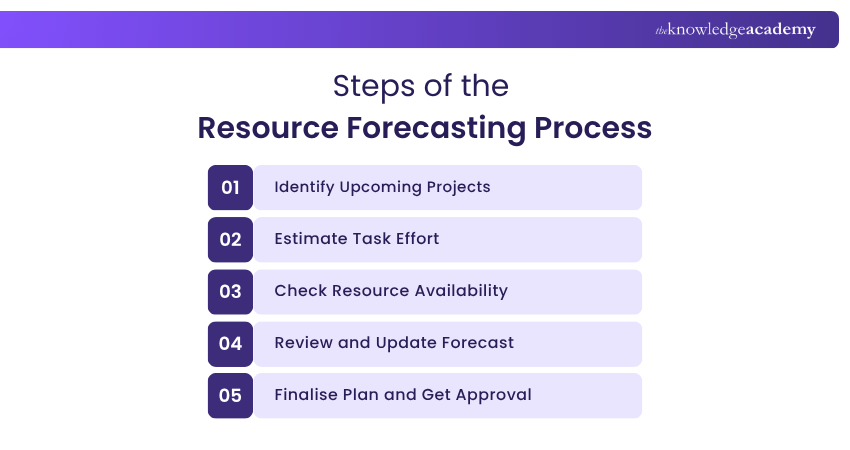
1) Identify Your Upcoming Project Pipeline
1) Write down all the projects your company will work on soon
2) Include the start and end dates for each project
3) Note what each project is about
4) List the main tasks for every project
2) Estimate the Effort Required to Complete Each Task
1) Think about how much time each task will take
2) Decide how many people or tools are needed
3) Break big tasks into smaller steps to estimate better
4) This helps plan team size and workload
3) Match Project Needs with Current Resource Availability
1) Check what your team can do right now
2) See if you have enough people for each task
3) Make sure your team has the right skills
4) Find any gaps or missing resources
4) Review and Adjust Your Estimates as Needed
1) Plans can change, so check your forecast often
2) A task may take longer than you thought
3) Someone might be on leave or unavailable
4) Make updates to your plan as needed
5) Finalise the Forecast and Secure Necessary Approvals
1) When your plan is ready, share it with your manager or client
2) Get their approval before you start the work
3) Make sure you have the right people and tools in place
4) Clearly explain the plan so everyone understands their role
Learn about estimating methods like specific analogue. Join our Project Planning and Control™ (PPC) Practitioner Training now!
Resource Forecasting Techniques in Project Management
Here are some common ways to forecast resources:
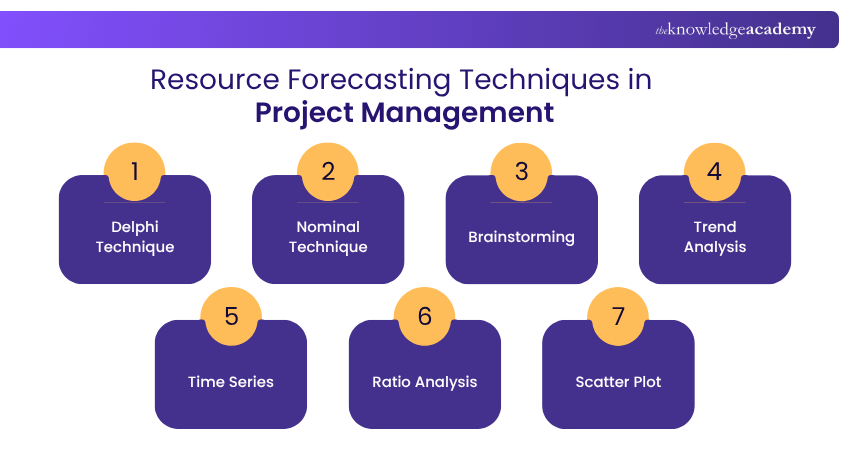
1) Delphi Technique
A group of experts gives ideas separately and privately using the Delphi Technique. Their answers are shared, and they update them until they agree on the best solution.
Example: Managers give their opinion on staff needs for next year and change it after seeing others’ views.
2) Nominal Technique
People quietly write down their ideas without talking. A leader collects them without names. Then, the group discusses and picks the best one together.
Example: Team members suggest ways to fix a delay by writing ideas, then choose the best together.
3) Brainstorming
A group quickly shares ideas without judging anyone. The goal is to collect many ideas and find creative solutions together.
Example: A marketing team lists all ideas for a new ad in one short meeting.
4) Trend Analysis
Looks at old patterns to guess future needs and helps in early planning, staffing, and decision-making.
Example: A company sees that it always needs more staff in December, so it plans ahead.
5) Time Series
Uses past data over time to see changes and helps predict what may happen again in the future.
Example: A business sees sales rise every summer and plans for more staff then.
6) Ratio Analysis
Uses simple maths to plan how many people are needed based on expected output or demand.
Example: A factory uses one worker for every 50 shoes. To make 500 shoes, it needs 10 workers.
7) Scatter Plot
Shows a link between two things using a graph to help managers plan better with clear visual data.
Example: A manager sees that more website visits mean more support requests and plans staff accordingly.
Benefits of Resource Forecasting in Project Management
Resource Forecasting doesn’t just support planning; it improves the way projects run. Here are the key benefits it brings to your team and business.
1) Significantly Cuts Down Overall Project Costs
1) Enables better budget tracking and planning
2) Reduces the risk of over-allocation and unnecessary spending
3) Helps spot cost overruns before they become major problems
4) Supports smarter decision-making to avoid financial waste
2) Boosts Resource Utilisation for High-value Work
1) Ensures team members work on high-value, billable tasks
2) Reduces time spent on low-impact or non-essential activities
3) Maximises output from available resources
4) Contributes to long-term business growth
3) Improves Management of Future Pipeline Projects
1) Helps teams prepare early for upcoming projects
2) Reduces last-minute resource gaps and scheduling conflicts
3) Enables smoother transitions between projects
4) Supports long-term project planning and visibility
4) Balances Resource Supply and Demand Effectively
1) Prevents overstaffing or understaffing across projects
2) Maintains a healthy workload for each team member
3) Aligns capacity with actual demand
4) Helps avoid delays caused by resource shortages
5) Strengthens Control Over Financial Aspects of Projects
1) Gives better visibility into project expenses
2) Helps identify cost-saving opportunities early
3) Allows for accurate financial forecasting
4) Reduces financial risk by staying within budget
6) Minimises the Idle or "Bench" Time of Team Members
1) Shows when team members may be free in the future
2) Allows managers to reassign or rotate tasks quickly
3) Minimises lost time and keeps the workforce engaged
4) Improves overall team productivity and morale
Understand project roles, themes, principles, and processes for better control. Join our PRINCE2® Foundation Course now!
Challenges of Resource Forecasting
While Resource Forecasting is powerful, it’s not always easy. Here are some common challenges teams face when trying to plan ahead.
1) Limited Knowledge of Individual Team Members Capabilities
The Problem: Managers don’t always know what each person is good at.
The Solution: Keep a simple list of each team member’s skills and strengths. This helps you give the right job to the right person.
2) Lack of Visibility into Current Resource Capacity
The Problem: You might plan work for someone who is already too busy.
The Solution: Use tools or calendars to check who is free and who is fully booked. Update it often to stay accurate.
3) Inadequate Communication Between Teams
The Problem: Teams don’t always talk or share updates. This causes confusion.
The Solution: Have regular check-ins and share plans openly. Make sure everyone knows what’s going on and what is changing.
4) Data Gaps That Hinder Informed Decision-making
The Problem: If your information is old or wrong, your forecast will be wrong too.
The Solution: Keep all your data, like work hours, skills, and team plans, up to date. Ask your team to help keep it accurate.
5) Misalignment Among key Stakeholders
The Problem: Managers and leaders may have different goals or plans. This causes delays.
The Solution: Involve everyone early in planning. Talk together and agree on what’s most important before work starts.
Best Practices for Resource Forecasting
To get the most out of Resource Forecasting, it’s important to follow some proven practices. Here are the best ways to make your planning more accurate and effective.
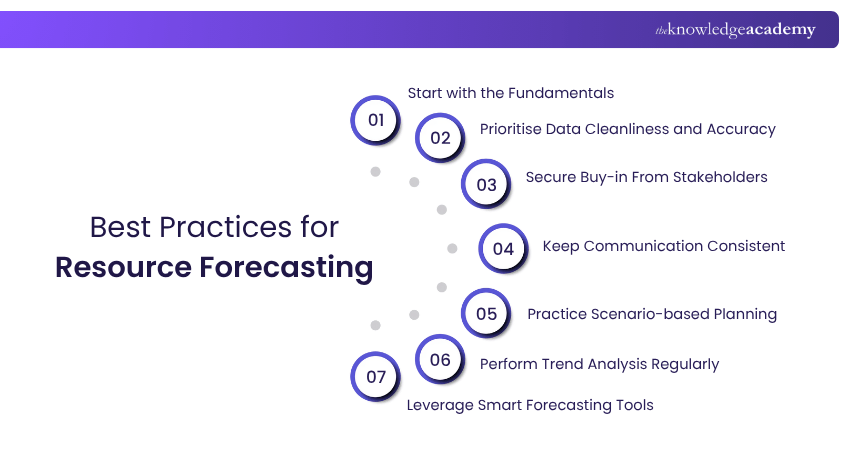
1) Start with the Fundamentals
1) Make a list of projects that are coming soon
2) Check what skills are needed for each project
3) Look at which team members and tools are already available
4) Think about how long each task will take
2) Prioritise Data Cleanliness and Accuracy
1) Use the latest and correct information
2) Fix wrong or old details quickly
3) Ask team members to update their tasks and hours
4) Use tools to check your data regularly
3) Secure Buy-in From Stakeholders
1) Talk to managers, team leads, and clients before planning
2) Make sure they agree with your plan
3) Ask for their advice and feedback
4) When everyone agrees, things go smoother
4) Keep Communication Consistent
1) Have short check-in meetings with your team
2) Share updates or changes as soon as possible
3) Make sure everyone understands their tasks and deadlines
4) Listen to your team’s questions or problems
5) Practice Scenario-based Planning
1) Think about what could go wrong (like sick leave or delays)
2) Make a backup plan for each “what if”
3) Keep some extra time or people ready if needed
4) Review your plan often in case things change
6) Perform Trend Analysis Regularly
1) Look at older projects to see what worked well
2) Check when your team was too busy or had free time
3) Find patterns (like more work in December or summer breaks)
4) Use these patterns to plan better for next time
7) Leverage Smart Forecasting Tools
1) Tools like Runn, Float, or MS Project help plan faster
2) You can see who is busy or free in one place
3) They make updates easy when things change
4) These tools help you avoid mistakes and save time
Conclusion
Resource Forecasting is an effective way to plan ahead, prevent delays, and make the best use of your team and tools. It helps you control costs, meet deadlines, and keep projects running smoothly. Whether you’re managing a single task or multiple projects, forecasting your resources can improve results and reduce last-minute stress. By starting early and planning carefully, you can keep every project on track and set your team up for success.
Gain strategies and techniques applied to plan and close a project. Join our Project Planning and Control™ Training now!
Frequently Asked Questions
What is the Difference Between Forecasting and Prediction?

Forecasting is based on data and trends. It uses past numbers to guess future needs. Prediction is more general and may not always be based on numbers. Forecasting is more reliable in business planning.
What is the Best Forecasting Method and why?
There isn’t a single “best” method. It depends on your project. For example:
1) Use trend analysis if you have lots of past data
2) Use the Delphi technique if you need expert opinions
3) Use a time series if the same type of work happens repeatedly
Choose the one that fits your team, your data, and your goals.

 If you wish to make any changes to your course, please


