


 Top Rated Course

We may not have the course you’re looking for. If you enquire or give us a call on 01344203999 and speak to our training experts, we may still be able to help with your training requirements.
What is Cash Flow and How do you Manage it?
Olivia Taylor 16 July 2026Cash Flow is the net cash moving in and out of a business, showing liquidity. Positive means inflows exceed outflows; negative means spending exceeds income. It helps businesses manage daily operations and plan future expenses effectively. Strong cash flow ensures stability, supports growth, and reduces financial risks.

Training Outcomes Within Your Budget!
We ensure quality, budget-alignment, and timely delivery by our expert instructors.
Table of Contents
Related Courses

Revenue is not the only factor that determines financial success. Cash Flow is very important for smooth operation of business and keeping plans up to date. The parts below discuss its significance and the ways companies effectively control it. Together, these insights highlight how strong financial control supports stability and growth.
Table of Contents
1) What is Cash Flow?
2) Formula and Calculation of Cash Flow
3) Cash Flow Explained for Beginners
4) Why is Managing Cash Flow so Important?
5) Different Types of Cash Flow
6) How to Manage Your Cash Flow?
7) Cash Flow Example
8) Benefits of Cash Flow Forecasting
9) Differences Between Cash Flow and Profit
10) How to Analyse Cash Flows?
11) What is Free Cash Flow, and Why is it Important?
12) Conclusion
What is Cash Flow?
Cash Flow is the net movement of cash and cash equivalents in and out of a business over a specific period. It indicates a company’s ability to generate enough money to meet its financial obligations, such as paying off debts, covering operating expenses, and funding future growth initiatives.
A healthy Cash Flow ensures that a business can operate smoothly without interruptions due to liquidity issues. It provides insight into the financial stability of the company and is often used by investors, lenders, and stakeholders to assess the organisation’s short-term viability and long-term potential. Positive Cash Flow suggests efficient management and strong revenue streams.

Formula and Calculation of Cash Flow
Cash Flow is computed by deducting total cash outflows of a company from total cash inflows within a given time. The basic formula is:

It indicates either a gain or a loss of cash in the business over that period. One can also divide this figure based on how the activity is performed by using a cash flow statement by summing up all the operating, investing, and financing cash flows.
Cash Flow Explained for Beginners
Cash Flow is the lifeblood of any business; it refers to the movement of money in and out of a company. Unlike profit, which is often calculated on an accrual basis, Cash Flow tracks the actual flow of cash at a given time. This includes income from sales, payments to suppliers, operational expenses, and capital investments.
Understanding Cash Flow is crucial for evaluating whether a company can meet its financial obligations, reinvest in operations, and maintain stability during downturns. Strong, consistent Cash Flow is a sign of a healthy business, while irregular or negative Cash Flow may indicate underlying financial issues. By monitoring Cash Flow, businesses can anticipate shortages, make informed budgeting decisions, and maintain better control over their financial future.
Why is Managing Cash Flow so Important?
Proper Cash Flow Management ensures a business can meet its obligations, invest in opportunities, and prepare for unforeseen challenges. By regularly creating a Cash Flow Forecast, businesses can better anticipate and plan for cash needs, ensuring smooth operations. Without adequate Cash Flow management, even profitable companies can face liquidity crises threatening survival.
Handling Cash During Times of Change
During periods of economic uncertainty or market shifts, effective cash flow management becomes essential for business stability. Maintaining a structured cash budget and sufficient reserves helps organisations handle disruptions, reduced income, and strategic changes more confidently. This approach lowers the risk of financial strain, allowing businesses to continue operations without drastic measures like layoffs or closures.
Managing Cash During Periods of Growth
Rapid business growth can put pressure on cash flow if not managed carefully. As sales increase, so do expenses such as production, staffing, and inventory. Businesses must ensure they have enough working capital to support this expansion while maintaining a healthy cash position. For instance, a growing startup should balance investing in additional stock with keeping adequate cash reserves to avoid liquidity challenges.
Different Types of Cash Flow
Understanding the different Cash Flow types is crucial to understanding a complete picture of a business's financial health. Each type highlights specific areas of a company's operations, investments, and financing.
Cash Flows from Operations
Cash Flows from Operations (CFO) are the cash generated or consumed by a company's core business activities. This includes cash receipts from sales of goods and services and cash payments to suppliers and employees. CFO is often seen as the most important type of Cash Flow because it shows whether a company can generate enough positive Cash Flow to maintain and grow its operations without external financing.
Cash Flows from Investing
Cash Flows from Investing (CFI) reflect the cash used for investing in assets that will benefit the company in the long term, such as purchasing property, plant, and equipment (PPE) or acquiring other businesses. This category can also include cash generated from the sale of these assets. A company’s CFI activities often provide insight into its growth strategy and prospects.
Cash Flows from Financing
Cash Flows from Financing (CFF) encompass the cash transactions related to funding a company through debt, equity, or dividends. This includes cash raised by issuing stocks or bonds and money spent on repaying loans or distributing dividends to shareholders. CFF is critical for understanding how a company funds its operations and growth outside its day-to-day activities.
Optimise your Cash Flow and boost efficiency with our Cash Cycle Management Training. Join today!
How to Manage Your Cash Flow?
Effective Cash Flow management involves maximising inflows and minimising outflows. Here are some strategies to help you manage your Cash Flow mentioned below.
Improving Your Cash Flow
Improving cash flow requires proactive planning and consistent financial discipline. Businesses can strengthen their cash position by speeding up customer payments, agreeing clear payment terms, and managing expenses carefully. It also helps to involve the whole organisation in maintaining a healthy cash reserve and regularly reviewing cash flow forecasts to stay prepared for future needs.
Never Ignore a Cash Shortfall
Ignoring a cash shortfall can quickly lead to serious financial problems. Businesses should act early by identifying gaps in working capital and exploring solutions such as increasing credit, using invoice financing, or considering alternative funding options. Taking timely action helps maintain operations and prevents unexpected disruptions.
Unlock the power of secure transactions—Join our Letters of Credit Training now!
Cash Flow Example
Let's consider a fictional company, GreenThumb Gardens, a small business that sells organic gardening supplies. In one fiscal year, GreenThumb Gardens generated £5,00,000 in revenue from sales (CFO), spent £1,00,000 on new equipment (CFI), and repaid £50,000 of its bank loan (CFF).
From these activities, GreenThumb Gardens’ Cash Flow statement would show:
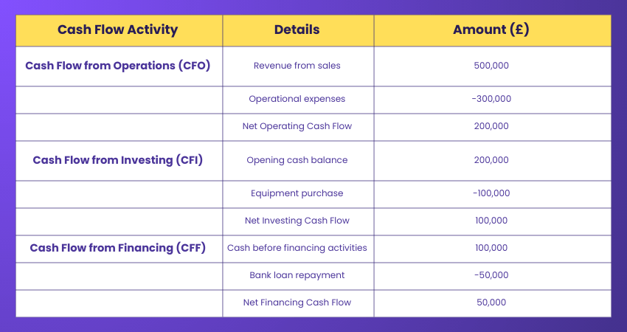
This example illustrates how different types of Cash Flow contribute to a business's overall financial health. GreenThumb Gardens has positive Cash Flow from its operations, which is a strong indicator of its ability to sustain and grow its business.
Unlock your Financial Potential—Join our Capital Market Course today!
Benefits of Cash Flow Forecasting
Cash Flow forecasting that is effective assists companies in anticipating their future cash situations, enhancing their liquidity visibility, and making assured plans for their growth and stability.
a) Anticipates Cash Shortfalls: Plans the cash shortages ahead of time in order to ensure that corrective measures are implemented beforehand.
b) Enhances Liquidity Visibility: Displays the amount of cash available to cover the short-term liabilities.
c) Supports Growth Planning: Aids in planning investments and expansion according to the future cash availability.
d) Rigidifies Financial Control: Allows improved monitoring and control of incoming and outgoing cash.
e) Improves Decision-making: Gives quality information to make sound financial decisions.
Funds Applications: Shows that there is financial readiness and stability towards lenders and investors
Differences Between Cash Flow and Profit
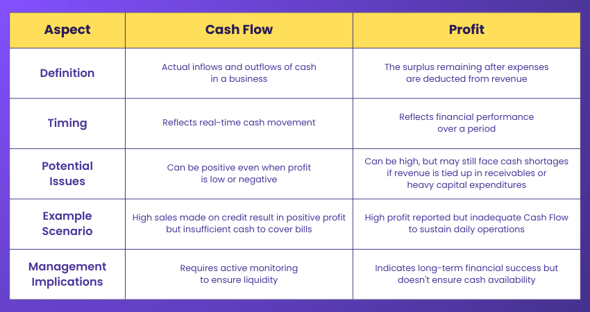
While Cash Flow and profit are related, they are distinct financial metrics. Profit is the amount of money left over after all expenses have been deducted from revenue, whereas Cash Flow refers to the actual inflows and outflows of cash in a business.
For example, a business might report a high profit due to large sales, but if those sales are made on credit, the company may struggle with Cash Flow vs Profit, needing more cash to pay its bills. This underscores the importance of managing both Cash Flow and profit carefully to maintain a business's financial health.
How to Analyse Cash Flows?
To analyse Cash Flows, review the Cash Flow statement’s three sections: operating, investing, and financing activities. Focus on cash from operations to assess business health, watch trends over time, and compare cash inflows vs outflows to understand liquidity, sustainability, and the company's ability to fund growth or pay debts.
What is Free Cash Flow, and Why is it Important?
Free Cash Flow (FCF) is the cash a company generates after capital expenditures. It shows how much cash is available for dividends, debt repayment, or reinvestment. FCF is important because it reflects true profitability, operational efficiency, and financial flexibility. It makes it a key metric for investors and decision-makers.
Conclusion
The success of a business is measured not just by its profits, but also by its punctuality and its ability to control the situation. When organisations plan their Cash Flow ahead of time, they gain the confidence to make wise decisions and keep their finances stable even in fluctuating conditions.
Take control of your finances—Join our Introduction to Credit Control Course today!
Frequently Asked Questions
Do Companies Need to Issue a Cash Flow Statement?

Yes, most companies prepare a cash flow statement that reveals the money flows in and out of the business. The public firms have to incorporate it into their financial reporting for the sake of transparency.
How Can Small Businesses Improve Their Cash Flow Management?
They can improve Cash Flow by accelerating receivables, negotiating better payment terms with suppliers, closely monitoring expenses, and keeping a cash reserve for emergencies. Implementing strict budget controls and regularly reviewing financial statements help maintain a healthy Cash Flow.

Olivia Taylor


Chartered Accountant and Financial Training Specialist
Olivia Taylor is a qualified chartered accountant with over a decade of experience in financial management, auditing and corporate reporting. Having worked with leading firms in both the public and private sectors, Olivia brings clarity to complex financial topics. Her writing focuses on helping professionals build confidence in key areas of accounting, compliance and financial planning.
View Detail

 If you wish to make any changes to your course, please


