


 Top Rated Course

We may not have the course you’re looking for. If you enquire or give us a call on 01344203999 and speak to our training experts, we may still be able to help with your training requirements.
Understanding the Difference Between Cash Flow vs Profit
Olivia Taylor 16 July 2026Cash Flow vs Profit compares liquidity and profitability, showing how money moves through a business versus how much is earned after expenses. Knowing how they differ helps organisations manage day-to-day operations, maintain stability, and make informed financial decisions for sustainable growth and long-term resilience.

Training Outcomes Within Your Budget!
We ensure quality, budget-alignment, and timely delivery by our expert instructors.
Table of Contents

Running a successful business is not just about making sales. Many businesses appear profitable on paper but still struggle to pay suppliers, employees, or everyday expenses. This is why understanding Cash Flow vs Profit is important. Although these terms are used interchangeably, they measure different aspects of a business's financial health and performance.
Knowing the difference between Cash Flow vs Profit helps business owners, Managers, and finance professionals make smarter financial decisions. In this blog, you'll learn how these concepts differ, why both matter, explore real-world examples, and more to better understand their impact on business. So, let’s get started!
Table of Contents
1) What is Cash Flow?
2) What is Profit?
3) Cash Flow vs Profit: Key Differences
4) Which is More Important: Cash Flow or Profit?
5) Why Cash Flow and Profit Both Matter?
6) Cash Flow and Profit in Financial Analysis
7) Cash Flow vs Profit: A Real-world Example
8) Conclusion
What is Cash Flow?
Cash flow means the movement of money in and out of a business over a specific period. It tracks how much cash a company receives from sales, investments, or financing, and how much it spends on expenses, salaries, and operations. By maintaining a healthy cash flow, businesses ensure that they a business can meet its short-term financial obligations without difficulty.
Positive cash flow means more money is coming in than going out, which supports growth and stability. On the other hand, a negative cash flow may signal financial strain if it continues for a long time. Monitoring cash flow regularly helps organisations plan better, avoid shortages, and make informed financial decisions.

What is Profit?
Profit is the financial gain a business earns upon subtracting all expenses from its total revenue. These expenses include operating costs, salaries, rent, taxes, and other overheads. When a company’s income exceeds its costs, the remaining amount is considered profit.
Profit is a vital indicator of a business’s performance and long-term sustainability. It shows whether the company is operating efficiently and creating value from its activities. Businesses often analyse different types of profit, such as gross profit and net profit, to understand their financial health more clearly.
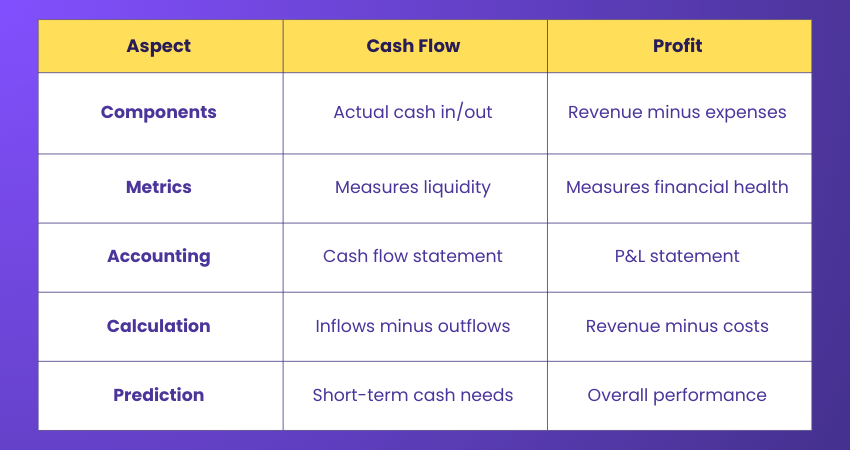
Cash Flow vs Profit: Key Differences
Accountants frequently use both cash flow and profit in various financial processes. They recognise the significant differences between these terms, which include several key distinctions.
1) Components Included
Cash flow represents the actual money flowing into and out of a company over a specific period. It excludes credit balances, amounts owed by debtors, and credit from suppliers, focusing solely on cash transactions.
In contrast, profit is the remaining amount from a company's revenue after deducting costs such as taxes, payroll, and other operating expenses. Unlike cash flow, profit includes non-cash items such as depreciation and accounts for revenue earned even if the cash has not yet been received.
2) Metrics They Assess
Both cash flow and profit are crucial indicators of a company's success and stability. Profit reflects the financial health and long-term sustainability of the business. Meanwhile, cash flow is the capital that keeps the business operational. This means that while profit measures ongoing viability, cash flow assesses the company’s ability to meet its immediate financial obligations.
A business can be profitable while facing cash flow issues. For example, a small electronics manufacturer in the UK might struggle to pay its suppliers due to delayed payments from large clients. This situation can occur even if the company has a profitable product line.
3) Accounting Methods
Cash flow and profit are tracked using different accounting methods for income and cash flow statements. Cash flow statements can be crafted using the direct or indirect method. The direct method sums all cash payments and receipts, reflecting the company's liquid assets at the start and end of the period. The indirect method adjusts the net income from the income statement by deducting taxes and interest, then adding back non-operating activities.
In contrast, profit is tracked on a profit and loss statement using either the cash-basis or accrual accounting method. The cash-basis method records only transactions where payments have been received or made. In contrast, the accrual method accounts for all revenues and expenses, reflecting both current and future financial commitments.
Transform accounting with intelligent automation by signing up for the Certified Artificial Intelligence (AI) For Accountants Training today!
4) Calculation Process
To calculate cash flow, a company sums up cash from operating, investing, and the financing activities and subtracts any cash outflows from these activities. For example, if a Florist in London pays £8,000 to a supplier on 13th June, this results in a cash outflow. When the florist receives £12,000 from a customer on 15th June, its net cash flow becomes £4,000.
In contrast, profit is calculated by subtracting direct and indirect costs from total sales revenue. For instance, if a pizza restaurant in Manchester reports quarterly revenue of £20,000 and £13,000 in expenses, its Profit for the quarter would be £7,000.
5) What They Predict
Cash flow and profit are necessary to analyse the financial trends. However, these are the indicators that show the company’s performance from different perspectives. Cash flow tracks the flow of money into and out of the organisation in order to help understand liquidity. It assists businesses to ensure that they have adequate capital to manage arising short-term needs.
On the other hand, profit reflects the company’s sales and expenses, offering a view of overall performance. Analysing profit trends can reveal seasonal fluctuations, helping companies align their objectives with actual performance. This also allows them to prepare effectively for quieter periods.
Enhance your career with our expert-led Accounting Courses. Register now and take control of your financial future!
Which is More Important: Cash Flow or Profit?
Both cash flow and profit play equally important roles in measuring a business's financial health, and each provides valuable insights. Profit reflects how effectively a business generates earnings after expenses, while cash flow shows how efficiently money moves through the business to support its daily operations. Together, they offer a more complete view of financial performance.
Rather than choosing one over the other, businesses should evaluate Cash Flow vs Profit side by side. Healthy cash flow helps maintain smooth operations, while strong profits support long-term growth and success. Understanding both metrics enables business owners, Managers, and financial investors to make accurate and informed financial decisions and build a more resilient business.
Why Cash Flow and Profit Both Matter?
Cash flow and profit are both essential because they measure different financial aspects of a business's performance. Profit shows whether a business is generating earnings that support long-term growth, while cash flow reflects how effectively money is available to fund daily operations and meet financial commitments.

Together, these metrics provide a complete picture of a business's financial health. Profit creates opportunities for future growth, while healthy cash flow ensures smooth daily operations. Maintaining a balance between the two helps businesses make informed decisions, improve financial stability, and achieve sustainable success.
Cash Flow and Profit in Financial Analysis
Your business cash flow assessment shows your ability to handle financial operations together with your daily Expense Management. Businesses that monitor their cash flow on a regular basis can avoid operational problems while they maintain their financial health. The assessment of profit provides a complete view of your business operations, which includes its financial success and potential for future development.
Cash Flow vs Profit: A Real-world Example
Imagine a small retail shop that makes £20,000 in sales in one month. On paper, after deducting expenses like rent, salaries, and utilities, the business shows a profit of £5,000. However, most customers purchased goods on credit and have not yet paid. Although the company is profitable, it may still struggle to pay suppliers because the actual cash has not been received.
Now consider the opposite situation. The shop might receive £15,000 in advance payments from customers for future orders, creating strong cash flow. However, once expenses are deducted, it may show little or no profit for that month. This example highlights that profit reflects overall earnings, while cash flow sheds light the actual movement of money in and out of the business.
Conclusion
Understanding the distinctions between Cash Flow vs Profit is essential for making informed financial decisions. While profit reflects a company’s earnings after expenses, cash flow spotlights the actual movement of money in and out of the business. A company may appear profitable yet face cash shortages. By carefully managing cash flow and the profit, businesses can strengthen stability, reduce financial risks, and support long term growth.
Build strong financial governance skills and create policies that drive success with the Accounting and Finance Policies Course – Join now!
Frequently Asked Questions
Is Cash Flow More Important Than Profit?

Businesses need cash flow and profit because both financial metrics measure different elements of their performance. The actual cash amount in a business determines its ability to operate everyday activities. Profit shows financial success for a business, but cash flow serves as the primary short-term requirement for business operations.
Can a Business Have Good Cash Flow but No Profit?
A business can maintain positive cash flow while experiencing short-term financial losses. Businesses can receive positive cash flow from their existing operations when they obtain large loans or sell important assets. Your business needs to generate profits from its core activities to achieve sustainable success.

Olivia Taylor


Chartered Accountant and Financial Training Specialist
Olivia Taylor is a qualified chartered accountant with over a decade of experience in financial management, auditing and corporate reporting. Having worked with leading firms in both the public and private sectors, Olivia brings clarity to complex financial topics. Her writing focuses on helping professionals build confidence in key areas of accounting, compliance and financial planning.
View Detail

 If you wish to make any changes to your course, please


