


 Top Rated Course

We may not have the course you’re looking for. If you enquire or give us a call on 01344203999 and speak to our training experts, we may still be able to help with your training requirements.
Business Performance Management: A Complete Guide
James Smith 15 July 2026Business Performance Management (BPM) helps organisations track KPIs, analyse data and align operations with strategy to improve efficiency and decision-making. It gives clear insights into performance and areas to improve. Organisations can use data to make better decisions and improve results.

Training Outcomes Within Your Budget!
We ensure quality, budget-alignment, and timely delivery by our expert instructors.
Table of Contents

Businesses often rely on the performance of their employees for better results and their success. However, it is impossible to maintain the same enthusiasm among employees towards work, which can negatively impact the organisation’s performance as a whole. This is where Business Performance Management and Business Activity Monitoring come in.
Business Performance Management is streamlines approach to monitor, analyse, and enhance an organisation's performance to achieve its objectives. Thus, it is crucial to learn about this approach and thrive in the competitive business environment.
Don't know where to begin from? Worry no more, this blog is for you. Read this blog to learn everything about Business Performance Management, including its importance, types and cycle. Also, explore the activities conducted during its implementation.
Table of Contents
1) What is Business Performance Management?
2) Why is Business Performance Management Important?
3) Types of Business Performance Management
4) Benefits of A Robust Business Performance Management Process
5) The Business Performance Management Cycle
6) What is the Best Tool for Performance Management?
7) What are the Components of Business Performance Management?
8) Conclusion
What is Business Performance Management?
Business Performance Management (BPM) is a strategic approach that enables organisations to monitor and manage their performance effectively. It includes various processes to ensure alignment with strategic objectives, including goal setting, monitoring, analysis, and optimisation. Using Key Performance Indicators (KPIs) and metrics, Business Performance Management provides insights into the health and efficiency of business operations.
By consistently monitoring and analysing, organisations can pinpoint improvement areas, enabling informed decision-making to boost performance. Through Business Performance Management, companies make informed decisions, staying agile in dynamic markets. Today, BPM has become a guiding framework that enables organisations to achieve their goals.

Why is Business Performance Management Important?
Business Performance Management holds significant importance for organisations due to the following key reasons:

1) Aligning with Goals
Business Performance Management ensures that all departments work towards common organisational goals by tracking key performance metrics. This alignment helps improve decision-making and ensures resources are used effectively where they add the most value.
It also allows organisations to monitor performance continuously and adjust strategies when needed. This improves accountability and helps businesses stay responsive to changes while maintaining focus on their objectives.
2) Considering Alternatives
Business Performance Management supports better decision-making by analysing data and evaluating different strategies. It helps organisations identify inefficiencies, challenges, and areas that need improvement across business processes.
By exploring alternative approaches, organisations can optimise operations, improve productivity, and reduce risks. This enables them to respond quickly to changes and take advantage of new opportunities in competitive markets.
3) Keeping Everyone Accountable
Business Performance Management promotes accountability by clearly defining roles, responsibilities, and performance expectations. It uses measurable metrics to track individual and team contributions towards organisational goals.
It also encourages transparency and open communication, helping employees take ownership of their work. This supports collaboration and motivates teams to achieve shared goals, improving overall performance.
Elevate your career with our Performance Management Training– register today!
Types of Business Performance Management
Now that you know Business Performance Management definition, it is time to understand its various types:

1) Financial Performance Management
Financial Performance Management involves analysing, monitoring, and optimising financial metrics and outcomes within an organisation. It encompasses budgeting, estimating, financial reporting, variance, and profitability analysis. Organisations utilise Financial Performance Management for resource allocation, goal achievement, and strategic decision-making based on financial insights.
2) Operational Performance Management
Operational Performance Management targets efficiency and effectiveness in organisational processes. It involves monitoring key metrics, identifying improvement areas, and implementing enhancements to align with goals. This approach aids in cost reduction, productivity enhancement, and delivering superior products or services to customers.
By prioritising operational metrics and strategic objectives, organisations drive continuous improvement. The Business Operations Manager Job Description highlights how this role plays a crucial part in streamlining operations, optimising processes, and enhancing performance. With a focus on KPIs and ongoing refinement, businesses achieve greater efficiency, effectiveness, and customer satisfaction.
3) Strategic Performance Management
Strategic Performance Management involves aligning organisational objectives with strategic priorities and monitoring performance against long-term goals. It encompasses strategic planning, goal setting, performance measurement, and strategic alignment. Organisations utilise strategic Performance Management to ensure alignment with their strategic direction.
4) Employee Performance Management
Employee Performance Management focuses on managing and improving the performance of individual employees within an organisation. Business Performance Management involves the following:
a) Setting expectations
b) Offering feedback
c) Coaching
d) Evaluating performance
e) Addressing training needs
f) Rewarding high performance to improve growth effectively
Effective employee Performance Management helps organisations enhance employee engagement, motivation, and productivity. This, in turn, leads to better organisational Performance.
5) Customer Performance Management
Customer Performance Management involves understanding customer-facing processes and interactions. It strives to improve customer satisfaction, loyalty, and retention. Business Performance Management involves collecting and analysing customer feedback. It measures satisfaction and loyalty metrics and identifies areas for improving the customer experience.
Finally, it implements initiatives addressing customer needs and preferences. Organisations use customer Performance Management to build strong customer relationships, increase lifetime value, and drive business growth.
Unleash your team's full potential with our Introduction to Managing People Training- join now!
Benefits of A Robust Business Performance Management Process
A strong Business Performance Management (BPM) process helps organisations improve performance, make better decisions, and stay aligned with strategic goals. The key benefits are outlined below:
1) Improved Financial Performance
Business Performance Management helps organisations plan, budget, and forecast more effectively, leading to stronger financial outcomes. By analysing performance data, businesses can identify cost-saving opportunities and improve profitability.
2) Enhanced Operational Visibility
It provides clear visibility into business operations by tracking performance across multiple areas. This allows organisations to monitor progress in real time and quickly identify inefficiencies or performance gaps.
3) Strategic Alignment and Focus
BPM ensures that all departments and activities are aligned with overall business goals. By linking performance metrics to strategy, organisations can maintain focus and ensure every function contributes to long-term objectives.
4) Better Risk Management
By continuously monitoring data and performance indicators, BPM helps organisations identify risks early. This enables proactive decision-making and reduces the impact of potential issues on business performance.
5) Enhanced Decision-making Quality
With access to accurate data and insights, organisations can make faster and more informed decisions. BPM supports data-driven strategies that improve overall business outcomes and performance.
The Business Performance Management Cycle
Business Performance Management Cycle consists of the following four stages:
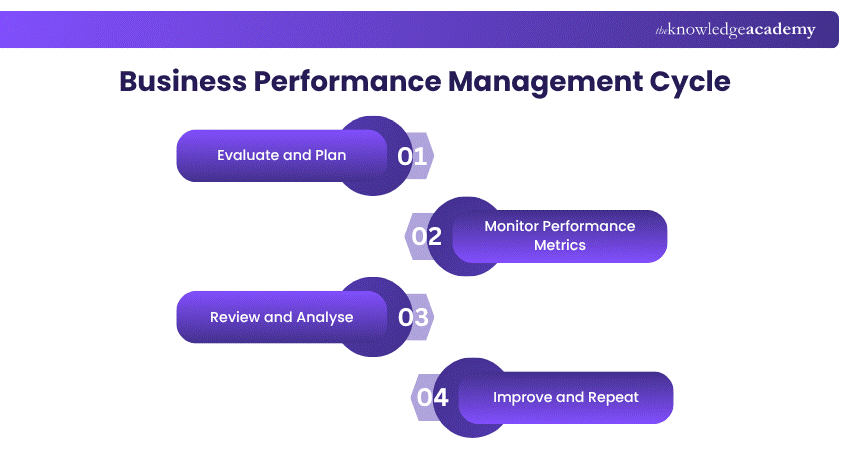
1) Evaluate and Plan
In this stage, organisations assess current performance, define short-term and long-term goals, and create strategic plans to align efforts with business objectives, setting a clear foundation for improved performance and sustainable growth. It also ensures clarity in direction and supports better decision-making across the organisation.
2) Monitor Performance Metrics
Once goals are set, organisations continuously track performance metrics and KPIs using real-time data to measure progress and identify strengths and weaknesses. This helps ensure activities remain aligned with business objectives. It also supports timely adjustments and better decision-making to maintain performance and competitiveness.
3) Review and Analyse
Organisations regularly review and analyse performance data to understand trends, identify gaps, and compare results against targets. This helps uncover the reasons behind performance differences and areas for improvement. It also supports data-driven decisions and allows organisations to refine strategies and respond effectively to changes.
4) Improve and Repeat
Based on insights from analysis, organisations implement improvements and corrective actions to enhance processes and performance. Lessons learned are applied to future planning to ensure continuous progress. It also supports ongoing improvement, helping businesses adapt to change and maintain growth.
Unlock the key to achieving excellence in every aspect with our Senior Management Training - Join now!
What is the Best Tool for Performance Management?
Performance Management tools vary based on an organisation’s size, goals, and operational needs. Choosing the right tool depends on how effectively it supports tracking performance, feedback, and overall business objectives. Some popular options include:
1) Performance Pro: Helps evaluate employee performance through customised assessment tools.
2) PerformYard: Allows organisations to design and manage performance review processes based on their needs.
3) Deel: Supports continuous feedback and one-to-one reviews, especially for distributed teams.
4) Trakstar (Mitratech): Manages performance across the full employee lifecycle, from onboarding to development.
5) Lattice: Enables multi-source feedback and helps align individual goals with organisational objectives.
6) Primalogik: Suitable for structured and scalable performance review cycles as teams grow.
7) Leapsome: Focuses on employee development through goal setting, reviews, and learning tools.
8) Workleap: Offers flexible review systems with automation to support growing organisations.
9) Workable HR: Facilitates feedback across different teams and management levels.
10) Spidergap: Provides clear insights using 360-degree feedback to improve performance and engagement.
What are the Components of Business Performance Management?
Business Performance Management involves a strategic framework that helps organisations plan, monitor, and improve performance. Its components typically include:
1) Strategic Goal Setting
Establishes clear, measurable objectives aligned with the organisation’s mission and long-term vision. This includes defining KPIs, OKRs, or SMART goals that guide team and individual performance.
2) Performance Planning
Involves creating detailed plans that link business strategy to operational actions. This covers resource allocation, timelines, accountability, and expected outcomes.
3) Data Collection and Integration
Gathers quantitative and qualitative performance data from various sources (finance, HR, sales, operations) and consolidates it into a central system for analysis.
4) Monitoring and Measurement
Tracks progress in real time through dashboards, scorecards, and regular check-ins. This ensures timely visibility into what’s working and what’s not.
5) Analysis and Reporting
Uses tools like business intelligence, analytics, and benchmarking to assess performance against goals. Identifies trends, variances, and opportunities for improvement.
6) Feedback and Review Cycles
Regular performance reviews and feedback loops, both at the individual and organisational level ensure continuous learning and adjustment.
7) Performance Appraisal and Recognition
Formal evaluation of employee or team performance, often linked to rewards, promotions, or development plans. Encourages motivation and accountability.
8) Learning and Development
Supports employee growth through training, coaching, mentoring, and career progression aligned with performance insights.
9) Corrective Actions & Optimisation
Based on insights, leaders implement strategic or operational changes to address underperformance and improve processes.
10) Technology and Tools
BPM platforms (e.g., ClearPoint, Leapsome, PerformYard) support automation, collaboration, visualisation, and integration with existing systems (ERP, HRIS, etc.).
Conclusion
Optimising organisational performance through Business Performance Management is vital for achieving strategic objectives. By adopting a systematic Performance Management approach, organisations can navigate market changes and maintain long-term success in competitive Business environments.
Accelerate growth with Personal and Organisational Development Training – Join today!
Frequently Asked Questions
What are the Three Primary Activities Involved in Business Performance Management?

The three main activities in Business Performance Management are evaluation and planning, monitoring Performance metrics, and reviewing and analysing data. These activities involve assessing current performance, tracking progress, and gaining insights.
What is the Role of a Business Performance Manager?
The role of a Business Performance Manager involves overseeing the entire Business Performance Management Cycle. This includes evaluating current performance, setting goals, monitoring metrics, analysing data, implementing improvements, and ensuring alignment with strategic objectives.

James Smith


Digital Marketing Manager and Trainer
James Smith is a digital marketing professional with over a decade of experience in SEO, content strategy, paid media and analytics. He has supported both SMEs and global brands in transforming their digital presence. James’s writing and training are rooted in results-driven tactics and the latest marketing trends.
View Detail

 If you wish to make any changes to your course, please


