


We may not have the course you’re looking for. If you enquire or give us a call on 01344203999 and speak to our training experts, we may still be able to help with your training requirements.
Benefits of Mind Mapping
ByThe Knowledge AcademyLast updated on: 02 November 2026
Discover the benefits of mind mapping, from boosting creativity and improving memory to simplifying complex ideas and enhancing productivity.

What You'll Learn
1. Mind mapping encourages free-flowing ideas and helps discover connections between different concepts.2. Mind mapping organises information visually to support understanding, revision and recall.3. Mind mapping breaks complex challenges into smaller parts, making it easier to explore possible solutions.4. Mind mapping helps organise goals, identify priorities and structure tasks more effectively.5. Mind mapping presents ideas clearly, making discussions, presentations and collaborative work easier to follow.
A project has dozens of ideas, but no one knows where to begin. Tasks overlap, important details get missed, and discussions keep moving between unrelated topics. What if you could organise everything on a single page and see how the different ideas connect?
This is where mind mapping can help. By placing a central idea at the heart of a visual diagram and connecting related thoughts through branches, it offers a practical way to bring structure to scattered information. Read on to discover how mind mapping can help you understand information and plan tasks more effectively.
Key Benefits of Mind Mapping
Mind mapping helps make ideas easier to explore, understand and communicate. Whether you are studying a new subject or managing a complex task, its visual structure provides a practical way to organise information. Here are 10 important benefits:
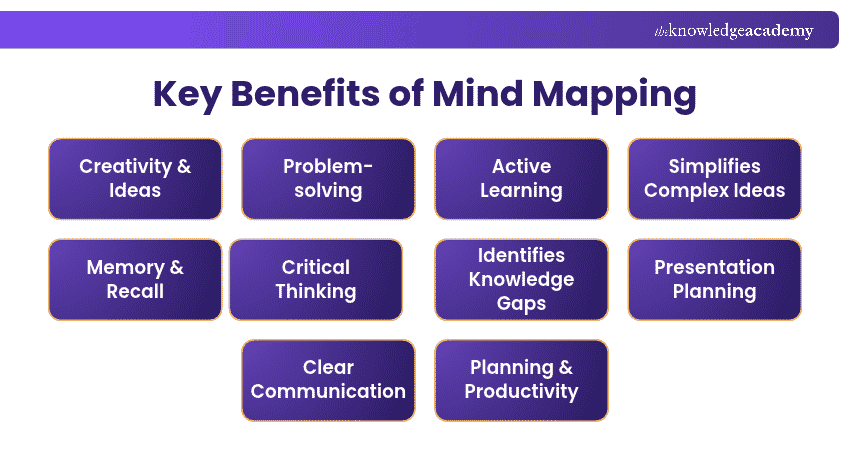
1) Boosts Creativity and Idea Generation
Mind mapping encourages free-flowing thinking by allowing ideas to develop in different directions. Instead of following a fixed sequence, you can explore multiple possibilities and discover connections between seemingly unrelated concepts. This makes mind mapping particularly useful during brainstorming sessions, where the goal is to generate ideas before evaluating them.
For example, a marketing team planning a campaign can create branches for target audiences, content ideas, promotional channels and campaign messages. The team can explore different possibilities before selecting the most suitable approach.

2) Supports Problem-solving
Mind mapping helps break complicated problems into smaller, manageable parts. By visually organising possible causes, contributing factors and solutions, it becomes easier to examine the issue from different perspectives. It also supports structured discussions by showing how different aspects of a problem are connected.
For example, if a project misses its deadline, a team can create branches for resource shortages, unclear requirements, communication gaps and unexpected changes. This helps them investigate potential causes before deciding on corrective actions.
3) Supports Active Learning and Understanding
Mind mapping encourages active engagement with information. Rather than simply reading or copying notes, learners identify important concepts, organise them into categories and connect related ideas. This approach can make unfamiliar topics easier to understand by showing how individual concepts contribute to a larger subject.
For example, a student learning about the human circulatory system can organise information into branches covering the heart, blood vessels, blood components and circulation. A systematic review of six randomised trials involving medical students found improved assessment scores in four studies using mind maps or concept maps, while two studies found no significant differences.
4) Simplifies Complex Information
Large amounts of information can be difficult to understand when presented as lengthy paragraphs or unstructured notes. Mind mapping helps simplify complex material by dividing it into clear categories and supporting details. Its visual layout allows readers to focus on the main concepts while still understanding how smaller pieces of information connect.
For example, someone studying business management can create separate branches for finance, operations, marketing and human resources. Each branch can then include the processes and responsibilities associated with that area.
Pro Tip
When creating a mind map, turn the main branches into questions such as “What causes this?”, “How does it work?” or “Why is it important?” This helps you explore the topic in greater depth and develop more meaningful supporting branches.
5) Improves Memory and Recall
Mind mapping can support memory by organising information into meaningful visual groups. Keywords, branches and connections can provide useful cues when reviewing or recalling material. It can be particularly helpful during revision because a single map can summarise the main concepts from a larger topic. However, the learning benefit depends on how the map is created and used.
For example, a student preparing for an exam can create a mind map showing key theories, supporting examples and definitions. Reviewing and attempting to recreate the map can help identify information that needs further revision.
6) Strengthens Critical Thinking
Mind mapping can support critical-thinking activities by providing a visual structure for examining information from different viewpoints. Users can organise arguments, identify assumptions and compare supporting evidence within a mind map. By laying out ideas visually, you can assess how well different points relate to the central topic rather than accepting information without examining it.
For example, when evaluating a business proposal, a professional can create branches for expected benefits, costs, risks and supporting evidence. This provides a clearer basis for considering the proposal's strengths and weaknesses.
7) Helps Identify Knowledge Gaps
A mind map can reveal areas where information is incomplete or further investigation is needed. When one branch contains considerably less detail than others, it may indicate a topic requiring additional research or clarification. This is especially useful when reviewing unfamiliar subjects, preparing reports or planning work that involves several interconnected areas.
For example, a student creating a mind map about cyber security may develop detailed branches for malware and network security but discover that the branch covering access control is incomplete.
8) Improves Presentation Planning
Mind mapping helps organise presentation content before creating slides or speaking notes. It allows presenters to identify the main message, group supporting ideas and check whether important topics have been included. This can make the planning process more structured and reduce the chances of overlooking relevant information.
For example, a professional preparing a quarterly performance presentation can create branches for achievements, challenges, financial results and future priorities. These can then be arranged into a logical presentation sequence.
9) Supports Clear Communication
Mind mapping provides a shared visual reference that can make complex discussions easier to follow. By organising key points and showing their relationships, it helps individuals communicate information more clearly. This is particularly useful during meetings, collaborative discussions and knowledge-sharing activities where participants need a common understanding of the subject.
For example, a team discussing a new product can use a mind map to outline customer needs, essential features and technical considerations. The map gives participants a common reference for discussing the proposed product.
Transform every moment into meaningful experiences with the Mindfulness Training – Sign up now!
10) Enhances Planning and Productivity
Mind mapping helps organise objectives, activities and priorities in a clear visual format. It allows users to break larger goals into smaller components and understand how different tasks contribute to the overall outcome. By making priorities and next steps easier to identify, mind mapping may also reduce time spent organising work and support more efficient task management.
For example, an Event Manager can create a mind map with branches for venue arrangements, catering, guest management, marketing and logistics. Once the main activities have been identified, they can be transferred into a detailed action plan.
How to Create a Mind Map?
Creating a mind map does not require specialised software or advanced design skills. You can begin with a piece of paper or use a digital tool. Follow these steps to create a simple and effective mind map:
1) Choose a Central Topic: Write the main subject or objective in the centre of the page.
2) Identify Main Ideas: Add branches representing the most important themes related to the topic.
3) Expand Supporting Details: Create smaller branches containing relevant keywords, examples or explanations.
4) Show Connections: Use lines, colours or symbols to distinguish related ideas where helpful.
5) Review and Refine: Check the map for missing information, unclear relationships and unnecessary details.
Quick Checklist: Is Your Mind Map Ready?
Before using your mind map, check that it includes:□ A clear central topic□ Main branches representing important themes□ Concise keywords instead of lengthy explanations□ Relevant supporting details□ Clear relationships between connected ideas
A mind map should be easy to follow and detailed enough to support its intended purpose.
Mind Map Examples for Students and Professionals
Mind mapping can be adapted to different learning and workplace activities. Below are practical examples showing how students and professionals can use them.
1) Mind Mapping Examples for Students
Students can use mind maps to organise study materials, plan assignments and prepare for examinations. Common applications include:
a) Note-taking: Organising important information from lectures and reading materials.
b) Essay Planning: Creating branches for arguments, evidence and supporting examples before writing.
c) Exam Revision: Summarising topics into smaller sections for structured review.
d) Group Projects: Organising research areas and sharing ideas among team members.
Example: Planning an Essay
A student preparing an essay on climate change can place the topic at the centre of a mind map and create branches for Causes, Environmental Impacts, Economic Effects and Possible Solutions. Each branch can then be expanded with research findings and supporting examples. Once the information is organised, the student can develop an essay outline.
2) Mind Mapping Examples for Professionals
Professionals can use mind maps to explore ideas, structure discussions and organise workplace activities. Common applications include:
a) Project Planning: Identifying project objectives, major activities and potential risks.
b) Strategy Development: Exploring business opportunities, challenges and possible approaches.
c) Meeting Preparation: Organising agenda topics, questions and discussion points.
d) Problem-solving: Examining possible causes and solutions to workplace challenges.
Example: Preparing for a Team Meeting
A team leader planning a monthly meeting can create a mind map with branches for project updates, current challenges, team feedback and upcoming priorities. Supporting branches can capture questions and discussion topics. After the meeting, confirmed decisions and action points can be recorded separately with responsible owners and deadlines.
Common Mind Mapping Mistakes to Avoid
□ Too Many Branches: Avoid overcrowding your mind map with unnecessary ideas.□ Lengthy Descriptions: Use short keywords instead of complete paragraphs.□ Unclear Connections: Ensure each branch has a meaningful relationship with the central topic.□ Excessive Colours: Use colours purposefully rather than making the layout distracting.□ Missing Priorities: Distinguish important ideas from less relevant details.
Understand communication and interpersonal skills for effective interactions with our Building an Empowering Mindset Training - Join now!

The Knowledge Academy develops accessible learning content across Project Management, IT, Cybersecurity, Data Science, Business Analysis, HR, Accounting and Finance, Leadership and Health and Safety. Its resources combine subject research with clear explanations to help professionals build practical knowledge across a wide range of disciplines.
View Detail

 If you wish to make any changes to your course, please


