


 Top Rated Course

We may not have the course you’re looking for. If you enquire or give us a call on 01344203999 and speak to our training experts, we may still be able to help with your training requirements.
Benefits of Active Listening and Ways to Improve It
The Knowledge Academy 03 September 2026Discover the key Benefits of Active Listening, including how it strengthens relationships, improves communication, supports conflict resolution, and enhances decision-making.

Training Outcomes Within Your Budget!
We ensure quality, budget-alignment, and timely delivery by our expert instructors.
Table of Contents

Key Takeaways
1. Active Listening focuses on understanding before responding.2. Listening carefully can strengthen communication, trust and relationships.3. Clarifying and paraphrasing help reduce assumptions and misunderstandings.4. Active Listening can support more constructive conflict resolution and decision-making.5. The skill is valuable in leadership, teamwork, learning and customer interactions.
Picture two conversations.
In the first, you're speaking while the other person checks their phone, interrupts halfway through and jumps straight to a conclusion. In the second, they stay focused, ask a thoughtful question and respond to what you said. Same conversation, completely different experience.
That difference is where Active Listening begin. When people listen to understand, conversations can become clearer, relationships stronger and disagreements easier to navigate.
The Benefits of Active Listening can also extend to better teamwork, more informed decisions and more meaningful customer interactions.
So, the next time someone speaks, ask yourself: Am I really listening, or am I just waiting to reply?
What is Active Listening?
Active Listening is a communication approach that involves giving full attention to a speaker with the aim of understanding their message. It considers both verbal and non-verbal cues to better understand what the speaker is communicating.
It also involves using techniques such as clarification, paraphrasing, and relevant questions to confirm understanding. Importantly, Active Listening does not mean agreeing with the speaker; it means making a genuine effort to understand their perspective and respond thoughtfully.

What are the Benefits of Active Listening?
Active Listening can improve both the quality of communication and the relationships surrounding it. The benefits can be seen in personal relationships, workplaces, negotiations, customer interactions, and learning environments. Let's look at the key ones below:
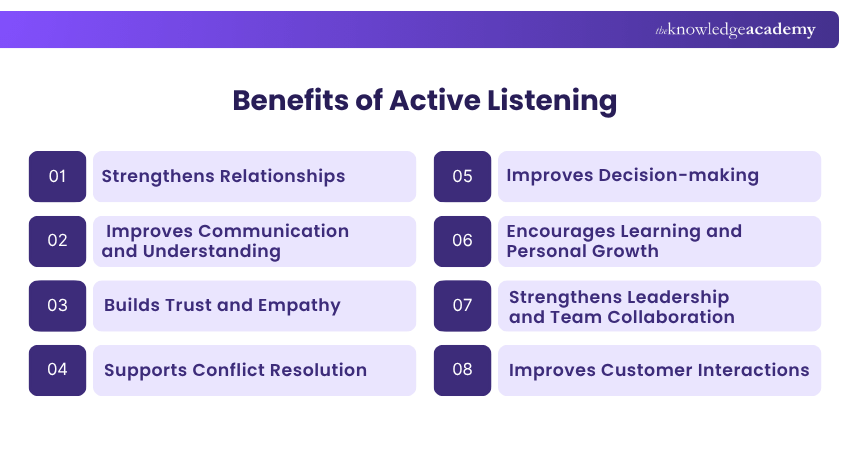
1) Strengthens Relationships
Active Listening strengthens relationships by showing people that their thoughts, feelings and perspectives are valued. Giving someone your full attention can encourage more open and meaningful conversations.
This applies across friendships, families, and professional relationships. Listening without constantly interrupting or dismissing another person can create stronger connections and improve mutual understanding.
Trainer's Insight
Active Listening does not require you to agree with another person. The goal is to understand their message and perspective accurately before deciding how to respond.
2) Improves Communication and Understanding
Active Listening improves communication by helping people understand the complete message before responding. Paying attention, asking relevant questions, and avoiding assumptions can reduce misunderstandings.
Techniques such as clarification, paraphrasing, and summarising can confirm whether the speaker's intended meaning has been understood. This is especially useful when conversations involve complex or sensitive information.
3) Builds Trust and Empathy
Active Listening helps people understand situations from another person's point of view, not just what they're saying, but why they might see it differently. This kind of perspective-taking builds empathy, since it requires setting aside an immediate reaction in favour of genuinely trying to understand someone else's reasoning or experience.
This does not require agreement. Someone can fully understand why a colleague feels frustrated about a decision, for example, without needing to think the frustration is justified. The value lies in the understanding itself, which often changes how a conversation unfolds next.
4) Supports Conflict Resolution
Active Listening can make disagreements more constructive by helping people understand each other's concerns before attempting to find a solution. It can reveal misunderstandings, underlying interests and areas of common ground.
During conflict, people often focus on defending their own position. Listening to understand rather than immediately persuade can improve information exchange and create a stronger basis for resolving disagreements.
Pro Tip
When a disagreement begins, resist jumping immediately to a solution. First clarify what each person is concerned about. Solving the wrong problem rarely resolves the real disagreement.
5) Improves Decision-making
Active Listening can support better decision-making by helping people gather information and consider different perspectives before reaching a conclusion. This is particularly useful when decisions involve several stakeholders or areas of expertise.
For example, leaders can listen to people working directly with an issue to identify risks, constraints or alternatives they may not have considered. This creates a broader information base for making informed choices.
Communicate with clarity and influence with confidence by joining the Communication and Influencing Skill Training now!
6) Encourages Learning and Personal Growth
Active Listening encourages learning by helping people remain open to new information, feedback and different perspectives. It can be especially valuable when learning from experienced individuals or receiving constructive feedback.
Instead of listening only for ideas that confirm existing beliefs, Active Listening encourages curiosity and thoughtful questioning. This can help individuals identify new insights, challenge assumptions, and support continued personal development.
7) Strengthens Leadership and Team Collaboration
Active Listening helps leaders understand employee concerns, ideas and feedback. By listening attentively, leaders can gather useful information while demonstrating that team members' contributions are valued.
Within teams, Active Listening can also improve collaboration by encouraging clearer information sharing and consideration of different viewpoints. This can help teams coordinate work, identify problems and approach decisions more constructively.
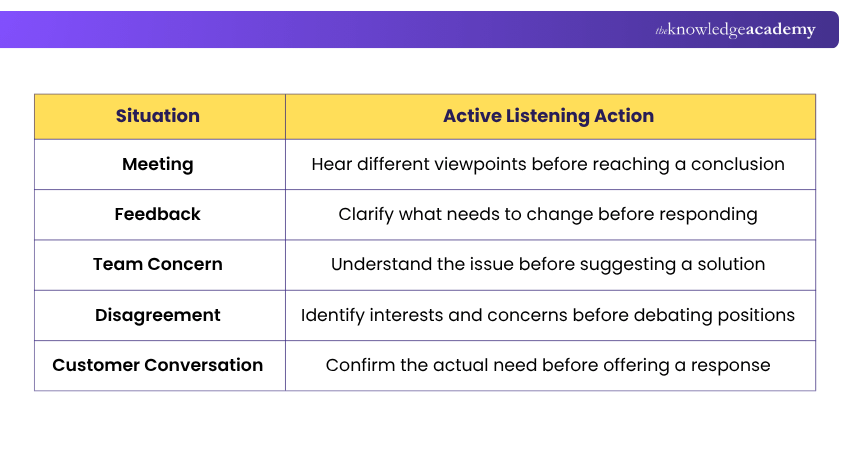
8) Improves Customer Interactions
Active Listening helps customer-facing professionals understand what customers need before offering a response or solution. This is particularly important when customers are explaining complex problems or service concerns.
Listening carefully, clarifying the issue and acknowledging the customer's concerns can reduce misunderstandings and unnecessary repetition. It also creates a stronger basis for providing a relevant and appropriate response.
Quick Active Listening Check
Before responding, ask yourself:
□ Did I let the person finish?□ Did I understand their main point?□ Did I avoid making assumptions?□ Did I clarify anything unclear?□ Am I responding to what they said?
Ways to Improve Active Listening
Active Listening is a skill that gets stronger with practice. Here are some simple ways to build it:
a) Remove Distractions Before Listening: Put the phone away, close other tabs, and turn to face the person speaking. A distracted mind can't fully take in what someone is saying.
b) Let the Other Person Finish Before Responding: Avoid jumping in or planning a reply while they're still talking. Wait until they've said what they need to say.
c) Ask Open Questions Instead of Closed Ones: Instead of asking "Did that upset you?", try asking "How did that make you feel?" Open questions invite a fuller answer and show real interest.
d) Paraphrase to Show You Understood: Repeat back what you heard in your own words, like "So what you're saying is..." This confirms you got it right and gives the other person a chance to correct any misunderstanding.
e) Pay Attention to Tone and Body Language: Words are only part of the message. Notice how something is said, not just what is said, since tone and posture often reveal more than words alone.
f) Pause Before Reacting, Especially When Upset: Take a breath before responding, particularly during a disagreement. A short pause can stop a reaction from making things worse.
Conclusion
The Benefits of Active Listening extend across personal and professional communication by strengthening relationships. Whether communicating with colleagues, teams or customers, making a genuine effort to understand before responding can lead to clearer, respectful and productive interactions. It's a skill that costs nothing to practise, yet consistently changes how conversations unfold.
Turn self-improvement into real-life impact by signing up for the Personal Development Courses today!
Frequently Asked Questions
What are the Main Signs That Someone is Actively Listening?

Common signs include maintaining appropriate attention, avoiding unnecessary interruptions, asking relevant questions, paraphrasing important points and responding to what the speaker has said. Non-verbal behaviour can also signal attention, although appropriate cues vary between individuals, cultures and communication settings.
Is Active Listening the Same as Agreeing With Someone?
No, you can understand another person's argument while still disagreeing with it. Active Listening requires accurate understanding and engagement, not automatic agreement.
Can Active Listening be Used in Virtual Meetings?
Yes, the same core principles apply in online communication. Focus on the speaker, minimise avoidable distractions, allow them to finish, ask clarifying questions and confirm important information. Since some non-verbal cues may be harder to interpret online, verbal clarification can become particularly valuable.

The Knowledge Academy


Global Training Provider
The Knowledge Academy is a world-leading provider of professional training courses, offering globally recognised qualifications across a wide range of subjects. With expert trainers, up-to-date course material, and flexible learning options, we aim to empower professionals and organisations to achieve their goals through continuous learning.


 If you wish to make any changes to your course, please


