




We may not have the course you’re looking for. If you enquire or give us a call on 01344203999 and speak to our training experts, we may still be able to help with your training requirements.
Types of Sales Tools Explained with Examples
ByThe Knowledge AcademyLast updated on: 24 November 2026
Discover the different types of sales tools and how they help businesses manage customer relationships, generate leads, automate communication, and track sales performance. Explore nine essential categories, popular software examples, and practical tips for choosing tools that support your sales process.

Quick Preview
1. CRM Software: Organise customer information, manage opportunities, and track sales pipelines.2. Sales Analytics: Measure performance, analyse trends and support revenue forecasting.3. Lead Generation: Capture leads, identify potential customers and build targeted prospect lists.4. Communication and Engagement: Manage sales conversations, outreach and follow-ups.5. Automation and AI: Automate repetitive tasks and provide insights to support sales decisions.
Imagine starting your sales day with everything already organised. Your leads are prioritised, follow-up reminders are ready, customer conversations are documented, and sales reports are available without manually updating spreadsheets.
Behind this organised workflow are different sales tools, each handling a specific part of the process. From Customer Relationship Management (CRM) platforms to AI-powered sales assistants, these tools help teams manage their activities more efficiently. Let's explore the different types and their uses.
Types of Sales Tools
Different types of sales tools serve different purposes throughout the sales cycle. Some platforms cover multiple functions, so the following categories group tools according to their primary uses.
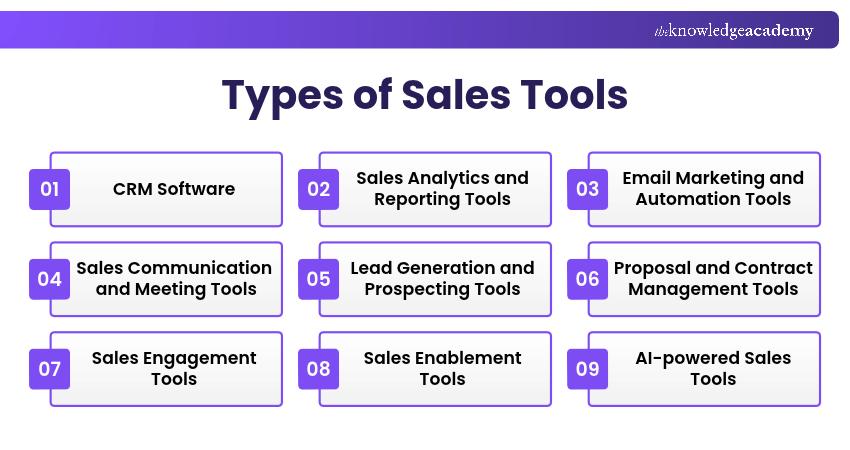
1) CRM Software
Customer Relationship Management (CRM) software helps businesses organise and manage interactions with customers. It provides a central location for storing customer details, tracking opportunities, and monitoring sales activities.
CRM systems also support pipeline management, reporting and workflow automation, allowing sales teams to maintain visibility into customer relationships and sales opportunities.
a) Salesforce
Salesforce is a widely used CRM platform offering lead management, contact management, opportunity tracking, and workflow automation. It also provides extensive customisation capabilities and integrations with other business applications.
Businesses can configure Salesforce to support different sales processes, making it suitable for organisations with complex requirements.
b) HubSpot CRM
HubSpot CRM offers features such as contact management, deal tracking, and pipeline management. Its accessible interface makes it useful for businesses looking to organise customer information and coordinate sales activities.
HubSpot also offers a free CRM option, while more advanced automation, reporting, and sales capabilities depend on the selected subscription.
c) Zoho CRM
Zoho CRM offers contact management, sales pipeline tracking, workflow automation, and reporting capabilities. It is particularly relevant for businesses seeking configurable CRM functionality.
The platform also integrates with applications such as Microsoft 365 and Google Workspace to support connected workflows.
d) Microsoft Dynamics 365 Sales
Microsoft Dynamics 365 Sales provides tools for managing customer relationships, sales opportunities, and sales performance.
It integrates with the wider Microsoft ecosystem and offers capabilities for sales forecasting, reporting and AI-assisted insights, depending on licensing and configuration.
Learn to manage sales pipelines effectively with the Microsoft Dynamics 365 Training – Register now!
e) Pipedrive
Pipedrive focuses on visual sales pipeline management. Sales teams can organise deals, track activities, set reminders, and monitor progress through different pipeline stages.
Its customisable pipelines and reporting tools help businesses maintain visibility into ongoing sales opportunities.
2) Sales Analytics and Reporting Tools
Sales analytics and reporting tools help businesses evaluate sales performance, identify trends and make better decisions using data from different sources.
These platforms support revenue analysis, conversion tracking, customer behaviour analysis and performance reporting. Some can also support forecasting when connected to suitable sales data and forecasting models.
a) Google Analytics 4
Google Analytics 4 (GA4) helps businesses analyse customer activity across websites and apps, providing insights into user behaviour and engagement.
It uses event-based tracking to measure activities such as page visits, form submissions and purchases. Businesses can identify important actions as key events and use these insights to evaluate digital marketing performance and lead generation.
b) Tableau
Tableau is a business intelligence and data visualisation platform that helps organisations analyse information from multiple sources.
Sales teams can use it to create dashboards, compare revenue trends, evaluate sales performance and identify patterns in customer or market data. Its forecasting capabilities can also support trend-based analysis when appropriate historical data is available.
c) Looker
Looker is a Business Intelligence (BI) platform that helps organisations analyse data through governed reporting, interactive dashboards and reusable data models.
Businesses can connect Looker to supported data sources to examine sales trends, evaluate revenue performance and maintain consistent reporting metrics across teams.
d) Microsoft Power BI
Microsoft Power BI helps businesses analyse data from various sources and present insights through interactive reports and visualisations.
Sales teams can connect CRM data, spreadsheets and other supported systems to monitor revenue, track pipeline performance and analyse sales trends. Its data modelling and reporting capabilities can also support forecasting analysis.
e) Domo
Domo is a cloud-based data analytics platform that combines data integration, reporting and visualisation capabilities.
Businesses can connect information from CRM systems, financial applications and other sources to monitor sales performance, evaluate trends and share insights through interactive dashboards.
f) Mixpanel
Mixpanel is a product analytics tool that helps digital businesses understand how users interact with websites and applications.
It provides funnel analysis, retention tracking and behavioural insights that can help organisations identify where potential customers disengage during digital journeys. It is particularly relevant to product-led businesses rather than traditional sales forecasting.

3) Email Marketing and Automation Tools
Email marketing tools help businesses communicate with prospects, nurture leads and support customer relationships through targeted campaigns.
These platforms offer features such as email templates, audience segmentation, automated sequences, and performance reporting.
a) Mailchimp
Mailchimp offers email campaign creation, audience management, and marketing automation capabilities.
Businesses can use its templates and reporting features to create campaigns, monitor engagement, and improve their email communication strategies.
b) Constant Contact
Constant Contact provides email marketing tools, customisable templates, audience management, and automation features.
It also offers event marketing capabilities, making it useful for businesses that regularly organise webinars and promotional events.
c) Brevo
Brevo, formerly Sendinblue, supports email marketing, transactional messaging and communication automation.
Its features include an email editor, audience segmentation and automated campaigns. Businesses can use it to manage customer communications across supported channels.
d) GetResponse
GetResponse combines email marketing with landing pages, automation workflows and webinar-related capabilities.
Businesses can use these features to capture leads, create automated customer journeys, and monitor campaign performance.
e) ActiveCampaign
ActiveCampaign helps businesses automate marketing activities and manage customer interactions to strengthen engagement.
It offers audience segmentation, email automation, and customer behaviour tracking, enabling businesses to create personalised communication workflows.
f) AWeber
AWeber provides email templates, autoresponders, and audience management features.
Its automation capabilities allow businesses to schedule follow-up messages and maintain communication with subscribers.
g) Kit
Kit, formerly ConvertKit, is an email marketing platform primarily designed for creators and audience-led businesses.
It offers email campaigns, subscriber segmentation, and visual automation workflows that support audience engagement and nurturing.
h) Drip
Drip focuses on email marketing automation for e-commerce businesses.
It enables retailers to create customer segments, track shopping behaviour and send automated messages based on activities such as abandoned carts.
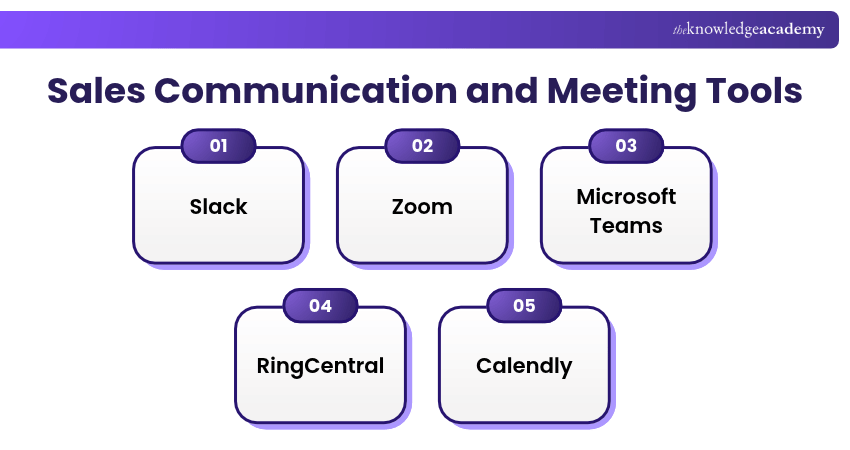
4) Sales Communication and Meeting Tools
Sales communication tools help teams coordinate internal activities and maintain direct communication with prospects and customers.
They support functions such as messaging, voice calls, video meetings, and information sharing. These capabilities are particularly useful for remote and hybrid sales teams.
a) Slack
Slack is a workplace collaboration platform that helps sales teams communicate through channels and direct messages.
Its integrations with business applications allow teams to receive updates, share information, and coordinate activities without constantly switching between platforms.
b) Zoom
Zoom provides video conferencing and online meeting capabilities for sales presentations, customer discussions, and product demonstrations.
Features such as screen sharing, meeting recording and scheduling integrations support remote sales communication.
c) Microsoft Teams
Microsoft Teams combines messaging, video meetings, calling and collaboration features within the Microsoft ecosystem.
Sales teams can use it to coordinate activities, share files, and conduct meetings while working with supported Microsoft 365 applications.
d) RingCentral
RingCentral provides cloud-based business communication solutions, including calling, messaging, and related communication capabilities.
It is useful for sales teams that depend on telephone conversations and need to manage customer communication across different devices.
e) Calendly
Calendly is an appointment scheduling platform that helps sales teams arrange meetings with prospects and customers.
It allows contacts to book available meeting slots, reducing repeated scheduling emails. Its routing capabilities can also qualify enquiries and direct suitable prospects to the appropriate Sales Representative, depending on the configuration.
5) Lead Generation and Prospecting Tools
Lead generation and prospecting tools help businesses attract potential customers, identify suitable prospects and collect information that supports sales outreach.
Some platforms focus on capturing enquiries through websites, while others support contact discovery, company research and prospect qualification. Understanding these differences helps sales teams select tools for their specific requirements.
a) HubSpot
HubSpot provides lead generation capabilities through website forms, landing pages and CRM integrations.
Businesses can capture prospect information, track interactions and organise leads within their CRM. Its data enrichment capabilities can also add supported contact and company information, while eligible scoring and automation features help teams prioritise follow-ups.
b) OptinMonster
OptinMonster is a lead capture and conversion optimisation platform that helps businesses collect enquiries from website visitors.
It offers pop-ups, targeted forms, behavioural triggers and A/B testing capabilities. Businesses can use these features to encourage relevant visitors to submit their details and enter lead nurturing workflows.
c) LinkedIn Sales Navigator
LinkedIn Sales Navigator helps sales professionals identify and research potential B2B customers through advanced lead and account searches.
Its search filters, saved leads and account insights support targeted prospecting and relationship-building activities.
d) Hunter.io
Hunter.io helps businesses discover and verify professional email addresses associated with companies and domains.
Sales teams can use it to find relevant business contacts and check email addresses before beginning outreach.
6) Proposal and Contract Management Tools
Proposal and contract management tools help businesses prepare sales documents, manage approvals, and collect electronic signatures.
They streamline administrative activities during the final stages of the sales cycle and improve visibility into document progress.
a) PandaDoc
PandaDoc provides document creation, proposal templates, and electronic signature capabilities.
Businesses can create professional proposals, configure document workflows, and monitor customer interactions with shared documents.
b) Docusign
Docusign offers electronic signature and agreement management capabilities.
Its features include document routing, signature collection, and integrations with business applications. The legal validity of electronic signatures depends on applicable laws and the type of agreement.
c) Proposify
Proposify helps businesses create, send and manage sales proposals. It offers customisable templates, document tracking, and proposal analytics that help sales teams monitor customer engagement.
d) Adobe Acrobat Sign
Adobe Acrobat Sign provides electronic signature workflows and document management capabilities.
It integrates with supported business applications and helps organisations manage document approvals and signing activities.
Acquire skills to automate document workflows with our Adobe Acrobat Training – Join now!
e) Dropbox Sign
Dropbox Sign, formerly HelloSign, offers electronic signature functionality for business documents.
It provides reusable templates, signature requests, and integrations that help businesses simplify agreement workflows.
f) Concord
Concord is a contract lifecycle management platform that supports document collaboration, approval workflows and contract tracking.
Its capabilities help businesses organise agreements, manage contract-related activities and maintain visibility throughout the contract lifecycle.
g) ContractSafe
ContractSafe provides contract storage, search and management functionality. It helps businesses organise agreements, control access, and track important contract dates.
h) Qwilr
Qwilr enables businesses to create interactive, web-based proposals and sales documents. Its features include configurable pricing, document engagement insights, and integrations with supported business platforms.
7) Sales Engagement Tools
Sales engagement tools help businesses organise and manage interactions with prospects across different communication channels.
Unlike general email marketing platforms, these tools focus on sales outreach activities, including personalised contact sequences, follow-ups, and engagement tracking.
a) Outreach
Outreach provides sales engagement and workflow capabilities that help teams organise prospect communication. Its features support outreach sequences, activity management, and sales execution workflows.
b) Salesloft
Salesloft helps sales teams manage prospect interactions, organise communication activities, and maintain consistent follow-up processes.
It also offers capabilities for analysing sales activities and supporting revenue workflows.
c) Mailshake
Mailshake focuses on outbound prospecting and sales outreach. It provides email sequencing, personalisation and follow-up automation features that help teams manage prospect communication at scale.
8) Sales Enablement Tools
Sales enablement tools help sales professionals access the content, guidance and training resources needed to engage effectively with potential customers.
These platforms support sales content management, coaching and consistent communication throughout the sales process. They also help organisations keep customer-facing materials organised and accessible.
a) Highspot by Seismic
Highspot by Seismic is a sales enablement platform that helps businesses organise sales content, support coaching and improve sales execution.
It enables sales professionals to access relevant resources, share approved materials and receive guidance during customer interactions. Following the merger between Highspot and Seismic in August 2026, Highspot operates as part of the combined Seismic organisation.
b) Seismic
Seismic is a sales enablement platform that supports content management, personalisation, training and customer engagement.
Businesses can use it to distribute approved sales materials, support professional development and deliver consistent information across customer-facing teams. Seismic and Highspot are now part of the same organisation, although their platforms continue to serve customers.
c) Showpad
Showpad provides sales enablement capabilities that help businesses organise content, support sales training and deliver relevant resources during customer interactions.
Sales professionals can use the platform to access presentations, product information and supporting materials, helping them communicate consistently with potential customers.
9) AI-powered Sales Tools
AI-powered sales tools help businesses automate repetitive activities, analyse customer information and support sales decisions.
These tools use technologies such as Machine Learning (ML), Natural Language Processing (NLP) and Generative AI to support tasks such as prospecting, communication, sales analysis and customer engagement. Their capabilities vary from specialised sales intelligence software to general-purpose AI assistants.
a) Gong
Gong is a revenue intelligence platform that analyses customer interactions and sales conversations to provide insights into deal progress and sales performance.
Its conversation intelligence capabilities help sales teams identify customer concerns, evaluate engagement and review opportunities for coaching. Businesses can use these insights to improve sales execution and understand potential deal risks.
b) Salesforce Agentforce
Salesforce Agentforce provides AI-powered agents that support sales activities within the Salesforce ecosystem.
Its sales capabilities include prospect research, lead engagement and pipeline-related workflows. Depending on the configuration and available features, businesses can use AI agents to automate selected sales activities and assist representatives with customer information and follow-ups.
c) HubSpot Breeze
HubSpot Breeze provides AI-powered assistants and agents across supported HubSpot applications, including sales and marketing.
Its prospecting capabilities help sales teams research potential customers, identify relevant buying signals and prepare personalised outreach. Businesses can use these features to reduce manual research and support more targeted sales engagement.
d) ChatGPT
ChatGPT is a general-purpose AI assistant that can help sales professionals prepare communications, research questions and sales materials.
Businesses can use it to draft prospecting emails, develop sales scripts, summarise meeting notes and analyse appropriately shared sales information. Unlike dedicated sales platforms, its integration with CRM data and sales workflows depends on the tools, permissions and configurations available.
Learn about chatbot customisation and deployment with our ChatGPT Course – Join now!
How to Choose the Right Sales Tools?
Choosing appropriate sales tools requires understanding business requirements, existing processes, and the activities that need improvement. Consider the following factors before introducing new software:
Title: Ways to Choose the Right Sales Tools
1) Identify Your Sales Requirements: Determine which activities require additional support, such as lead generation, pipeline tracking, communication, or forecasting. This helps narrow the selection to relevant tool categories.
2) Evaluate Integration Capabilities: Check whether the software integrates with existing CRM platforms, email applications, and reporting systems. Connected tools help reduce duplicate data entry and fragmented workflows.
3) Consider Usability: Choose tools that match your team's technical capabilities and daily responsibilities. An intuitive interface and suitable training resources can make adoption easier.
4) Assess Scalability: Consider whether the platform can support additional users, data volumes, and workflows as the business grows. Review subscription limits and available features before making a decision.
5) Review Security and Costs: Evaluate data protection controls, access permissions and relevant compliance requirements. Compare total costs, including subscriptions, implementation, integrations, and ongoing administration.
6) Test Before Implementation: Where possible, use demonstrations or trial access to evaluate the software against real sales activities. Gather feedback from the people who will use the platform regularly.
Pro Tip
Start with tools that address your most important sales challenges. Add specialised software only when it provides a clear improvement over existing capabilities.
Strengthen sales planning and team performance with our Sales Management Training – Sign up today!

The Knowledge Academy develops accessible learning content across Project Management, IT, Cybersecurity, Data Science, Business Analysis, HR, Accounting and Finance, Leadership and Health and Safety. Its resources combine subject research with clear explanations to help professionals build practical knowledge across a wide range of disciplines.
View Detail

 If you wish to make any changes to your course, please


