


We may not have the course you’re looking for. If you enquire or give us a call on 01344203999 and speak to our training experts, we may still be able to help with your training requirements.
Best Tools for Psychologists: A Complete Guide
ByThe Knowledge AcademyLast updated on: 11 September 2026
Discover essential tools for Psychologists that can simplify daily tasks, support client care, and improve professional practice.
Imagine a Psychologist preparing for three very different tasks:
One client requires a cognitive assessment.
Another needs support with changing unhelpful thought patterns.
Later that day, the Psychologist needs to analyse responses collected for a research study.
Would the same tool work for all three situations? Probably not.
Psychology involves assessment, intervention, research and ongoing professional practice. Each activity requires tools suited to a particular purpose. Some help assess cognitive abilities or personality characteristics, while others support therapy, research or digital workflows.
In this blog, we explore some of the best Psychological Tools, what they are designed to do and how Psychologists can select suitable tools for different professional needs. Let's dive in!
What are Psychological Tools?
Psychological Tools are instruments, techniques and methods used by Psychologists to understand behaviour, assess psychological functioning, support interventions and conduct research. They can range from standardised assessments and structured interviews to therapeutic techniques, surveys and experimental methods.
Not every tool serves the same purpose. For example, an intelligence assessment measures different characteristics from a personality inventory, while a research survey serves a different purpose from a therapeutic technique.

Psychological Assessment Tools
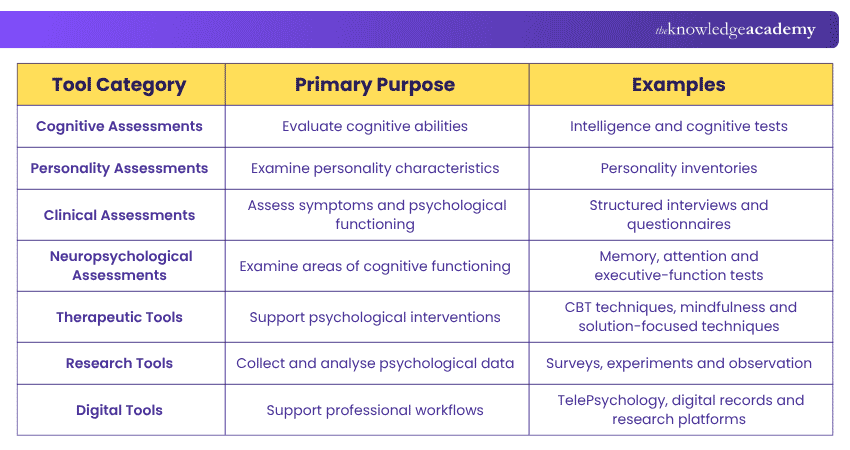
Psychological assessment tools help professionals systematically collect information about an individual's cognitive abilities, personality, behaviour or psychological functioning. Different assessment tools answer different questions, so understanding their purpose is important when selecting one:
1) Intelligence and Cognitive Assessments
Intelligence and cognitive assessments are designed to evaluate different aspects of cognitive functioning. Depending on the assessment, these can include areas such as reasoning, processing speed, working memory and verbal comprehension.
The Wechsler Adult Intelligence Scale (WAIS) and Wechsler Intelligence Scale for Children (WISC) are good examples. These assessments can provide structured information about an individual's cognitive strengths and difficulties when used and interpreted appropriately.
2) Personality Assessments
Personality assessments are used to examine patterns of personality characteristics, behaviour and psychological functioning. One key example is the Minnesota Multiphasic Personality Inventory (MMPI), used to assess personality characteristics and psychopathology. Personality assessments may be used alongside interviews, observations and other sources of information rather than being considered in isolation.
3) Clinical and Diagnostic Assessments
Clinical assessment can involve structured or semi-structured interviews, questionnaires and other assessment methods that help professionals gather information about psychological symptoms and functioning.
The Structured Clinical Interview for DSM-5 Disorders (SCID-5) is one example of an assessment used to support diagnosis. Such tools can contribute to a broader assessment process that informs clinical understanding and treatment planning.
4) Neuropsychological Assessments
Neuropsychological assessment examines cognitive functioning in areas that may include memory, attention, language, processing speed and executive functioning. Rather than relying on one test alone, an assessment may involve several measures selected according to the referral question and the individual's circumstances.
Trainer's Pro Tip
Do not select an assessment simply because it is widely used. Consider what it measures, its intended population and purpose, and whether you have the appropriate professional competence to administer and interpret it.
Therapeutic Tools and Techniques
Psychologists may also use therapeutic techniques to support clients experiencing psychological or behavioural difficulties. These techniques can aim to facilitate insight, support behavioural change, develop coping skills and improve psychological well-being. The appropriate technique depends on the therapeutic approach, the client's circumstances and the goals of intervention.
1) Cognitive Behavioural Therapy (CBT) Techniques
Cognitive Behavioural Therapy (CBT) focuses on relationships between thoughts, emotions and behaviours. Techniques can include:
a) Cognitive restructuring which involves identifying and challenging unhelpful thinking patterns.
b) Exposure-based techniques which can involve gradual and structured engagement with feared situations or stimuli.
These techniques are applied according to the individual's needs and treatment goals.
2) Psychodynamic Techniques
Psychodynamic approaches explore how unconscious processes, relationships and past experiences may influence current emotions and behaviour. Techniques can include:
a) Free association, in which clients communicate thoughts and feelings openly.
b) Dream exploration as part of understanding psychological processes.
The broader objective is to help individuals develop greater awareness of recurring emotional and behavioural patterns.
3) Mindfulness-based Interventions
Mindfulness-based interventions encourage individuals to direct attention towards present experiences with awareness and reduced judgement. Mindfulness meditation is one example. Additionally, Acceptance and Commitment Therapy (ACT) can involve accepting difficult thoughts and feelings while taking actions consistent with personal values. These approaches can help develop psychological flexibility and awareness.
4) Solution-focused Techniques
Solution-Focused Brief Therapy (SFBT) concentrates on desired outcomes, strengths and practical steps towards change rather than focusing solely on problems. Psychologists using this approach may help individuals identify what is already working, explore exceptions to difficulties and establish achievable goals.
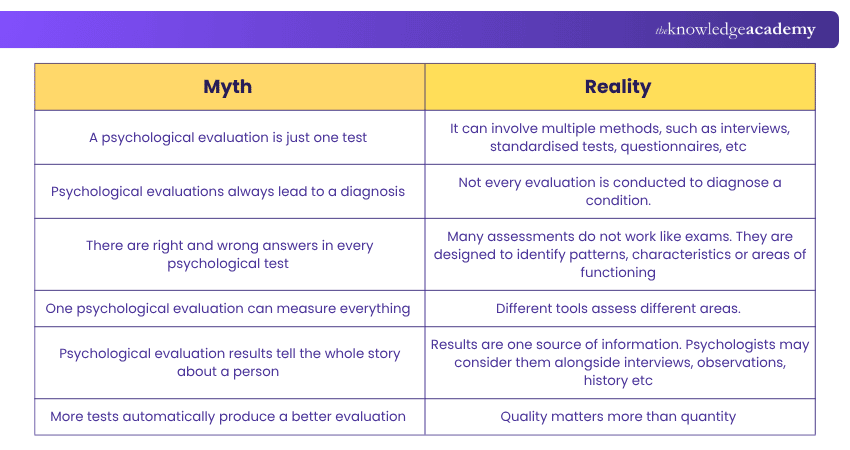
Here are some myths and realities to simplify the complex field of psychological evaluations:
Research Tools for Psychologists
Psychological research requires systematic methods for collecting, measuring and interpreting information. Here are some common research tools:
1) Surveys and Questionnaires
Surveys and questionnaires allow Researchers to collect structured information about attitudes, beliefs, experiences and behaviours from individuals or groups. Researchers need to consider how questions are constructed, how participants are sampled and how responses will be analysed. They can be particularly useful when Researchers need to gather comparable responses from many participants.
2) Experimental Design
Experimental design is used to investigate potential cause-and-effect relationships. Researchers manipulate an independent variable and examine its effect on a dependent variable while attempting to control other relevant factors. Randomisation and control groups may also form part of experimental designs. This approach enables Researchers to investigate how particular factors may influence behaviour or cognition systematically.
Take a deep dive into the fascinating science behind human interactions with our Social Psychology Training - Sign up now!
3) Observation Methods
Observation involves systematically recording behaviours, interactions or events. Depending on the research question, observation may take place in natural settings or more controlled environments. Researchers can establish clear criteria beforehand so that relevant behaviours are recorded consistently.
4) Data Analysis and Statistical Tools
Once psychological data has been collected, Researchers need methods for organising, analysing and interpreting it. Descriptive statistics can summarise characteristics of a dataset, while inferential statistical techniques can help Researchers examine relationships, differences or patterns and draw conclusions from sample data.
Trainer's Pro Tip
Let the research question determine the tool. Surveys, observations and experiments answer different types of questions, so choose the method after defining what you need to investigate.
Digital Tools for Psychologists
Digital technology can support many aspects of psychological practice and research. Rather than replacing professional judgement, these tools can make activities such as communication, record management, data collection and research more efficient.
1) TelePsychology and Communication Tools
Secure video and communication platforms can support remote psychological services where telePsychology is appropriate. When selecting these tools, professionals should consider confidentiality, privacy, security and any relevant professional or regulatory requirements.
2) Digital Record and Practice Management Tools
Practice management systems can help organise activities such as appointments, client records, documentation and administrative workflows. Digital systems may make information easier to organise and retrieve, but Psychologists need to consider how sensitive information is stored, accessed and protected.
3) Digital Assessment and Research Platforms
Digital platforms can also support questionnaires, research surveys, data collection and, where appropriate, psychological assessment. The suitability of a digital platform depends on its intended purpose and how information is collected, stored and interpreted.
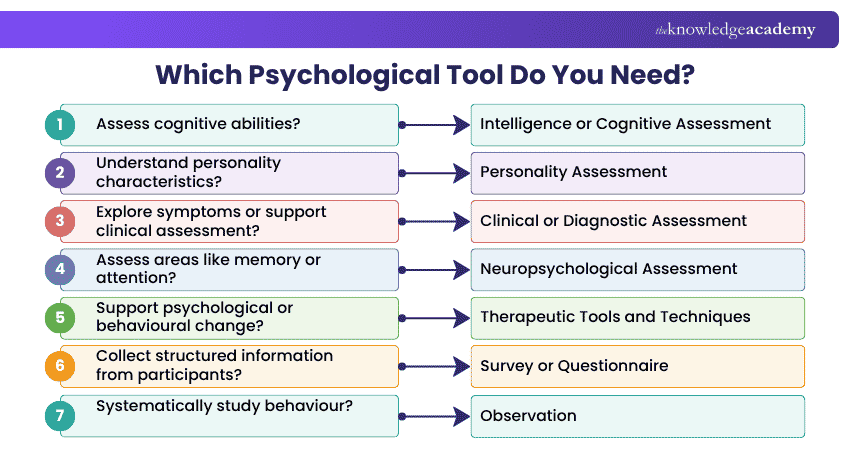
How to Choose the Right Psychological Tool?
There is no single Psychological Tool that is suitable for every task. Selection should begin with a clear understanding of what the Psychologist wants to assess, investigate or achieve. Consider the following before choosing a tool:
1) Purpose: What question should the tool help answer?
2) Evidence: Is there appropriate evidence supporting its use?
3) Reliability: Does the assessment produce sufficiently consistent results for its intended purpose?
4) Validity: Does it appropriately measure what it claims to measure?
5) Population: Is it suitable for the person or group with whom it will be used?
6) Professional competence: Does its use require specific qualifications, training or experience?
7) Ethical considerations: Are consent, confidentiality and appropriate use adequately addressed?
8) Practical requirements: Consider factors such as administration, accessibility, time and resources.
Build the knowledge that supports healthier minds with our Mental Health Courses – Sign up now!

The Knowledge Academy develops accessible learning content across Project Management, IT, Cybersecurity, Data Science, Business Analysis, HR, Accounting and Finance, Leadership and Health and Safety. Its resources combine subject research with clear explanations to help professionals build practical knowledge across a wide range of disciplines.
View Detail

 If you wish to make any changes to your course, please


