


We may not have the course you’re looking for. If you enquire or give us a call on 01344203999 and speak to our training experts, we may still be able to help with your training requirements.
Top Group Discussion Tips to Ace Your Interview
ByThe Knowledge AcademyLast updated on: 14 November 2026
Explore practical group discussion tips to improve your communication, build confidence, express ideas effectively and stand out during the interview selection process.
Quick Look
1. Group discussions assess how candidates communicate, listen, collaborate and approach problems.2. Speaking first or contributing the most does not necessarily lead to better performance.3. Clear arguments, relevant examples and active listening help candidates make meaningful contributions.4. Respectful disagreements, effective time management and inclusive participation support productive discussions.5. Preparing for different topics, staying composed and summarising key points can help candidates perform confidently.
The topic is announced. The timer starts. Ten candidates. One discussion. Everyone wants to make an impression.
Some speak immediately. Others wait for the right moment. A few struggle to get their points across. But here's the question: Does speaking the most mean performing the best?
Not necessarily. Group discussions are about more than expressing opinions. They also reveal how well you listen, think critically and work with others. In this blog, we'll explore practical group discussion tips to help you participate effectively and make a positive impression during interviews.
Top 12 Group Discussion Tips
Group discussions are commonly used in assessment centres and certain recruitment processes to evaluate how candidates interact, solve problems and work together. Employers may assess communication, teamwork, negotiation, reasoning and time management rather than simply looking for the most outspoken candidate.
Here are 12 practical group discussion tips to help you prepare and perform effectively:
1) Prepare Thoroughly
In any interview, preparation is important, and group discussions are no exception. Start by researching common discussion topics, industry developments and current affairs relevant to the position you're applying for.
Understand different perspectives, gather reliable information, and practise presenting well-supported viewpoints. Think ahead about potential arguments that might arise during discussions. This will help you respond thoughtfully and contribute more effectively.
Practise analysing unfamiliar topics under time limits, identifying the main issue, considering different viewpoints and organising your arguments quickly. This can help you prepare for exercises where the discussion topic is revealed only during the assessment.

2) Initiate the Discussion
Initiating a discussion confidently can create a positive first impression. However, speaking first is not always necessary. A thoughtful contribution at the right moment can be more valuable than rushing to start.
Here are some strategies for initiating a group discussion effectively:
a) Be Proactive: If you understand the topic, begin with a clear introduction that establishes the main issue without dominating the conversation.
b) Pose a Thoughtful Question: Start with a relevant question that encourages different perspectives and provides a meaningful direction for the discussion.
c) Share a Relevant Example: Introduce a practical example or real-life situation that helps participants connect with the topic.
d) Clarify the Objective: If the exercise involves solving a problem or reaching a decision, help the group identify its goal before exploring possible solutions.
For example, if the discussion is about remote working, you could begin with:
“Remote working offers flexibility, but it also creates communication challenges. Should we explore both perspectives before reaching a conclusion?”
3) Structure Your Points
Presenting your thoughts in a clear and organised manner is essential during a group discussion. Before speaking, take a moment to organise your ideas and consider how they relate to the topic.
Present your arguments in a logical sequence rather than introducing several unrelated points at once. A structured explanation makes it easier for others to understand your reasoning and respond constructively.
You can use the PREP technique to organise your contributions:
a) Point: Clearly state your opinion.
b) Reason: Explain why you hold that viewpoint.
c) Example: Support your argument with a relevant example.
d) Point: Reinforce your main argument briefly.
For example, when discussing workplace automation:
“Automation can improve workplace productivity because it reduces repetitive manual work. For instance, automated reporting tools help teams spend less time preparing routine reports. Therefore, automation can free up time for more valuable activities.”
4) Practise Active Listening
Active listening is an important part of effective communication in group discussions. It involves understanding what others are saying rather than simply waiting for an opportunity to speak.
Here's how you can improve this skill:
a) Engage With the Speaker: Pay attention to the ideas being presented and avoid distractions. Focus on understanding the speaker's main argument.
b) Avoid Interrupting: Allow others to finish their thoughts before responding. This demonstrates patience and respect.
c) Ask Clarifying Questions: If something is unclear, politely request clarification. This can help prevent misunderstandings and improve discussion.
d) Build on Previous Contributions: Refer to relevant points raised by others and explain how your ideas support or extend them.
For example:
“That's an interesting perspective on employee productivity. I'd also like to consider how team communication influences those results.”
By practising active listening, you create a collaborative environment and demonstrate your ability to engage thoughtfully with different perspectives.
5) Manage Time Wisely
Time management is crucial in group discussions, particularly when participants must reach a conclusion or complete a task within a limited period.
Keep track of the available time and ensure your contributions remain relevant to the discussion. If the conversation moves away from the main subject, politely help the group return to its objective.
When appropriate, suggest allocating time to understanding the problem, exploring different viewpoints and agreeing on an outcome. Avoid repeatedly checking the clock or assuming responsibility for controlling the entire discussion.
Trainer's insight
During a timed group exercise, a useful contribution might be: “We have a few minutes remaining. Shall we identify the strongest recommendations and agree on our final response?”
Develop practical planning and prioritisation skills with our Time Management Training - Register now!
6) Communicate Effectively
Clear and concise communication is fundamental to making a meaningful contribution during a group discussion.
Express your thoughts using straightforward language and avoid unnecessary jargon or complicated explanations. Speak at a comfortable pace and ensure each contribution adds something relevant to the conversation.
When explaining complex ideas, use short examples to make your arguments easier to understand. Avoid repeating the same point simply to increase your speaking time.
7) Pay Attention to Your Body Language
Your non-verbal communication can influence how others perceive your engagement during a group discussion. Appropriate body language can support your spoken contributions and help create a positive atmosphere.
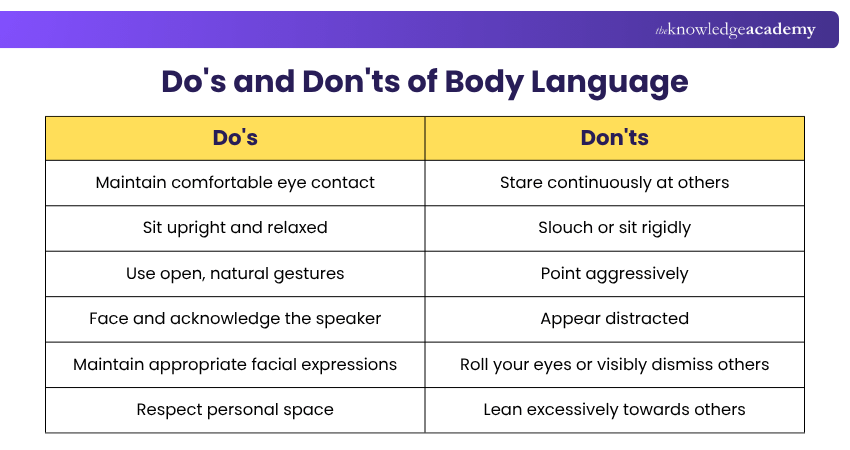
Here's how to use body language effectively:
a) Maintain Natural Eye Contact: Look towards the people you're addressing without staring continuously. Adapt your eye contact to what feels comfortable and appropriate.
b) Adopt a Comfortable Posture: Sit in a relaxed but attentive position that allows you to engage naturally with the discussion.
c) Gesture Mindfully: Use natural hand movements to emphasise important points without distracting others.
d) Show Attentiveness: Face the discussion and use appropriate facial expressions or small acknowledgements when listening.
e) Respect Personal Space: Avoid leaning excessively towards other participants or making gestures that could appear confrontational.
8) Moderate Your Tone
The tone of your voice can greatly influence the dynamics of a group discussion. Show confidence but avoid appearing overly authoritative or aggressive.
Maintain a calm and composed tone, even when discussing sensitive or contentious topics. A measured approach helps you express your ideas clearly while respecting different perspectives.
Avoid raising your voice or speaking over others to make yourself heard. Instead, use an appropriate volume and adjust your speaking pace when explaining important points.
For example, rather than saying:
“You're completely wrong. That approach will never work.”
Try:
“I understand your reasoning, but I see a potential challenge with that approach. Could we consider an alternative?”
9) Stay Calm Under Pressure
Interviews and group discussions can be nerve-racking, particularly when several candidates are competing for limited opportunities. Maintaining composure can help you organise your thoughts and respond more effectively.
Here are some practical techniques:
a) Take Controlled Breaths: If you feel nervous, slow your breathing and give yourself a moment to refocus.
b) Practise Positive Self-talk: Remind yourself of the preparation you've completed and focus on making useful contributions rather than speaking perfectly.
c) Concentrate on the Discussion: Pay attention to the topic and the task instead of constantly evaluating your own performance.
d) Avoid Rushed Responses: Take a brief moment to organise your thoughts before presenting your argument.
e) Accept Short Pauses: Don't feel compelled to fill every moment of silence. A thoughtful pause can help you formulate a clearer response.
10) Handle Disagreements Constructively
Disagreements are common in group discussions, particularly when participants approach the same problem from different perspectives.
When a disagreement arises, focus on understanding the opposing viewpoint before presenting your response. Look for areas of agreement and consider whether different ideas can be combined into a stronger solution.
Avoid making personal remarks or questioning another candidate's ability. Instead, evaluate the evidence, assumptions, and practical implications of the ideas being discussed.
For example:
“Your suggestion could reduce costs in the short term. However, I think we should also consider its long-term impact on customer satisfaction.”
Constructive disagreement can demonstrate reasoning, negotiation, and collaboration skills. It also helps the group examine alternatives without turning the discussion into a personal argument.
Approach complex conversations with confidence through our Managing Difficult Conversations Training – Sign up soon!
11) Summarise the Discussion When Appropriate
Finishing a group discussion effectively can help reinforce the main ideas and outcomes of the conversation. If the format allows participants to summarise, briefly recap the important points, areas of agreement, and any recommendations reached by the group.
For example:
“To summarise, we discussed the advantages and challenges of remote working. The group identified flexibility and reduced commuting as important benefits, while communication and collaboration remain key concerns. A hybrid approach emerged as one possible solution, although views differed on its implementation.”
12) Stay Informed
Being well-informed about current events and relevant industry topics is a valuable asset in group discussions. Make a habit of reading reputable newspapers, online news sources, and industry publications to understand emerging developments.
Focus on subjects that could be relevant to the organisation, industry, or job role you're applying for. These may include workplace technology, economic developments, sustainability, business ethics, or changing employment practices.
However, remember that not every group discussion focuses on general knowledge. Some recruitment exercises involve unfamiliar case studies or workplace scenarios where the ability to interpret information and solve problems is more important than prior knowledge.
Pro Tip
When researching a current topic, identify three things: the central issue, the arguments on both sides and the possible consequences. This helps you prepare balanced contributions rather than memorised speeches.
Turn every interview into an opportunity to showcase your strengths with Interview Skills Training – Join now!

The Knowledge Academy develops accessible learning content across Project Management, IT, Cybersecurity, Data Science, Business Analysis, HR, Accounting and Finance, Leadership and Health and Safety. Its resources combine subject research with clear explanations to help professionals build practical knowledge across a wide range of disciplines.
View Detail

 If you wish to make any changes to your course, please


