


 Top Rated Course

We may not have the course you’re looking for. If you enquire or give us a call on 01344203999 and speak to our training experts, we may still be able to help with your training requirements.
Self-Improvement Techniques: Strategies for Personal Growth
The Knowledge Academy 26 August 2026Self-Improvement Techniques can help individuals develop self-awareness, build positive habits, strengthen useful skills, and work towards meaningful personal growth.

Training Outcomes Within Your Budget!
We ensure quality, budget-alignment, and timely delivery by our expert instructors.
Table of Contents
Key Takeaways
1. Self-improvement is an ongoing process of developing personal qualities, behaviours, knowledge and skills.2. Different Self-Improvement Techniques can support areas such as self-awareness, emotional wellbeing, learning and healthy habits.3. A practical self-improvement plan turns broad intentions into specific goals and manageable actions.4. Progress can be affected by challenges such as unrealistic expectations, inconsistency and loss of motivation.5. Sustainable personal growth comes from making realistic changes and regularly reviewing what works for you.
What if becoming better did not mean changing everything about yourself?
Sometimes, personal growth starts with something much smaller: recognising a habit, changing how you respond to a setback, learning something new or making time to reflect.
Self-Improvement Techniques provide practical ways to turn that awareness into action, helping you work towards personal goals while developing a more intentional approach to growth.
What is Self-Improvement?
Self-improvement is the conscious, ongoing effort to develop personal qualities, skills, knowledge, behaviours or habits. It can involve setting goals, learning new abilities, reflecting on experiences and making purposeful changes.

Self-improvement can take place across different areas of life, including emotional wellbeing, physical health, relationships, learning and career development. It is not about becoming a completely different person, but about identifying areas where meaningful growth is possible.
Quick Check
Which area would you most like to improve right now?
A. My habits and routinesB. My confidence or mindsetC. My skills and knowledgeD. My physical or emotional wellbeing
Note: There is no wrong choice. Your answer can simply help identify where to begin.
Why Is Self-Improvement Important?
Self-improvement is a continuous process that can influence how individuals approach their personal and professional lives. It encourages people to take an active role in their own development and work towards meaningful change.
Key Benefits of Self-Improvement are:
1) Greater Self-Awareness: Recognise your strengths, weaknesses, behaviours and patterns.
2) Personal Confidence: Build confidence by making progress towards meaningful goals.
3) Better Adaptability: Develop the ability to respond effectively to change and challenges.
4) Improved Wellbeing: Support healthier physical, emotional and mental habits.
5) Stronger Relationships: Improve interactions through greater emotional and self-awareness.
6) Continuous Learning: Develop knowledge and skills for personal and professional growth.
Self-Improvement Techniques for Personal Growth
There is no single technique that works for everyone. The most useful approach is to choose techniques that match your goals, circumstances and areas for development.
The following Self-Improvement Techniques provide practical starting points for building self-awareness, managing challenges, developing healthier habits and continuing to learn.
1) Practise Self-Reflection
Self-reflection involves examining your thoughts, emotions, behaviours and decisions to understand yourself more clearly. It can help you identify strengths, recognise areas for development and understand patterns that may influence your choices.
Try this: At the end of the week, ask yourself: What worked? What did not? What would I do differently next time?
2) Practise Mindfulness
Mindfulness involves paying attention to the present moment with curiosity and acceptance. It can help you notice thoughts and feelings without immediately reacting to them.
The NHS describes mindfulness as paying attention to what is happening moment by moment and notes that it can help people understand themselves better and deal with issues more productively.
3) Develop a Growth Mindset
A growth mindset involves viewing abilities as capable of development through learning, practice and effort. This perspective can encourage people to treat challenges as opportunities to learn rather than as evidence that improvement is impossible.
Try this: Replace “I cannot do this” with “I cannot do this yet.”
4) Build Reappraisal Skills
Reappraisal involves reconsidering how you interpret a difficult situation rather than automatically accepting your first reaction. For example, a setback can be viewed as information that highlights what needs to change or improve.
Example:
Setback: “I failed at this.”
Reframe: “I now know what I need to practise.”
5) Keep a Journal
Journaling provides a structured way to record thoughts, experiences, goals and reflections. Regular writing can help you notice recurring patterns, clarify your thinking and identify areas where you want to make changes.
Begin with three questions:
What happened? → How did I respond? → What can I learn from it?
6) Recognise Your Strengths
Self-improvement does not have to focus entirely on weaknesses. Recognising existing strengths can help you understand what you already do well and consider how those qualities can be developed further.
Strengthen self-awareness, manage emotions and build more effective communication with our Emotional Intelligence Training- Sign up now!
7) Practise Gratitude
Keeping a gratitude journal can encourage you to notice positive experiences and aspects of your life that might otherwise be overlooked. The gratitude is identified as one of key approach to supporting personal growth and wellbeing.
8) Keep Learning
Reading, taking courses, learning a skill or exploring a new subject can introduce different perspectives and expand your knowledge. Reading is highlighted as a way to explore new ideas, challenge existing beliefs and nurture curiosity.
9) Try Something New
Doing something unfamiliar can encourage you to move beyond established routines and explore new experiences. It can also provide opportunities to practise adaptability, creativity and resilience.
10) Manage Your Digital Habits
Technology can support learning and productivity, but constant notifications and unnecessary screen time can also interrupt attention. Creating boundaries around device use can help you use technology more intentionally.
Trainer’s Pro Tip:
Choose one technique that matches your goal, practise it consistently, and give it time before trying another.
How to Create a Self-Improvement Plan
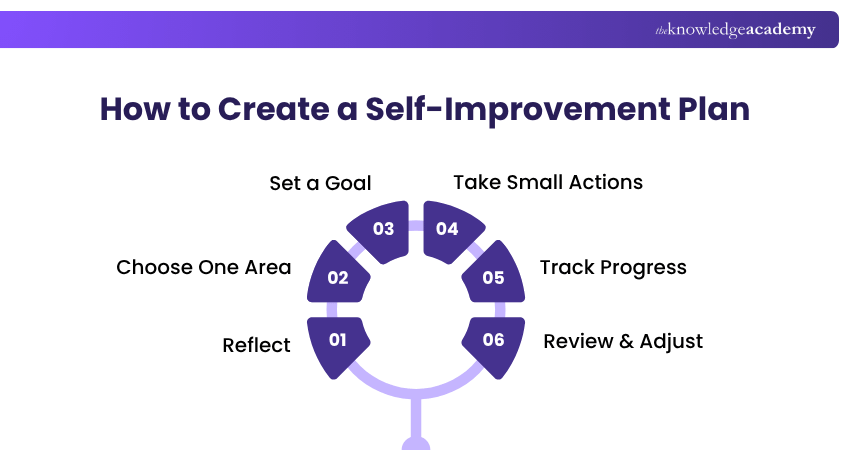
A self-improvement plan turns a general intention into a structured approach. Start by identifying what you want to change, why it matters and what a realistic improvement would look like. Here is how you can create a Self- Improvement plan:
1) Step 1: Identify an Area for Improvement
Start with honest self-assessment. Consider your strengths, challenges, habits and behaviours, then choose one area that would make a meaningful difference to you.
2) Step 2: Set a Clear Goal
Turn the area you identified into a specific and realistic goal. Defining what you want to achieve and when you want to review it makes progress easier to track.
3) Step 3: Choose Your Technique
Match the goal with an appropriate technique. For example, journaling can support self-awareness, while regular learning can help you develop a new skill.
4) Step 4: Break It Into Actions
Large goals can feel difficult to manage, so divide them into smaller actions. Identify the time, resources, knowledge or support you need to complete each step.
5) Step 5: Track Your Progress
Choose a simple way to monitor your actions, such as a checklist, journal or weekly review. Focus on whether you are making consistent progress rather than expecting immediate results.
6) Step 6: Review and Adjust
Your plan does not have to remain fixed. Review what is working, identify what is getting in the way and adjust your actions or goals when your circumstances change.
Build better habits, prioritise your workload and take control of your time with our Time Management Training- Join now!
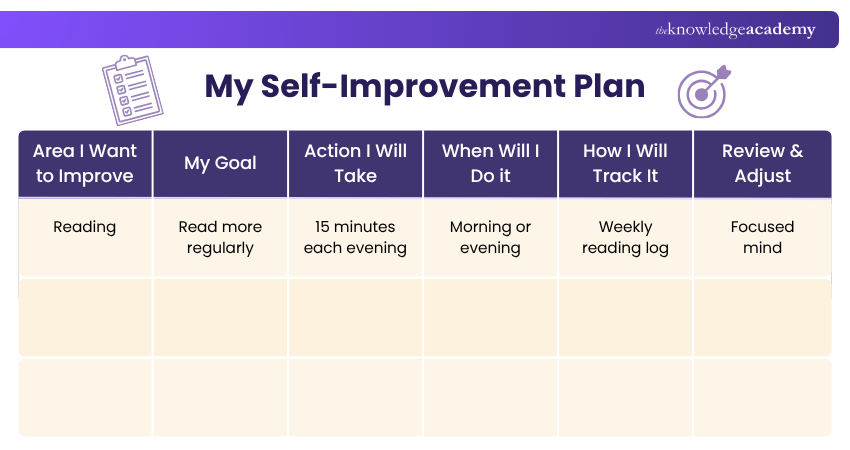
Self-Improvement Plan: Fill This In
Download the self-improvement planning sheet, fill it in with your goal and action steps, and use it to track your progress and review your growth regularly.
Common Challenges in Self-Improvement
Self-improvement can be rewarding, but progress is rarely completely linear. Recognising common obstacles can make it easier to respond to setbacks without abandoning the overall goal.
1) Unrealistic Expectations: Expecting dramatic results immediately can make normal, gradual progress feel like failure. Set realistic milestones and focus on changes that can be sustained.
2) Trying to Change Too Much: Taking on several goals simultaneously can make your plan difficult to maintain. Prioritise one or two meaningful areas before expanding your focus.
3) Losing Motivation: Motivation naturally changes over time. Creating routines, reducing friction and focusing on small actions can make progress less dependent on how motivated you feel on a particular day.
4) Comparing Yourself With Others: Other people's progress does not provide a reliable measure of your own development. Compare your current behaviours and capabilities with your previous position instead.
5) Being Too Critical of Yourself: Self-improvement can become counterproductive when every mistake is treated as proof of inadequacy. A more constructive response is to acknowledge what went wrong, identify what can be learned, and decide what to do next.
Example of Self-Improvement Journey
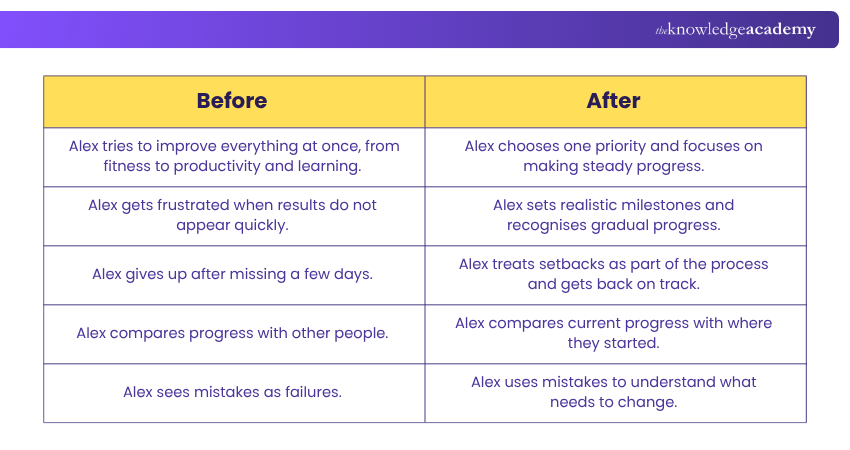
The challenges of self-improvement can make progress feel difficult, but they do not have to stop it. The difference often comes from how you respond to these obstacles and adjust your approach over time. Take Alex’s journey as an example.
Alex is a 29-year-old Project Coordinator who has been finding it difficult to balance work, personal development and learning new skills. He often starts several goals at once and struggles to stay consistent. Realising that this approach was holding him back, Alex decided to take a more focused and realistic approach to self-improvement.
How to Stay Consistent with Self-Improvement
Consistency does not mean making the same amount of progress every day. It means returning to the process, adjusting when necessary and continuing to take meaningful action.
1) Start Small: Choose actions that are easy to repeat. A manageable habit is more practical than an ambitious routine that becomes difficult to maintain.
2) Build Around Existing Routines: Attach a new behaviour to something you already do. For example, you could spend five minutes journaling after your evening routine rather than creating an entirely new schedule.
3) Track Actions, Not Just Results: Some outcomes take time to appear. Tracking the behaviours that contribute to your goal can help you recognise progress before the final result is visible.
4) Review Your Progress Regularly: Set aside a few minutes each week to ask what worked, what created difficulty and what needs to change. This keeps your plan responsive rather than rigid.
5) Be Patient with Setbacks: Missing a day or falling back into an old habit does not mean the entire effort has failed. Identify what interrupted your progress, adjust your approach and start again.
One-Minute Self-Improvement Check
Ask yourself:
1) What am I improving?2) Why does it matter?3) What is one action I can take today?4) How will I know I am progressing?If you can answer all four, you have a starting point.
Conclusion
Self-Improvement Techniques are most effective when they become realistic actions rather than short-term intentions. By choosing one meaningful area, setting achievable goals and reviewing your progress, you can turn personal growth into an ongoing process. The aim is not perfection, but purposeful and sustainable development.
Take charge of your growth and build the skills and mindset needed to achieve your personal and professional goals with Personal Development Courses- Register now!
Frequently Asked Questions
How Long Does Self-Improvement Take to Show Results?

There is no fixed timeframe for self-improvement. The pace depends on the goal, the individual and the consistency of the actions involved. Some changes may become noticeable relatively quickly, while developing lasting skills, habits or behaviours can take considerably longer.
Can Self-Improvement Become Counterproductive?
Yes. Constantly trying to improve without allowing time for rest, reflection or acceptance can create unnecessary pressure. Self-improvement should support your wellbeing rather than become a constant demand to be better, more productive or more successful.
How Can I Measure Personal Growth?
Personal growth can be assessed through changes in your behaviours, skills, confidence, responses to challenges or progress towards personally meaningful goals. Comparing your current position with where you started can provide a more useful measure than comparing yourself with other people.
Is Self-Improvement the Same as Personal Growth?
The two concepts are closely related but are not exactly the same. Self-improvement generally refers to the deliberate actions and changes you make, while personal growth describes the broader development that can result from those experiences over time.

The Knowledge Academy


Global Training Provider
The Knowledge Academy is a world-leading provider of professional training courses, offering globally recognised qualifications across a wide range of subjects. With expert trainers, up-to-date course material, and flexible learning options, we aim to empower professionals and organisations to achieve their goals through continuous learning.


 If you wish to make any changes to your course, please


