


We may not have the course you’re looking for. If you enquire or give us a call on 01344203999 and speak to our training experts, we may still be able to help with your training requirements.
Requirement Elicitation Techniques: 10 Methods with Examples
ByThe Knowledge AcademyLast updated on: 10 November 2026
Requirements elicitation techniques help Business Analysts understand stakeholder needs and identify project requirements. Explore 10 practical methods, including interviews, observation, workshops and prototyping, with examples and guidance on selecting suitable techniques.

The Gist
1. Requirements elicitation helps Business Analysts gather information from stakeholders and uncover requirements that may not be immediately obvious.2. Interviews, workshops and focus groups provide different ways to explore individual perspectives and encourage stakeholder discussions.3. Observation, document analysis and interface analysis help uncover existing processes, hidden requirements and system dependencies.4. Prototyping, scenario analysis and brainstorming help stakeholders explore ideas, clarify expectations and identify potential gaps.5. Choosing and combining appropriate elicitation techniques can improve requirement clarity, stakeholder collaboration and project planning.
Ever started a project only to discover halfway through that everyone had a different idea of what needed to be delivered? Unclear requirements can lead to confusion, repeated changes and unexpected delays. This is where requirements elicitation techniques become valuable. They help clarify stakeholder needs and establish a shared understanding of what the project must achieve.
From stakeholder interviews to observing everyday workflows, different techniques offer practical ways to uncover information that might otherwise be missed. But choosing the right approach is just as important as gathering the information itself.
In this blog, we'll explore how these techniques work, where they can be applied and how to choose the most suitable approach for your project.
Top 10 Requirements Elicitation Techniques
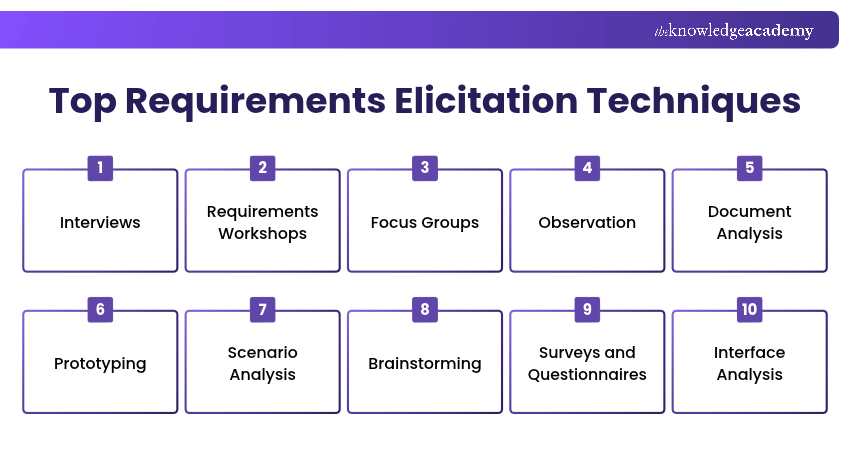
Different projects require different approaches to gathering requirements. Business Analysts should consider stakeholder availability, project complexity and information needs when selecting a technique. Here are 10 widely used requirements elicitation techniques:
The following table summarises when each method is most useful:
1) Interviews
Interviews are among the most commonly used requirements elicitation techniques. They involve direct conversations between Business Analysts and stakeholders to understand business needs, expectations, challenges and project objectives. Interviews may be structured around prepared questions or conducted more flexibly to explore new information as it emerges.
Business Analysts may interview Product Owners, end users, managers and Subject Matter Experts to understand different perspectives. Follow-up questions help uncover exceptions, dependencies and requirements that may not be immediately obvious.
Example: A Business Analyst interviews customer service employees to understand the difficulties they face while handling complaints. Their feedback helps identify requirements for a new customer support system.
Pro Tip
Start interviews with open-ended questions such as "What challenges do you face with the current system?" Follow up with questions about exceptions, dependencies and expected outcomes. This helps uncover requirements that stakeholders may not mention initially.

2) Requirements Workshops
Requirements workshops bring relevant stakeholders together to discuss, explore and clarify project requirements. These structured sessions encourage collaboration and help participants develop a shared understanding of business needs. A Business Analyst usually facilitates the workshop, guides discussions and documents important findings.
Workshops are especially useful when requirements involve several departments or when stakeholders have different expectations. Activities such as process mapping and user story mapping can support discussions by helping participants visualise workflows, understand user activities and identify requirements.
Example: During the development of an employee management system, representatives from HR, Finance and IT attend a workshop to discuss employee records, payroll requirements and system access. Their contributions help clarify how the departments should work together.
3) Focus Groups
Focus groups involve discussions with selected participants who share their opinions, experiences and expectations about a product, service or proposed solution. Unlike brainstorming, which primarily focuses on generating ideas, focus groups aim to understand the perspectives and preferences of a target audience.
A facilitator encourages participants to discuss their experiences and provide feedback. Focus groups are useful when Business Analysts need to understand customer expectations, investigate recurring problems or explore user reactions to potential changes.
Example: A retail company organises a focus group with regular customers to understand difficulties they experience while shopping online. Their feedback helps identify requirements for improving the website's search and checkout features.
4) Observation
Observation allows Business Analysts to understand business activities by watching how people perform their everyday tasks. It is particularly useful when stakeholders find it difficult to explain processes or overlook routine activities.
This technique may involve directly observing employees or shadowing them while they complete their work. Business Analysts examine task sequences, interactions, workarounds and operational challenges to identify relevant requirements.
Example: A Business Analyst observes warehouse employees processing incoming deliveries. The observation reveals that employees repeatedly enter the same information into different systems, highlighting a potential requirement for better system integration.
Trainer Insight
Stakeholders may describe how a process is supposed to work rather than how it actually happens. Observing everyday tasks can reveal undocumented workarounds, recurring delays and practical requirements that interviews alone might miss.
5) Document Analysis
Document analysis involves reviewing existing information to identify business requirements, rules, processes and constraints. It helps Business Analysts understand how current operations work before gathering additional information. Documents may include business policies, procedure manuals, reports, contracts, user guides and existing system specifications.
By examining these materials, Business Analysts can identify documented requirements, inconsistencies and areas that need further investigation. When existing software lacks sufficient documentation, reverse engineering can be used as a complementary technique to investigate system behaviour and uncover requirements that were never formally recorded.
Example: Before updating a banking application, a Business Analyst reviews existing transaction procedures, security policies and system documentation. This helps identify requirements that the new application must address.
6) Prototyping
Prototyping involves creating an early representation of a proposed solution to help stakeholders understand and discuss its requirements. Prototypes may include sketches, wireframes, screen mock-ups or interactive models. Rather than relying only on written descriptions, stakeholders can examine a visual example and provide feedback on expected features, interactions and workflows. Here are the key attributes of prototyping:
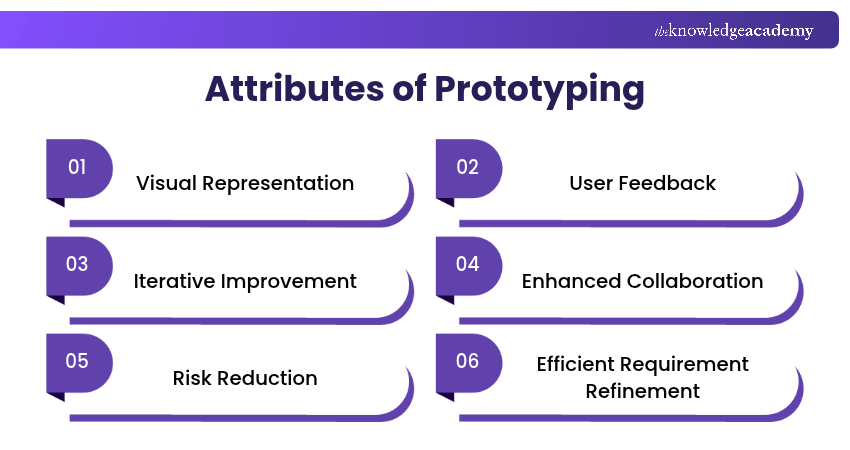
Business Analysts use this feedback to refine requirements, identify missing functionality and clarify expectations before further development. Prototyping is particularly valuable when users struggle to explain what they need or when the proposed system includes complex interactions.
Example: A Business Analyst creates a prototype of a mobile banking application showing account balances, fund transfers and transaction history. Users review the prototype and identify additional requirements for navigation and transaction confirmation.
Learn how to apply effective communication techniques for stakeholder engagement with the BCS Practitioner Certificate in Requirements Engineering Training – Join now!
7) Scenario Analysis
Scenario analysis explores how users, systems or business processes should behave in specific situations. It helps Business Analysts understand expected actions, possible outcomes and exceptions that need to be addressed.
A scenario typically describes a situation, the people or systems involved, the actions performed and the expected result. Business Analysts can explore normal workflows alongside alternative situations, such as missing information, failed transactions or unexpected user actions.
Example: While gathering requirements for an online booking system, a Business Analyst examines what should happen when a customer cancels a reservation, enters incorrect payment details or requests a refund.
8) Brainstorming
Brainstorming is a collaborative technique used to generate ideas, explore opportunities and identify potential requirements. It encourages participants to share suggestions without immediately judging their practicality.
Business Analysts may conduct brainstorming sessions with stakeholders, Subject Matter Experts, employees and project teams. The ideas generated during these sessions can be organised, evaluated and investigated further to determine which ones represent genuine business needs.
Example: A company planning a new employee engagement platform conducts a brainstorming session with HR representatives and employees. Participants suggest features such as recognition programmes, feedback surveys and internal communication tools.
9) Surveys and Questionnaires
Surveys and questionnaires help Business Analysts collect information from a large number of stakeholders through a structured set of questions. These questions may include multiple-choice options, rating scales or open-ended responses, depending on the information required.
Surveys are especially useful when stakeholders are geographically dispersed or when collecting individual feedback through interviews would require considerable time. The responses can reveal common challenges, preferences and patterns that help identify potential requirements.
Example: A university planning to introduce a student portal distributes a questionnaire asking students about difficulties with course registration, access to learning materials and communication with lecturers. The responses help the project team identify frequently reported needs and areas requiring further investigation.
10) Interface Analysis
Interface analysis examines how systems, users, devices or external components interact and exchange information. It helps Business Analysts identify requirements relating to these interactions. This technique is particularly useful when developing or updating solutions that must communicate with existing systems.
Business Analysts investigate what information moves between systems, how interactions are triggered and what should happen when communication fails. Unlike prototyping, which helps stakeholders explore a proposed solution, interface analysis focuses on understanding the requirements and constraints associated with system interactions.
Example: A Business Analyst working on an online shopping platform examines how its website communicates with payment gateways and inventory management systems. This helps identify requirements for transaction processing, stock updates, data exchange and error handling.
How to Choose the Right Requirements Elicitation Technique
Choosing the right requirements elicitation technique depends on project complexity, stakeholder availability and the information needed. Some techniques help explore individual requirements, while others clarify workflows or encourage stakeholder collaboration.
Consider the following factors:
1) Stakeholder Availability: Choose interviews for detailed individual discussions or surveys when collecting feedback from larger groups.
2) Project Complexity: Use requirements workshops when multiple stakeholders need to discuss expectations and clarify dependencies.
3) Existing Information: Review available documents or use observation to identify how current processes operate.
4) Requirement Clarity: Use prototyping or scenario analysis when stakeholders need help expressing how a proposed solution should work.
5) System Interactions: Consider interface analysis when requirements involve integrations, data exchange or interactions between systems.
Combining suitable techniques can provide a more complete understanding of stakeholder needs and help identify gaps that a single method might miss.
Master key skills to confidently support and deliver successful business transformations with the Business Analysis Courses – Sign up today!

The Knowledge Academy develops accessible learning content across Project Management, IT, Cybersecurity, Data Science, Business Analysis, HR, Accounting and Finance, Leadership and Health and Safety. Its resources combine subject research with clear explanations to help professionals build practical knowledge across a wide range of disciplines.
View Detail

 If you wish to make any changes to your course, please


