


 Top Rated Course

We may not have the course you’re looking for. If you enquire or give us a call on 01344203999 and speak to our training experts, we may still be able to help with your training requirements.
Strategic Thinking Skills and How to Improve Them
Charlotte Wilson 07 September 2026This blog explores what Strategic Thinking Skills are and practical ways to strengthen them so you can make more considered decisions and approach challenges with a broader perspective.

Training Outcomes Within Your Budget!
We ensure quality, budget-alignment, and timely delivery by our expert instructors.
Table of Contents
Key Takeaways
1. Strategic Thinking combines analysis, foresight, prioritisation and broader organisational awareness.2. Effective strategic thinkers look beyond immediate problems to understand causes, connections and longer-term consequences.3. Considering alternative scenarios helps people prepare for uncertainty rather than relying on a single expected outcome.4. Strong strategic decisions balance evidence, priorities, risks, resources and future objectives.5. Strategic Thinking Skills can be strengthened through deliberate questioning, reflection, perspective-taking and regular practice.
Imagine your organisation's strongest-selling service begins losing customers. You could immediately lower the price, increase advertising or copy what a competitor is doing.
A strategic thinker would probably pause first. What has changed? Is price really the problem? What are customers signalling? Could today's quick fix create a bigger problem six months from now?
Strategic Thinking Skills help turn that pause into a disciplined way of working. They enable you to examine the wider situation, consider alternatives and make decisions with both present conditions and future consequences in mind.
What are Strategic Thinking Skills?
Strategic Thinking Skills include a range of abilities that enable individuals to think critically, plan effectively, and execute actions aligning with their long-term goals. It's the art of taking a step back, assessing the current situation, and aligning your actions with a broader purpose.
Strategic thinkers don't merely react; they position themselves to thrive in various scenarios. Understanding what makes strategic thinking distinct from short-term, tactical decision-making helps clarify why these skills matter, and how they can support success across different areas of life.

Key Strategic Thinking Skills
No single ability makes someone a strong strategic thinker. Strategic Thinking develops from a combination of skills that help people understand where they are, anticipate where circumstances may lead and decide how best to respond.
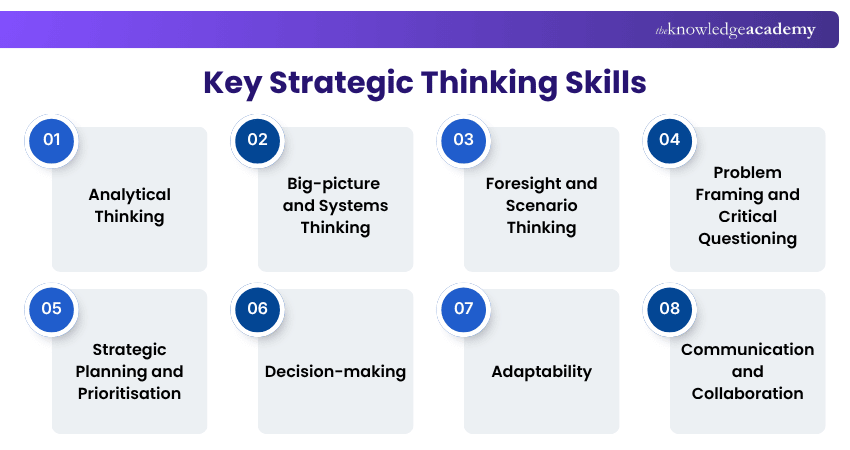
1) Analytical Thinking
Analytical thinking usually involves the following:
a) Breaking down complex problems into smaller components
b) Analysing information
c) Identifying relevant patterns or trends
d) Keen observation
e) Logical reasoning
f) Systematic approach to problem-solving
Analytical thinking, applied alongside strategic judgement, helps individuals gather and process information effectively, enabling them to make informed decisions and take purposeful actions.
These skills depend on several factors such as financial statements, Key Performance Indicators (KPIs), various market conditions, new business trends, and the allocation of internal resources. Considering these factors allows for a more comprehensive analysis of the organisation's current situation.
2) Big-picture and Systems Thinking
Big-picture thinking is the ability to look beyond an isolated task or department and understand how different parts of a situation connect.
Systems thinking strengthens this perspective by considering relationships, dependencies, and possible knock-on effects. A decision that benefits one area may create a problem elsewhere.
Consider a business that reduces customer support staffing to lower costs. The immediate financial result may appear positive. However, longer waiting times could affect customer satisfaction, retention, employee workload, and ultimately revenue.
3) Foresight and Scenario Thinking
The future cannot be predicted with certainty, but it can be considered systematically. Foresight involves looking for developments that could influence future decisions.
These may include changes in customer expectations, technology, competitors, regulations, available resources or wider market conditions. Scenario Thinking goes one step further by considering several plausible outcomes rather than assuming only one future will occur.
In Practice: One Decision, Three Futures
A team is considering expanding into a new market.Scenario A: Demand grows quicklyThe team may need additional capacity and faster recruitment.Scenario B: Demand grows graduallyA phased investment could protect resources while the market develops.Scenario C: Demand remains weakClear exit criteria could prevent continued investment based only on optimism.
4) Problem Framing and Critical Questioning
The way a problem is defined influences the solutions people consider. Problem Framing involves identifying what the real issue is before attempting to solve it. Critical questioning helps test whether the first explanation is accurate.
Suppose a project repeatedly misses deadlines. Framing the problem as “employees need to work faster” points towards one type of solution. Asking why delays occur may instead reveal unclear requirements, unrealistic scheduling, dependencies between teams or repeated approval bottlenecks.
5) Strategic Planning and Prioritisation
Strategic planning is the ability to perform the following:
a) Setting clear goals
b) Outlining action steps
c) Developing a roadmap or an action plan
d) Breaking down larger objectives into actionable plans
e) Assigning responsibilities
f) Establishing timelines
It involves considering various factors, such as resources, timelines, and potential obstacles, to create a comprehensive plan. Strategic thinkers anticipate potential obstacles and develop contingency plans to overcome them.
For example, a Project Manager using strategic planning skills may create a detailed project plan and allocate resources efficiently. They may also proactively identify alternative solutions in case of unexpected challenges.
6) Decision-making
Effective decision-making is one of the crucial Strategic Thinking Skills. It involves evaluating different options, weighing pros and cons, considering potential risks and benefits and making choices that align with long-term goals.
For instance, a business leader with strong decision-making skills may evaluate market research, financial data, and competitive analysis to make strategic decisions on product development or market expansion.
7) Adaptability
Adaptability refers to the ability to adjust plans and strategies in response to changing circumstances. It involves being flexible, open-minded, and resilient in front of unexpected challenges or opportunities.
For example, an entrepreneur with adaptability skills may alter their business model in response to market shifts or embrace new technologies to stay competitive.
8) Communication and Collaboration
Implementing a strategy is only half the work. Communicating it clearly is what allows a team to carry it out effectively and achieve the intended outcome.
Regardless of the size of the business, individuals must communicate complex ideas efficiently. With good communication skills, employees must also collaborate with internal and external stakeholders and take feedback on how the strategies are working out.
Build communication skills that inspire action with our Communication and Influencing Skill Training – Join now!
How to Improve Strategic Thinking Skills?
Strategic Thinking improves through regular practice. The goal is to look beyond immediate tasks, question assumptions, consider alternatives and learn from decisions.
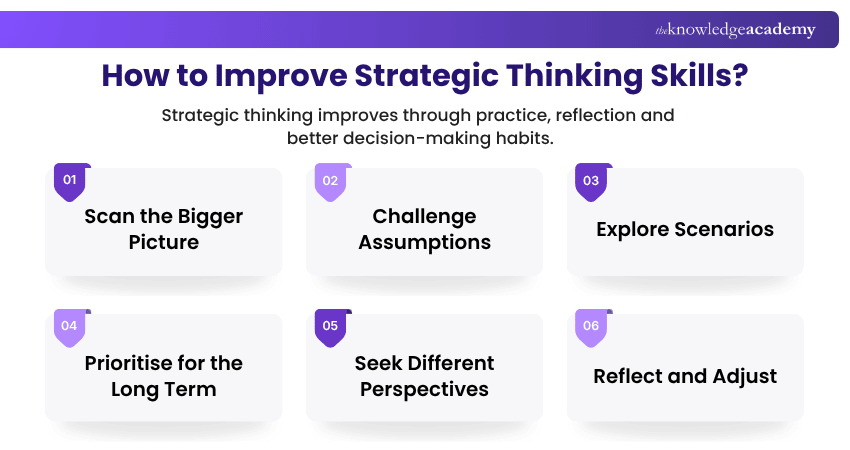
1) Step Back and Scan the Bigger Picture
Look beyond day-to-day tasks and consider wider factors such as customer behaviour, competitors, emerging trends, resources and organisational priorities. This helps you recognise patterns and understand how different issues connect.
2) Ask Questions That Challenge Assumptions
Test the beliefs behind important decisions. Ask what evidence supports them, what could prove them wrong and whether alternative explanations exist. Challenging assumptions can reveal risks and overlooked opportunities.
Turn Self-belief into stronger performance with our Confidence Building Training – Join now!
3) Explore Different Scenarios and Trade-offs
Consider several possible outcomes instead of relying on one prediction. Ask what could happen if demand changes, resources become limited or competitors respond. Compare the benefits, risks and compromises involved in each option.
4) Practise Prioritisation and Long-term Decision-making
Focus on actions that contribute most strongly to important objectives. Before deciding, consider both the immediate benefit and the longer-term consequences of each option.
5) Seek Different Perspectives and Constructive Feedback
Discuss challenges with people from different roles or backgrounds. Different viewpoints can expose blind spots, test your reasoning and help you consider possibilities you may have missed.
6) Reflect on Decisions and Adjust Your Thinking
Review important decisions after the outcome becomes clear. Identify what worked, which assumptions were incorrect and what you would change next time. Regular reflection helps turn experience into better strategic judgement.
Trainer's Insight
Do not judge Strategic Thinking only by whether an outcome was successful. A good decision can still produce a disappointing result when circumstances change, while a poorly reasoned decision can occasionally succeed through luck.
Conclusion
Strategic Thinking Skills help you move beyond reacting to whatever appears most urgent. They enable you to understand the wider situation, question assumptions, anticipate possibilities, and make decisions with longer-term consequences in mind. The strongest strategic thinkers don't always predict what's next. They examine situations carefully, weigh multiple possibilities, and adjust as new information appears.
Build the skills that move you forward with our Personal Development Courses –Register now!
Frequently Asked Questions
Are Strategic Thinking Skills Only Important for Managers?

No. Managers frequently use Strategic Thinking, but the skills can be valuable at many organisational levels. Employees can use them to identify process improvements, anticipate problems, prioritise work and understand how their responsibilities contribute to wider objectives.
How Can You Tell Whether Someone is Thinking Strategically?
Strategic thinkers often look beyond immediate symptoms, ask questions about causes and consequences, connect information from different areas and consider more than one possible outcome. They are also usually able to explain how a proposed decision supports a broader objective rather than evaluating it only by its immediate effect.
Can too Much Strategic Thinking Lead to Over Analysis?
Yes. Exploring possibilities is useful, but continuing to analyse after sufficient information is available can delay necessary action. A practical approach is to match the depth of analysis to the decision's importance and reversibility. High-impact, hard-to-reverse decisions justify deeper analysis; smaller, easily tested ones don't.

Charlotte Wilson


Soft Skills and Business Training Manager
Charlotte Wilson is an expert in soft skills development, with over 14 years of experience helping individuals and teams improve communication, productivity and emotional intelligence in the workplace. Her training content is focused on enhancing interpersonal effectiveness and fostering positive, collaborative environments across all levels of an organisation.
View Detail

 If you wish to make any changes to your course, please


