Who should attend this BCS CISMP Training Course?
The BCS Certificate in Information Security Management Principles (CISMP) training is prepared for the professional who intends to strengthen the base of Information Security Management. This BCS CISMP Training Course can be beneficial for a wide range of professionals, including:
- IT Managers
- Security Managers
- Information Security Officers
- Network Administrators
- System Administrators
- Risk Managers
- IT Auditors
- Compliance Officers
Prerequisites of the BCS CISMP Training Course
There are no formal prerequisites for the candidates to attend this BCS CISMP Course. However, knowledge of security, risk management, and cybersecurity governance would be more useful in their learning this CISMP Training.
BCS CISMP (Certificate in Information Security Management Principles) Course Overview
The BCS Certificate in Information Security Management Principles (CISMP) is a foundational course that equips individuals with the knowledge and skills to navigate the complex world of information security. Understanding these principles is critical in an era where data breaches are a constant threat.
Proficiency in the CISMP Course is essential for many professionals, including IT managers, security officers, compliance officers, and anyone responsible for protecting an organisation's digital assets. With cyber threats becoming increasingly sophisticated, mastering information security principles is vital for mitigating risks and ensuring the continuity of business operations.
This intensive 5-days CISMP Training is designed to give delegates a comprehensive understanding of information security management principles. Delegates will gain insights into risk management, access control, cryptography, and compliance, among other vital areas. Through lectures, discussions, and practical exercises, delegates will leave the course with actionable knowledge and skills that can be applied immediately in their professional roles.
Course Objectives
- To understand the fundamental principles of information security management
- To implement access control and authentication mechanisms
- To comprehend the importance of cryptography in information security
- To develop and maintain an effective security policy and procedures
- To ensure compliance with relevant laws and regulations
- To contribute to the overall security posture of their organisation
A delegate who will finish the CISMP Training will be awarded the BSC Certification in Security Management Principles. This verification of competency in information security management, issued at a global level, widens their career horizons and might create opportunities for advancement.
Key Benefits of BCS CISMP (Certificate in Information Security Management Principles)
The BCS CISMP Certification builds essential information security management skills in risk, controls and governance, trusted globally by organisations to protect data.
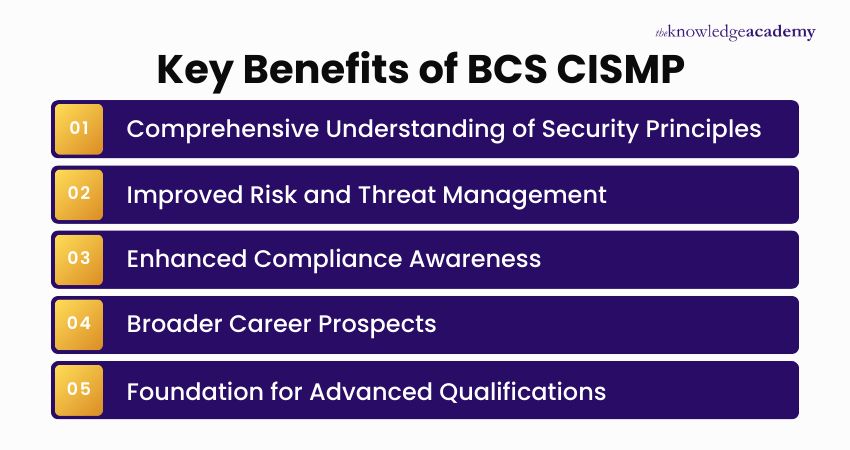
Here are the key benefits of this certification:
- Comprehensive Understanding of Security Principles: By taking the BCS CISMP Course, gain a solid grasp of confidentiality, integrity and availability concepts, and the core principles that underpin effective information security management.
- Improved Risk and Threat Management: Professionals gain the ability to identify and assess information security risks, understand threats and vulnerabilities, and support development of appropriate risk mitigation strategies.
- Enhanced Compliance Awareness: Professionals understand relevant legal, regulatory and governance frameworks with this BCS CISMP Training. This includes data protection and security standards that shape organisational security practices.
- Broader Career Prospects: The BCS CISMP Qualification is recognised by employers and opens opportunities in roles such as information security analyst, risk manager, compliance specialist and IT security professional.
- Foundation for Advanced Qualifications: As an entry-level credential, CISMP provides a stepping stone to further professional development in cybersecurity and information risk management, including higher-level certifications.




 If you miss out, enquire to get yourself on the waiting list for the next day!













 If you wish to make any changes to your course, please


