


We may not have the course you’re looking for. If you enquire or give us a call on 0800 446148 and speak to our training experts, we may still be able to help with your training requirements.
Home
 Resources
Business Skills
Personal Assistant Job Description: Responsibilities, Skills and Requirements
Resources
Business Skills
Personal Assistant Job Description: Responsibilities, Skills and Requirements
Personal Assistant Job Description: Responsibilities, Skills and Requirements
ByVidhya NairLast updated on: 27 October 2026
A Personal Assistant job description outlines the duties, skills and qualifications needed to provide professional administrative support. From managing schedules and correspondence to organising meetings and travel, discover the responsibilities of a Personal Assistant and the practical experience needed for the role.
Picture this scenario: you are coordinating meetings, handling urgent emails and solving problems before they even happen. That's just a glimpse into the life of a Personal Assistant (PA). These professionals help managers and executives stay organised, manage priorities and focus on important business activities.
Being a PA also involves communication, administrative coordination and handling confidential information. If you're thinking of becoming a PA or looking to hire one, understanding the Personal Assistant job description is key. Let's dive into what makes this role so essential and what it takes to succeed.
Who is a Personal Assistant?
A Personal Assistant (PA) provides administrative and operational support to managers, directors and other professionals, helping them organise their workload and manage daily commitments.
PAs often deal with confidential matters, prepare documents, coordinate meetings and maintain important records. Some may also help with research, expenses or budget administration, depending on their employer and level of responsibility.
Personal Assistant Responsibilities
A Personal Assistant acts as an important point of contact for the person they support, helping coordinate administrative activities and professional commitments. To perform effectively, they are expected to manage a variety of responsibilities, including:
1) Managing Correspondence: Handle phone calls, emails and written communication, responding or redirecting enquiries when appropriate.
2) Diary and Schedule Management: Organise appointments, coordinate meetings and maintain accurate calendars to support daily planning.
3) Deadline and Reminder Coordination: Track important commitments, meeting dates and deadlines to help ensure timely completion.
4) Travel Arrangements: Arrange transport, accommodation and itineraries for business trips, considering schedules and organisational requirements.
5) Meeting and Event Coordination: Organise meetings, workshops and conferences, including invitations, room bookings and administrative arrangements.
6) Meeting Documentation: Prepare agendas, take notes, record meeting minutes and distribute agreed information to relevant participants.
7) Internal and External Communication: Coordinate communication with colleagues, clients, suppliers and other stakeholders while maintaining professionalism.
8) Expense and Record Management: Prepare expense reports, maintain filing systems and organise documents for efficient information retrieval.
Essential Skills of a Personal Assistant
To perform effectively in a fast-paced environment, a Personal Assistant must possess a blend of interpersonal, organisational and technical skills that ensure seamless support and communication. The following skills are essential for every Personal Assistant:
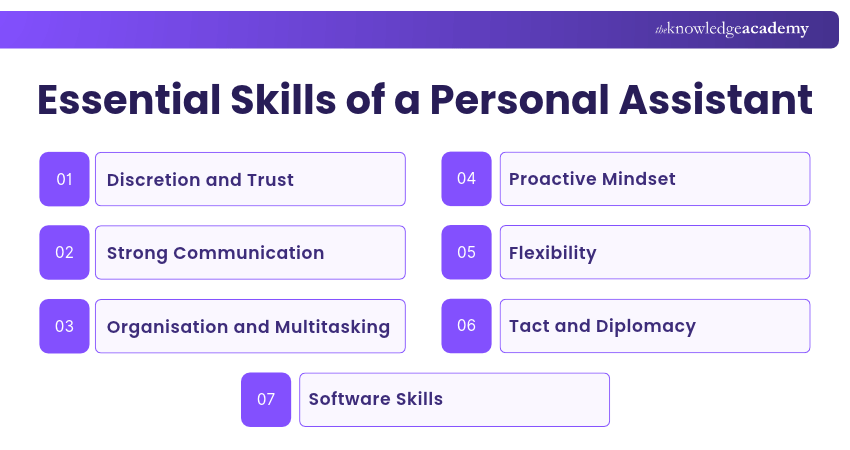
a) Discretion and Trust: Handle confidential information responsibly, maintain professional boundaries and follow relevant information-handling policies.
b) Strong Communication: Demonstrate excellent verbal and written communication skills when interacting with managers, colleagues, clients and external contacts.
c) Organisation and Multitasking: Manage competing priorities, maintain accurate schedules and organise administrative tasks while paying attention to detail.
d) Proactive Mindset: Anticipate routine administrative needs, take appropriate initiative and identify potential scheduling or operational problems early.
Trainer's Insight
Being proactive does not mean making every decision independently. Effective Personal Assistants recognise which routine tasks they can handle directly and which decisions require approval, particularly when dealing with confidential information or important commitments.
e) Flexibility: Adapt to changing priorities, urgent requests and unexpected adjustments while maintaining accuracy and professionalism.
f) Tact and Diplomacy: Handle sensitive conversations, competing requests and workplace situations with courtesy, good judgement and emotional awareness.
g) Software Skills: Use office applications, email platforms, calendars, spreadsheets and document management systems effectively.
From correspondence to coordination, make every office task count by signing up for the Secretarial Course today!
Requirements to Become a Personal Assistant
To qualify for a Personal Assistant role, individuals should have relevant administrative abilities, practical experience and the professional qualities required by the employer. Formal entry requirements vary depending on the seniority and complexity of the position. Let's look at the requirements below:
1) Educational Qualifications
A university degree is not universally required to become a Personal Assistant. In the UK, employers may look for GCSEs in English and Mathematics or equivalent qualifications, alongside strong administrative and communication skills.
Qualifications in business administration, office management or related subjects can be beneficial. Individuals may also enter the profession through apprenticeships, college courses or relevant office experience.
2) Professional Experience
Many established Personal Assistant positions prefer previous experience in administration, secretarial work or a similar support role. Some employers seek around two years of relevant experience, although this is not a universal requirement.
Individuals can develop practical experience through administrative assistant roles, temporary office work, internships or junior secretarial positions. Employers may particularly value experience managing diaries, coordinating meetings, preparing documents and handling sensitive information.
Pro Tip
If you have limited PA experience, highlight transferable achievements from administrative or customer-facing roles. Examples involving diary management, professional communication or accurate record-keeping can demonstrate your suitability.
3) Technical Knowledge
Personal Assistants should be comfortable using common office software and digital communication systems. Requirements may include:
a) Office Applications: Word processing, spreadsheets and presentation software for routine administrative tasks.
b) Scheduling Tools: Digital calendars and appointment systems for coordinating meetings and deadlines.
c) Communication Platforms: Email, video conferencing and workplace messaging tools for professional communication.
d) Document Management: Electronic filing systems and shared workspaces for organising and retrieving records.
e) Travel and Expense Systems: Booking platforms and expense management tools where these duties form part of the role.
Personal Assistant's Daily Checklist
This checklist gives readers a practical understanding of how PAs can organise their daily activities. It includes:
□ Review the day's calendar and upcoming appointments□ Identify urgent emails and pending responses□ Confirm meeting arrangements and required documents□ Check deadlines and outstanding follow-up tasks□ Verify upcoming travel or booking arrangements□ Update relevant records and task trackers□ Review the next day's priorities
Personal Assistant Job Description Example
The following two Personal Assistant Job Description examples demonstrate how organisations can outline responsibilities, skills and qualifications for different roles. Let's check the PA role that offers administrative support:
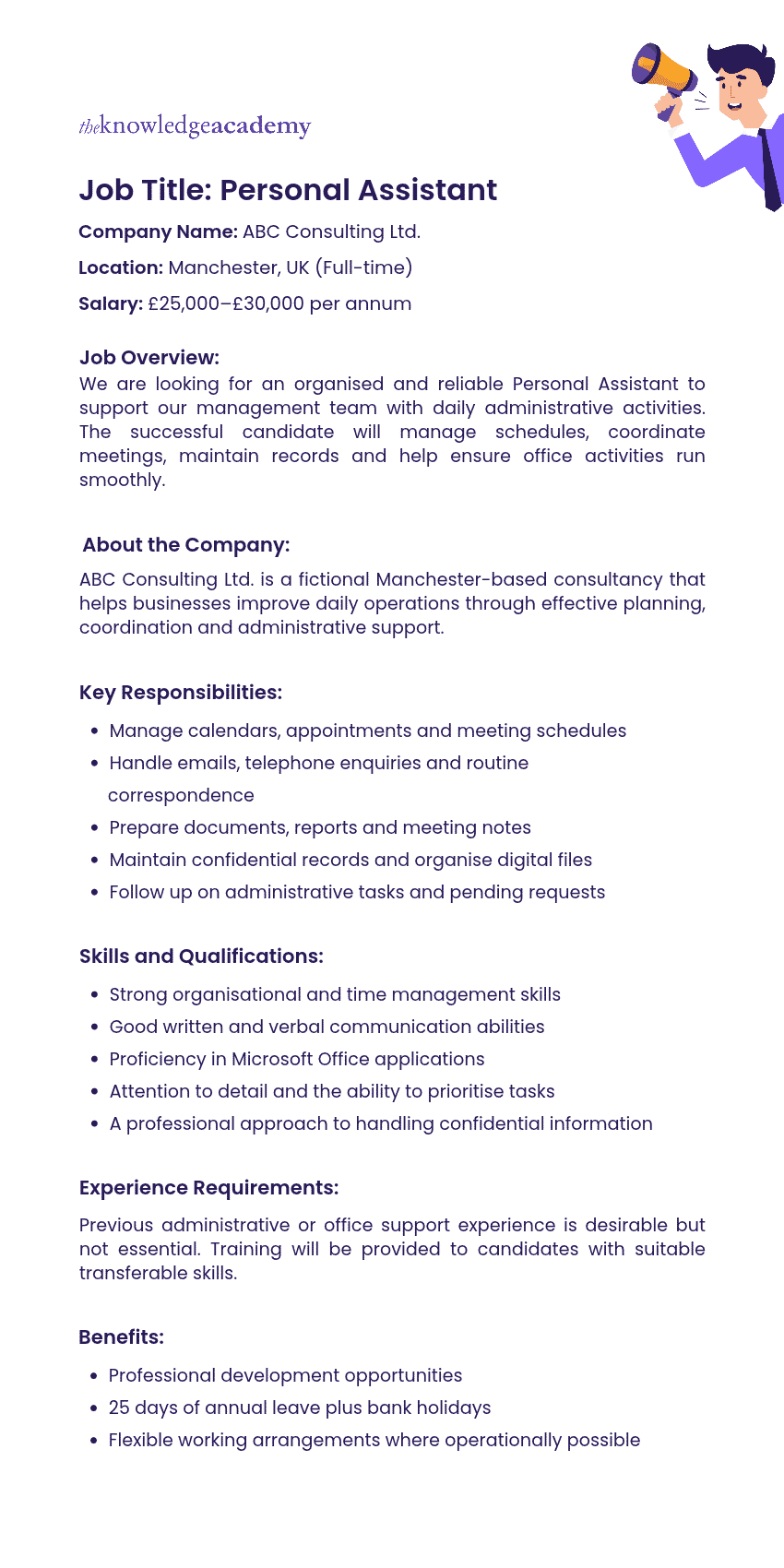
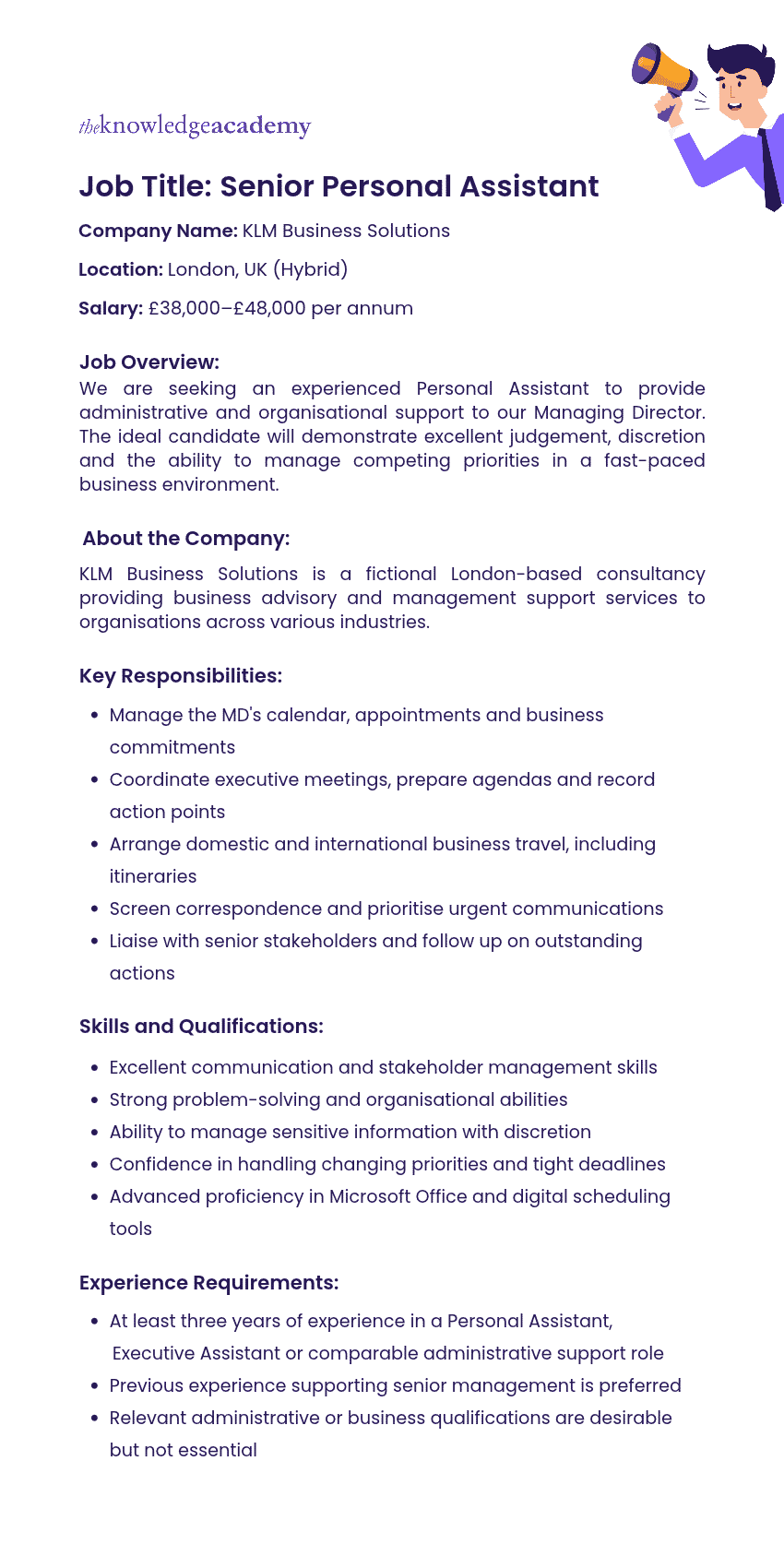
Here's a second example that covers a more senior position of PA supporting an executive:
Keep This in Mind
A Personal Assistant's role goes beyond managing schedules and handling administrative tasks. It requires strong organisational skills, adaptability, discretion and the ability to anticipate changing priorities. While responsibilities may vary depending on the employer and level of seniority, understanding the role's expectations can help candidates develop relevant skills and prepare for career opportunities.
Build smarter administrative skills and unlock your professional potential with the Administrative Assistant Training now!

Vidhya Nair is a Senior Copywriter with 7+ years of experience across copywriting, content writing and communication. Her extensive research and editorial experience supports her ability to present topics across Business Skills and Human Resources with clarity and purpose.
View Detail

 If you wish to make any changes to your course, please


