




We may not have the course you’re looking for. If you enquire or give us a call on +44 1344 203 999 and speak to our training experts, we may still be able to help with your training requirements.
What is Strategic Thinking: A Complete Guide
ByCharlotte WilsonLast updated on: 25 August 2026
Strategic Thinking is the ability to look beyond immediate priorities, understand the bigger picture, and make decisions with future goals in mind. Explore its key elements, benefits, examples, and practical ways to develop Strategic Thinking skills.
Key Takeaways
1. Strategic Thinking connects present decisions with future goals2. It combines analysis, creativity, foresight, and adaptability3. Strategic Thinkers consider the bigger picture before taking action4. Strategic Thinking guides direction, while Strategic Planning structures action5. Strategic Thinking improves through questioning, practice, and reflection
Most decisions are made by looking at what is directly in front of us. Strategic Thinking begins when you zoom out.
It means looking beyond today's priorities to understand what is changing, how different factors connect, and where current decisions could lead. Instead of focusing only on the next action, Strategic Thinkers consider the bigger picture and the direction ahead.
This blog explores what Strategic Thinking is, why it matters, and how you can develop and apply it effectively.
What is Strategic Thinking?
Strategic Thinking is the ability to analyse the current situation, consider future possibilities, and make decisions that support long-term objectives. It involves looking beyond immediate tasks to understand how decisions, opportunities, risks, and changing conditions connect.
It combines analytical thinking with creativity and foresight. Rather than simply reacting to events, Strategic Thinkers examine what is happening, question assumptions, explore alternatives and consider what could happen next.
The Strategic Thinking Shift
Don't just ask: “What should we do?”Also ask: “What will this lead to?”
Why is Strategic Thinking Important?
What looks like a good decision today may create a problem tomorrow. Strategic Thinking brings the future impact of today's choices into the decision-making process.
It helps professionals look beyond immediate results and consider changing conditions, potential risks, emerging opportunities, and wider business priorities. This broader perspective supports better decisions and reduces the chances of focusing on short-term gains at the expense of long-term goals.
The Real Value of Thinking Strategically
See beyond the problem → Understand the wider impact
Look beyond the present → Prepare for change
Think beyond one option → Explore better possibilities
Decide beyond the short term → Stay aligned with long-term goals
Strategic Thinking turns a decision from “What works now?” into “What makes sense for where we're going?”
Key Elements of Strategic Thinking
Strategic Thinking is not a single way of thinking. It brings together several elements that help you understand situations, explore possibilities, and make decisions with the bigger picture in mind. The key elements include:
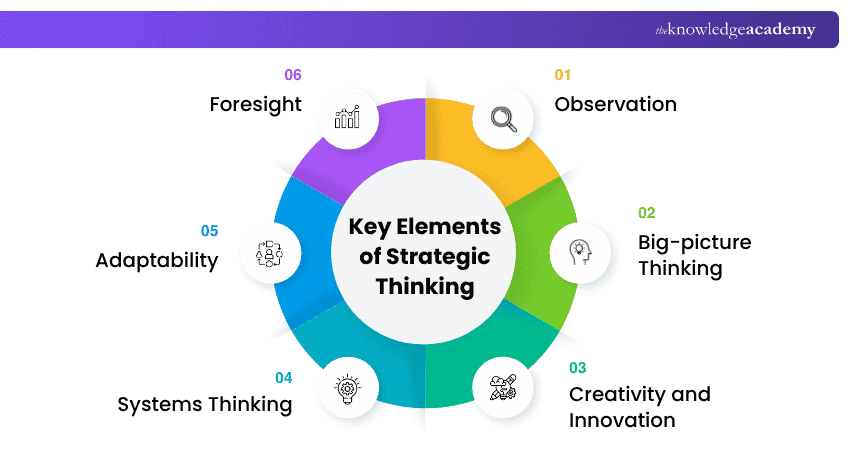
1) Observation
Observation is the starting point of Strategic Thinking. It involves paying attention to what is happening, recognising changes, and identifying signals that could influence future decisions.
By observing customers, competitors, performance, and industry developments, Strategic Thinkers can spot patterns, emerging trends, and potential opportunities or risks that might otherwise go unnoticed.
2) Big-picture Thinking
Strategic Thinkers look beyond individual issues to understand the wider situation. They consider how teams, customers, resources, objectives, competitors and external conditions connect.
This broader perspective makes it easier to recognise how one decision could influence several areas.
3) Creativity and Innovation
Strategic Thinking is not limited to analysing existing choices. It also involves exploring new possibilities and alternative approaches.
Creative Thinking allows professionals to challenge familiar assumptions, consider different solutions, and identify opportunities that may otherwise be overlooked.
4) Systems Thinking
Decisions rarely operate in isolation. Systems Thinking involves understanding how different parts of an organisation or situation influence one another.
It encourages Strategic Thinkers to consider connections, dependencies, and possible consequences before acting.
5) Adaptability
Adaptability allows Strategic Thinkers to adjust their approach when priorities, conditions, or information change. Instead of holding onto a strategy that no longer fits, they reassess the situation and respond accordingly.
This keeps strategic decisions relevant and responsive to changing circumstances.
6) Foresight
Foresight is the ability to look ahead and consider how current trends, changes, and decisions could shape future outcomes.
Strategic Thinkers use foresight to recognise emerging opportunities and potential challenges early, allowing them to prepare and make more informed decisions.
The Strategic Thinking Compass
LOOK AROUND → What factors are connected?LOOK AHEAD → What could change?LOOK BEYOND → What opportunities are emerging?LOOK BACK → What can previous decisions teach us?
Benefits of Strategic Thinking
Strategic Thinking supports better decisions by encouraging professionals to consider the bigger picture, future possibilities, and wider impact of their actions. Its key benefits include:
1) Stronger Problem-solving: Strategic Thinking encourages professionals to look beyond symptoms and examine the wider causes of a problem.
2) Greater Adaptability: Considering different possibilities makes it easier to adjust direction when circumstances or priorities change.
3) Clearer Goal Alignment: Connecting everyday decisions with long-term priorities keeps efforts focused on important objectives.
4) Greater Awareness of Opportunities: Recognising trends and changes early can reveal opportunities for growth and improvement.
5) Smarter Resource Allocation: Strategic Thinking supports more deliberate decisions about where time, people, budgets, and other resources should be focused.
6) Better Decision-making: Evaluating evidence, alternatives, risks, and consequences leads to more informed choices
Turn strategic insight into confident decisions with Decision-making Course – Join today!
Strategic Thinking vs Strategic Planning
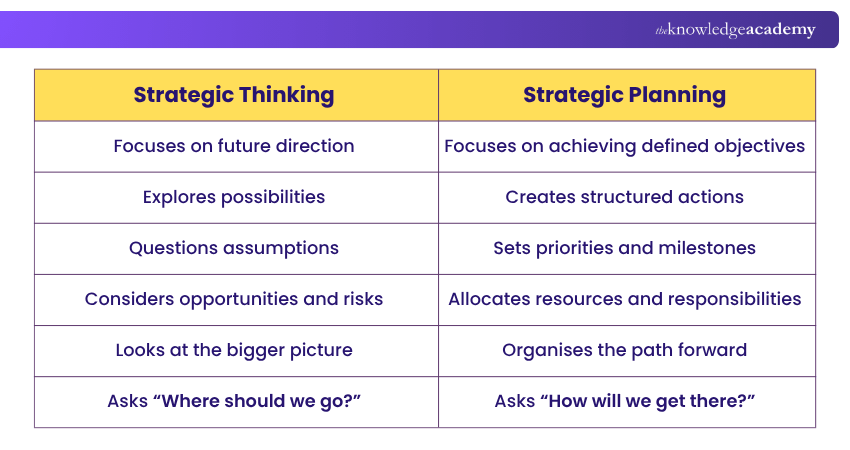
Strategic Thinking and Strategic Planning work together, but they serve different purposes. Strategic Thinking explores direction and possibilities, while Strategic Planning turns that direction into structured action.
The Simple Difference:
Strategic Thinking → Choose the direction
Strategic Planning → Build the route
What Does Strategic Thinking Look Like in Practice?
Strategic Thinking becomes easier to understand when you see it applied to a real situation.
A business notices that customer enquiries through digital channels are increasing while telephone enquiries are declining.
An immediate response might be to simply add more digital support.
A Strategic Thinker looks further:
SIGNAL
Digital enquiries are increasing
↓
QUESTION
Why are customer preferences changing?
↓
IMPACT
How could this affect future service expectations?
↓
OPTIONS
What different responses could work?
↓
DIRECTION
Which approach best supports long-term objectives?
The difference is not how quickly you respond, but how far ahead you think.
Same Change. Different Thinking.
Short-term view: How do we handle more digital enquiries?Strategic view: How should our service model evolve with customer behaviour?
Strategic Thinking vs Tactical Thinking
A company notices that customers are increasingly choosing newer competitors.
The Tactical Response:
The team launches a promotional campaign, offers discounts, and increases customer outreach to improve short-term retention.
The Strategic Response:
The company investigates why customers are leaving, how expectations are changing, where competitors are gaining an advantage, and whether its current offering will remain competitive.
The strategic analysis could lead to changes in the customer experience, product offering, pricing approach, or market positioning, while tactical actions support those decisions in the short term.
Strategic Thinking asks what needs to change for the future. Tactical Thinking determines what needs to be done now.
How to Improve Strategic Thinking Skills?
Strategic Thinking improves when you deliberately practise looking beyond immediate issues, questioning assumptions, and considering the wider impact of decisions. Here are practical ways to strengthen it:
1) Ask Better Questions
Challenge assumptions instead of immediately accepting the obvious explanation. Ask why something is happening, what could change, and what else could be affected.
2) Look at the Bigger Picture
Step away from individual tasks and consider wider objectives, stakeholders, resources, competitors, customers, and external conditions.
3) Strengthen Your Analytical Thinking
Use evidence to identify patterns, evaluate alternatives, and understand the factors influencing a situation. Tools like SWOT Analysis, PESTLE Analysis, scenario planning, and risk assessment can support structured analysis.
4) Explore Different Possibilities
Avoid settling immediately on the first workable solution. Consider alternative approaches and examine what each could lead to.
5) Consider Different Perspectives
Look at the situation through the eyes of customers, employees, stakeholders, competitors, and other relevant groups. Different perspectives can reveal assumptions or consequences that are easy to overlook.
6) Stay Open to Change
Strategic Thinking is not about committing to one direction regardless of what happens. When new information or changing conditions challenge your assumptions, reassess the situation and adjust your approach.
7) Learn From Your Decisions
Review important decisions after they have had time to produce results. Compare what you expected with what actually happened and use those insights to improve future judgement.
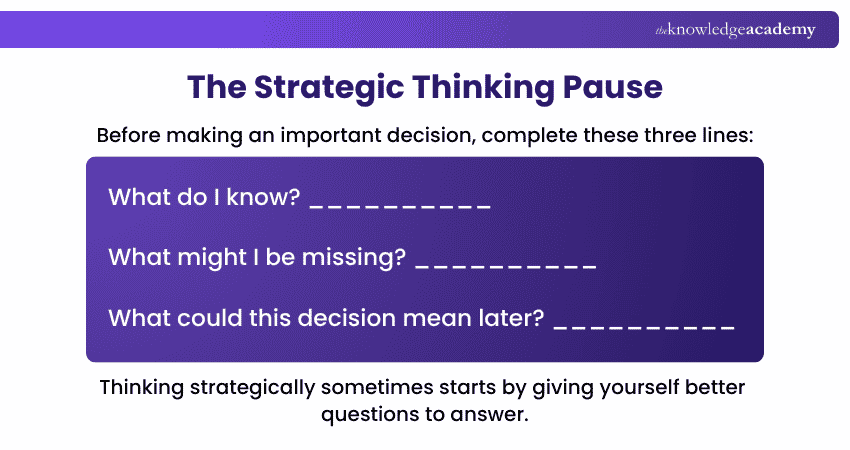
How to Apply Strategic Thinking at Work?
Strategic Thinking does not require a major business decision. It can be applied to everyday work by looking beyond the immediate task and considering its wider purpose, impact, and future value.
Turn Everyday Thinking into Strategic Thinking
Instead of: Which task should I finish first?
Think: Which priority contributes most to our wider goals?
Instead of: How do we fix this problem?
Think: Why does this problem keep happening, and what would prevent it?
Instead of: Should we pursue this opportunity?
Think: Does this opportunity support where we want to go?
Instead of: How should we respond to this change?
Think: What could this change mean for our future plans?
Instead of: Where should we use our resources?
Think: Where will our resources create the greatest long-term value?
Strategic Thinking at work begins when you move from completing what is in front of you to considering what it contributes to next.
Trainer's Insight
Strong Strategic Thinkers know when new information should change an existing direction.
Conclusion
Strategic Thinking is not about having all the answers. It is about looking beyond the obvious, asking better questions, and understanding where today's choices could lead. The more you consider different perspectives, recognise connections, and learn from outcomes, the stronger your Strategic Thinking becomes. Think beyond the next decision and focus on the direction it creates.
Build smarter strategies with Strategic Planning and Thinking Course – Join now!

Charlotte Wilson creates Business Skills content that helps professionals communicate more effectively, manage workplace pressures and collaborate with others. Her practical resources support stronger professional relationships, individual effectiveness and positive team behaviour.
View Detail

 If you wish to make any changes to your course, please


