


 Top Rated Course

We may not have the course you’re looking for. If you enquire or give us a call on +918037244591 and speak to our training experts, we may still be able to help with your training requirements.
What is IT Governance? A Detailed Explanation
The Knowledge Academy 16 July 2026IT Governance ensures alignment of IT activities with business goals, enhances Risk Management, optimises resource utilisation, and fosters accountability and transparency. Explore this blog on What is IT Governance and its systematic processes, policies, and procedures that ensure the efficient use of IT resources within an organisation.

Training Outcomes Within Your Budget!
We ensure quality, budget-alignment, and timely delivery by our expert instructors.
Table of Contents

Isn't it crucial for organisations to ensure that their IT activities are aligned with strategic business objectives? Is the lack of clear governance structures and processes a recipe for chaos and inefficiency in IT Management? If you answered both these questions in the affirmative, then you are probably already aware of What is IT Governance. But why has it become such a crucial factor in driving strategic decision-making?
Let's find out through this blog. In this blog, we delve into the intricacies of What is IT Governance, exploring its significance, principles, and practices. Through a detailed examination of various frameworks, best practices, and real-world examples, you will have a clear understanding of IT Governance's role in driving business success.
Table of Content
1) What is IT Governance?
2) Significance of IT Governance
3) IT Governance elements
4) IT Governance frameworks
5) IT Governance benefits
6) Best practices for effective IT Governance
7) Conclusion
What is IT Governance?
Information Technology or IT Governance deals with the systems of processes, structures, and policies that are implemented and operated to ensure that IT investment and resources are exploited in a way that caters to the organisational goals, highlighting the difference between IT Governance and IT Management in terms of strategic oversight versus operational execution. This involves the combination of strategic decision-making, determining where accountability is required, and managing risks to ensure that IT objectives and strategies are in line with the business goals.
It also ensures that IT performs to the utmost capability and that the business is compliant with the standards and regulations in effect. Proper IT Governance Best Practices are key to ensuring organizations can make the right IT investment judgments, manage IT risks, and bring out the best from those IT initiatives.
In addition, this strengthens communication, teamwork, and understanding between IT and Business owners. This leads to various benefits in the organisation’s success and competitiveness.

Significance of IT Governance
IT Governance holds significant importance for organisations across various industries due to several key reasons:

a) Alignment with business goals: IT Governance ensures that IT objectives and initiatives are in sync with the business goals. This allows for efficient decision-making and resource allocation.
b) Risk Management: IT Governance involves acknowledging and tackling IT related risks, including cyber threats, data breaches, and compliance issues to ensure the assets and reputation of the organisation are protected.
c) Regulatory compliance: IT Governance frameworks not only allow organisations to comply with current regulations but also lower penalties and fines which might be caused by noncompliance.
d) Resource optimisation: Through clear frameworks and grounds for accountability, IT Governance helps the optimal use of IT outputs, including budgets, personnel and IT infrastructure, thereby improving productivity and efficiency.
e) Stakeholder accountability: IT Governance encompasses roles, responsibilities, and outlines for the decision-making process for IT stakeholders. As a result, it increases accountability, transparency, and trust among all stakeholders, including senior officers, IT staff, customers and suppliers.
Explore our guide on IT Governance Interview Questions to ensure you're ready to impress in your interview.
IT Governance elements
IT Governance comprises certain crucial elements that help organisations ensure that their IT infrastructure is in line with the organisational goals. These elements include the following:
1) Governance principles
These are the basic ideas or constructs that determine how the business side of the organisation's IT Governance operates. Governance principles portray the fundamental beliefs and goals that guide technical resource management and activities. Some of the important principles include the following:
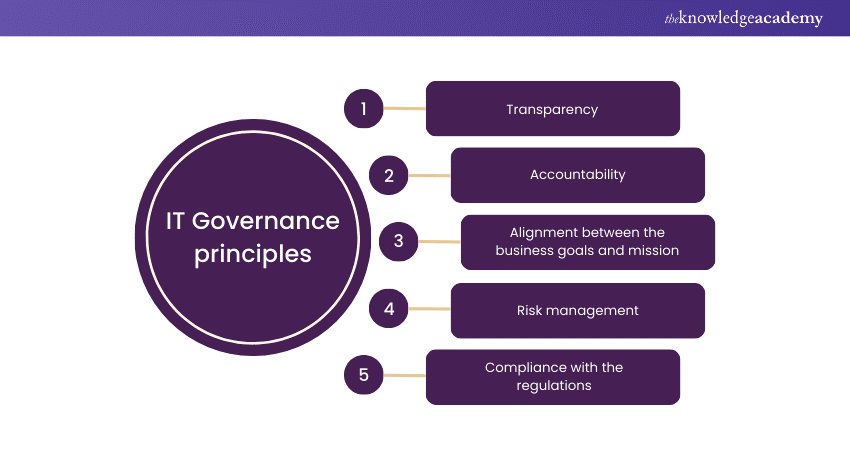
These principles are the starting point for all of the policies and procedures that govern the use of IT resources.
2) Governance structure
IT Governance structure consists of a framework and hierarchy to effectuate governance in IT. It spells out roles, duties, and reporting structures essential to guide the role of IT in decision-making and ownership. An IT Governance structure normally incorporates various governance organs, such as the following:
a) IT steering committee
b) Executive management
c) IT Governance board
d) Working groups
All governance bodies within the organisational IT Governance mechanism have distinct functions and levels of authority. The governance structure is established to ensure that the paths of communication and feedback within the IT department are clear, transparent and decision-making processes are effective.
3) Governance process
This covers the processes, values, and techniques that help govern and manage institutions in a suitable way. Governance processes include such activities as the following:
a) Strategic planning
b) Risk analysis
c) Performance evaluation
d) Regulatory control
e) Decision making
These functions allow for the proper alignment of IT efforts with the business goals, risk consideration, resource utilisation and compliance regulation adherence. Governance is usually documented, standardised, and continually enhanced with the requirements of altering business situations and modern technology development. They facilitate a systematised way of taking care of IT resources and operations necessary to meet business objectives, a concept that can be better understood when comparing Data Governance vs Information Governance.
Elevate your Cybersecurity career with our comprehensive Certified Information Security Manager (CISM) Training— join now!
IT Governance frameworks
IT Governance frameworks help simplify the governance process. Here’s how these frameworks are helpful:
1) COBIT
Control Objectives for Information and Related Technologies (COBIT), created by ISACA, is an umbrella of practices, principles, and processes supporting IT Governance, Risk Management, and compliance. It assists organisations in coordinating their business objectives with IT activities, maintaining IT regulatory compliance, and managing their IT resources properly.
2) ITIL
The Information Technology Infrastructure Library (ITIL) provides a comprehensive framework that incorporates the most widely used practices in IT Service Management. This approach focuses on delivering value to clients through IT services while addressing key areas such as service strategy, design, transition, operation, and continual improvement. For those managing network infrastructure within IT services, our GNS Command List PDF serves as a valuable resource for efficient network configuration and troubleshooting.
3) COSO
The Committee of Sponsoring Organisations of the Treadway Commission, or COSO, offers a blueprint for enterprise Risk Management, internal controls, and anti-fraud strategies. The system allows organisations to find, evaluate, and monitor the risks related to IT and other business processes to ensure that their objectives are met in a reasonable way.
4) CMMI
Capability Maturity Model Integration (CMMI) provides a guide for quality improvement in software development, service delivery, and other organisational processes with a set of defined best practices. It enables organisations to streamline their processes, ensure product quality, and reach a higher degree of maturity in their operations.
5) FAIR
Factor Analysis of Information Risk (FAIR) represents a ground for assessing and estimating the financial loss as well. It contributes to a more efficient way of risk assessment and decision making overall by offering a well-structured approach to information security management.
Be more mindful about your data privacy – sign up for our Data Privacy Awareness Course.
IT Governance benefits
IT Governance offers numerous benefits to organisations, contributing to their overall success and effectiveness:

1) Aligned goals
IT Governance is focused on aligning IT initiatives with the strategic objectives of the organisation. The corporation will fulfill this role by fostering business growth, innovation, and competitiveness through participatory planning of IT programs, ensuring they contribute to the achievement of organisational goals while adhering to the Information Governance Principles.
2) Enhanced culture
An IT Governance framework with a solid structure encourages a culture of transparency and accountability and also enforces the participation of each and all organisation members and staff. It builds confidence among stakeholders, is a catalyst for free expression, and everybody appreciates cyber security's effect on business processes.
3) Streamlined operations
Under effective IT Governance, all processes and procedures concerning the management of IT are streamlined into smooth and coherent operations. It outlines the distinct tasks, accountabilities, and authority over the operations, ensuring that unnecessary overlapping of duties is avoided. This approach helps prevent the clogging up of procedures, instead fostering an improvement in overall efficiency. The integration of IT Support Skills plays a crucial role in ensuring that these processes run seamlessly, enhancing the effectiveness of IT governance.
4) Successful projects
IT Governance is crucial so that the projects would be created and implemented properly, effectively reviewed for the assumed results. Governance in the IT projects by supervision, depreciation of risk and the resource allocation help these projects to reach their goals and deliver values.
5) Resource management
The case of IT Governance triggers policies for organisations that maximise the effectiveness of the IT resources they have while also ensuring their proper management. It is instrumental in specifying the direction of resource distribution, preparing an appropriate budget, and getting the highest returns on IT investments, with the main aim of satisfying business goals.
Solve crimes with just your screen and keyboard. Sign up for our Computer Forensics Foundation Training - register now!
Best practices for Effective IT Governance
Effective IT Governance relies on several best practices to ensure alignment with organisational objectives and efficient management of IT resources:
1) Establish a robust team
Create a dedicated IT Governance unit with members drawn from several departments being represented, hence tapping experts from varied fields. Given that the team should include managers, IT, finance, the legal department, and others relevant to the main processes, our team can make the proper oversight and decision-making.
2) Monitor IT performance
It means to evaluate and measure IT performance regularly. This involves the creation of Key Performance Indicators (KPIs), monitoring progress toward goals, and, during the review phase, making changes and resolving problems found.
3) Continuously review plans
Periodically, review and integrate IT Governance plans to serve the companies shifting business agenda, technology advancements, and laws/regulations. This makes sure that IT poise remains widespread and complex over time.
4) Utilise existing frameworks
Apply COBIT, ITIL, and ISO/IEC 27001 standards, which are frameworks and norms, to set the guidelines for IT Governance in the business. These approaches are the source of the time-saving methodologies, best practices, and performance guidelines for enlightened governance of IT activities without reinventing the process from the beginning.
5) Choose the technology solution that suits your needs
Enlist solutions or technologies in line with the objectives of your organisation, capacities, and competencies. Do you have a certain type of system for IT Governance software, a Project Management tool, or a performance monitoring system? Well, look for the functionality, scalability and ease of integration as your IT Governance initiatives require these to be supported effectively.
Build the best Network Security systems – sign up for our Network Defence Training!
Conclusion
We hope that after reading this blog you have understood What is IT Governance. It serves as the backbone of organisational success, guiding IT strategy, operations, and decision-making. By embracing the principles and practices mentioned in this blog, businesses can enhance transparency, manage risks, and optimise resources to achieve their goals effectively in today's dynamic digital landscape.
Unlock your potential in Cybersecurity leadership with our CISM Training - join today and advance your career to the next level!
Frequently Asked Questions
What is the role of IT Governance?

The role of IT Governance is to ensure alignment of IT activities with organisational objectives, manage risks effectively, optimise resource utilisation, foster accountability and transparency, and drive strategic decision-making in the digital era.
What are the three pillars of IT Governance?
The three pillars of IT governance are alignment with business objectives, Risk Management, and resource optimisation. These pillars ensure that IT activities support organisational goals, mitigate risks, and allocate resources efficiently to drive business success.

The Knowledge Academy


Global Training Provider
The Knowledge Academy is a world-leading provider of professional training courses, offering globally recognised qualifications across a wide range of subjects. With expert trainers, up-to-date course material, and flexible learning options, we aim to empower professionals and organisations to achieve their goals through continuous learning.


 If you wish to make any changes to your course, please


