


 Top Rated Course

We may not have the course you’re looking for. If you enquire or give us a call on + 1-866 272 8822 and speak to our training experts, we may still be able to help with your training requirements.
IT Management Explained: Definition, Roles, and Benefits
The Knowledge Academy 05 August 2026IT Management involves overseeing an organisation’s Information Technology systems to ensure they support business goals efficiently. It includes managing hardware, software, data, and networks, along with IT planning, Cyber Security, and system performance. Effective IT Management enhances productivity, innovation, and stability.

Training Outcomes Within Your Budget!
We ensure quality, budget-alignment, and timely delivery by our expert instructors.
Table of Contents
What is Meant by IT Management?
IT Management means overseeing and controlling all the technology resources in a company.This includes managing computers, networks, software, security systems, data storage, and IT teams. The main goal is to make sure technology runs smoothly, stays secure, supports business goals, and helps the company grow.
IT Managers plan upgrades, solve tech problems, monitor performance, and manage budgets to keep everything working efficiently. They make sure all the tech in a business works well, safely and supports success.
The Importance of IT Management
The most important goals of IT Management include ensuring reliability of IT infrastructure's, availability, and scalability. It also focuses on optimising resource utilisation. Along with it managing IT budgets properly and ensuring innovation to support the organisation's growth is also of utmost importance.
Without effective IT Management, organisation's risk of failing might be more. This can be due to outdated technologies, inefficient processes, and increased levels of cyber threats. By achieving these objectives, businesses can enhance their operational efficiency. Along with that, they can also improve user satisfaction and stand apart in a competitive market. In today's tech-driven world, IT Management is more crucial than ever. It helps businesses

1) Streamline Operations: Automating routine tasks and improving workflows
2) Enhance Security: Protecting sensitive data from cyber threats
3) Support Decision Making: Providing valuable data analytics and insights
4) Drive Innovation: Leveraging new technologies to develop innovative products and services
Key Features of IT Management
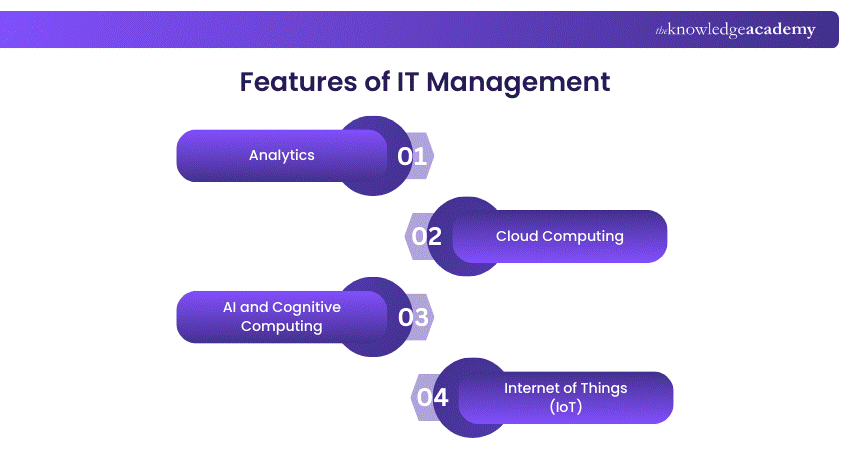
In the dynamic land of IT Management, several technological advancements have become key features. They significantly influence how organisations deploy, manage, and use technology for competitive advantage. Explore how features like analytics, cloud computing, AI and cognitive computing, and the Internet of Things (IoT) play vital roles in modern IT Management.
Analytics
Analytics in IT Management refers to the systematic analysis of data and metrics. It helps in informing decision-making processes. This includes use of advanced analytics tools and methodologies. It extracts insights from data, which can then be used to optimise operations, improve customer experiences, and drive strategic initiatives. The key aspects include:
1) Predictive analytics: It uses historical data to predict future trends. This helps organisations anticipate issues, understand customer behaviour, and identify opportunities.
2) Performance analytics: It focuses on analysing the performance of IT infrastructure and applications, ensuring they meet the desired efficiency and reliability standards.
3) Data visualisation: Tools that present data in an easily digestible format. It enables decision-makers to grasp complex concepts and identify patterns quickly.
Cloud Computing
Cloud computing has brough the necessary revolution. It offers adjustability, flexibility, and cost-effective solutions for storing data and deploying applications. It also eliminates the need for substantial upfront capital investment in hardware and reduces the burden on IT staff. This deduction in load is because of offloading maintenance and upgrades to the cloud provider. Its key features include:
1) Scalability
2) Disaster recovery and backup
3) Collaboration efficiency
AI and Cognitive Computing
Artificial Intelligence (AI) and cognitive computing are transforming IT Management. They enable smarter, automated, and more proactive operations. These technologies allow systems to simulate human thought processes. It learns from data and makes decisions with minimal human intervention. These applications include:
1) Automated problem resolution: AI tools can predict and diagnose IT issues before they impact business operations. This is often resolved without human intervention.
2) Enhanced security: AI and Machine Learning (ML) algorithms detect and respond to Cyber Security threats faster and more accurately. It is therefore more well-suited than traditional methods.
3) Optimised IT operations: Cognitive computing can analyse vast amounts of operational data to identify inefficiencies and recommend optimisations, leading to cost savings and improved performance.
Understand all the primary concepts of D programming language with our D Programming Language Training – join now!
Internet of Things (IoT)
The Internet of Things (IoT) refers to the network of physical objects ("things"). These are embedded with sensors, software, and other technologies to connect and exchange data with other devices and systems over the internet.
Incorporating these key features into IT Management practices allows organisations to enhance efficiency, foster innovation, and create a more resilient and agile IT infrastructure. As technology continues to evolve, staying abreast of these advancements and understanding how to effectively leverage them will be critical for IT leaders seeking to drive business value through their IT strategies.
Key Roles of IT Management
In today's world, technology drives everything, from daily operations to big business decisions. IT Management is about much more than just fixing computers; it’s about leading, protecting, planning, and growing a company's entire technology framework. Here are some of the key roles discussed:

Leading IT Projects
1) Initiate, plan, and manage key technology projects for business success
2) Define project goals, timelines, deliverables, and success metrics
3) Set deadlines and allocate resources efficiently
4) Ensure team alignment across different departments and project stages
5) Coordinate every phase, from kickoff meetings to final implementation
6) Manage risks and solve problems during project execution
7) Deliver projects on time, within budget, and meeting quality standards
8) Examples include CRM implementation, cloud migration, and Cyber Security upgrades
Monitoring Performance
1) Monitor performance of hardware, software, networks, and cloud services
2) Track uptime, speed, security alerts, and system failures
3) Analyse performance data to catch issues early
4) Use monitoring tools for real-time system health tracking
5) Reduce outages and system downtime
6) Enable faster troubleshooting and quicker fixes
7) Improve overall user experience and system reliability
Defining Infrastructure
1) Design, build, and maintain the company's IT infrastructure
2) Manage servers, data centers, networks, Cyber Security, and backup systems
3) Select technologies that meet current business needs
4) Plan for future growth with scalable solutions
5) Balance innovation, security, and cost-effectiveness in decision-making
6) Ensure reliable, secure, and efficient operations through a strong tech foundation
Assessing Software and Hardware
1) Regularly review company software and hardware needs
2) Evaluate performance of existing systems and tools
3) Research and compare new technologies and vendors
4) Recommend upgrades or replacements when needed
5) Ensure tools are secure, efficient, and scalable
6) Negotiate contracts and manage technology partnerships
7) Plan refresh cycles to avoid outdated or risky systems
Developing IT Policies
1) Create rules and guidelines for using company technology
2) Define policies on data security, passwords, and software usage
3) Establish protocols for remote work and Bring Your Own Device (BYOD)
4) Ensure compliance with legal and industry regulations
5) Protect sensitive information through clear access controls
6) Prepare disaster recovery and data backup policies
7) Train employees on safe and responsible tech use
Overseeing an IT Team
1) Lead and manage IT staff across various roles
2) Assign tasks and set clear team goals
3) Provide guidance, mentorship, and technical support
4) Foster collaboration and strong team communication
5) Handle recruitment, training, and performance reviews
6) Encourage innovation and skill development
7) Resolve team conflicts and maintain a productive environment
Managing IT Costs and Budgets
1) Plan and allocate budgets for IT resources
2) Track expenses on hardware, software, and services
3) Evaluate Return on Investment (ROI) on technology investments
4) Cut unnecessary costs without affecting performance
5) Forecast future IT spending based on business needs
6) Negotiate vendor contracts for better pricing
7) Ensure cost-effective and efficient use of all tech assets
Best practices in IT Management
Listed below are the best practices in IT Management:
1) Adopting a proactive approach
Proactively managing IT resources can help prevent issues before they occur, rather than reacting to problems after the fact. This involves regular system maintenance, monitoring, and forecasting future needs.
2) Emphasising on Security
Given the increasing sophistication of cyber threats, prioritising IT security is non-negotiable. Regularly updating security protocols, conducting training sessions on Cyber Security awareness, and implementing robust access controls are essential measures.
3) Fostering Collaboration
IT Management should not operate in a silo. Collaborating with other departments ensures that IT strategies are aligned with the overall business objectives and that technology solutions meet the needs of various stakeholders.
4) Leveraging Data for Decision Making
Utilising data analytics can provide valuable insights into operations, customer behaviour, and market trends. This information can guide strategic decisions, helping businesses to innovate and stay competitive.
Register today and learn the concept of data reshaping and regression with our R Programming Course - sign up now!
5) Staying updated With technological trends
The technology landscape is constantly changing. Keeping abreast of the latest trends, such as cloud computing, AI, and machine learning, can help organistions leverage new opportunities and stay ahead in the market.
Challenges Faced by IT Management
Managing IT in a modern organisation isn’t easy. IT leaders face a wide range of challenges as they try to balance technology, security, costs, and business goals. Here are some of the most common challenges:
1) Cyber Security threats like hacking, phishing, and data breaches
2) Fast-changing technology requiring constant learning and updates
3) Limited budgets for upgrades and new tools
4) System integration issues with new hardware/software
5) Shortage of skilled IT professionals and training needs
6) Downtime and reliability concerns affecting productivity
7) Aligning IT strategy with overall business goals
Is MIS the Same as IT Management?
No, Management Information Systems (MIS) and IT Management are related but not the same.
MIS focuses on using technology to organise, store, and manage information to help businesses make better decisions. It's more about how information flows through systems like databases, reporting tools, and dashboards to support business operations.
IT Management, on the other hand, is broader. It covers planning, implementing, and maintaining all of a company's technology infrastructure. It includes hardware, software, networks, Cyber Security, and support teams.
Here is a Comparison Table:

Conclusion
IT Management is the heart of every successful business today. Good IT Management keeps systems running smoothly, supports business goals, and prepares companies for future challenges. As technology becomes even more important, businesses that invest in strong IT leadership will always stay ahead. In simple words: Great IT Management means a stronger, smarter, and more successful business.
Attain knowledge of software essentials and various Operating Systems with our IT Training – join today!
Frequently Asked Questions
What are the Top Tools Used In IT Management?

Top IT management tools include ServiceNow (ITSM), Jira (project tracking), SolarWinds (network monitoring), Nagios (infrastructure monitoring), Microsoft System Center (system management), and Trello (collaboration). These tools help manage systems, track issues, monitor networks, and streamline IT operations for better efficiency and control.
Who Works Under IT Manager?
As the IT Manager is responsible for maintaining all system, a diverse range of professionals work under them. It ranges from engineers, operators, product managers, security practitioners, etc.

The Knowledge Academy


Global Training Provider
The Knowledge Academy is a world-leading provider of professional training courses, offering globally recognised qualifications across a wide range of subjects. With expert trainers, up-to-date course material, and flexible learning options, we aim to empower professionals and organisations to achieve their goals through continuous learning.


 If you wish to make any changes to your course, please


