




We may not have the course you’re looking for. If you enquire or give us a call on 01344203999 and speak to our training experts, we may still be able to help with your training requirements.
Home
 Resources
IT Security & Data Protection
What is Management Information Systems? A Complete Insights to MIS
Resources
IT Security & Data Protection
What is Management Information Systems? A Complete Insights to MIS
Resources
IT Security & Data Protection
What is Management Information Systems? A Complete Insights to MIS
What is Management Information Systems? A Complete Insights to MIS
ByThe Knowledge AcademyLast updated on: 02 October 2026
Curious about Management Information Systems (MIS)? MIS streamlines data flow, helping provide accurate and timely information for better decision-making. By integrating various functional areas, MIS enhances organisational efficiency and coordination, supporting overall strategic goals and operational effectiveness. Let's dive in!
Quick Overview
1. MIS combines people, processes and technology to manage organisational information.2. Technologies such as AI, cloud computing, automation and data analytics are expanding MIS capabilities.3. MIS professionals require a combination of business, technical, analytical and communication skills.4. Career opportunities include IT Manager, Business Intelligence Analyst, Systems Analyst, Information Systems Manager and Software Developer.5. MIS can support different organisational levels, from day-to-day operations to management and strategic planning.
Imagine running a business without any insight into your data: no understanding of customer behaviour, no visibility into inventory, and no grasp of financial health. This is where management information systems come into play, acting as the central nervous system of an organisation. So, what are management information systems?
By using MIS effectively, businesses can transform raw data into valuable insights, support strategic decisions, and improve operational efficiency. In this blog, we will explore what management information systems are, their components, and their role in modern business management.
What is a Management Information System?
A Management Information System (MIS) involves people, processes and technology used to collect, process, store and provide information that supports organisational operations, management and decision-making.
MIS can involve various systems and applications, including:
1) Decision Support Systems (DSS)
2) Transaction Processing Systems (TPS)
3) Enterprise resource planning and business reporting systems
4) Database and business intelligence systems used for organisational reporting and decision-making

What do Information Systems Professionals do?
MIS professionals connect business needs with computing knowledge within organisations. They can work across various roles that involve managing data, improving systems and supporting technology projects.
Data Analysts analyse organisational data, identify trends and present insights that support business decision-making, while Database Administrators manage, maintain and secure databases to ensure data remains available, reliable and properly structured.
Business and Systems Analysts help improve business processes by translating business needs into technical requirements and collaborating with IT professionals to develop or implement suitable systems. Project Managers oversee projects by coordinating efforts between data analysts, business professionals and IT teams using suitable project management approaches.
MIS graduates can also specialise in business domains such as accounting, finance or marketing to broaden their expertise. Their combination of business and technical knowledge can help them contribute to technological improvements across various organisational areas.
Common Types of Information Systems Used in MIS
Here are some common types of information systems that can support MIS:
1) Decision Support System (DSS): Analyses business data to help managers make informed decisions. For instance, a DSS can project revenue based on new product sales forecasts.
2) Transaction Processing System (TPS): Handles routine business transactions such as payroll processing, order management in e-commerce, and invoicing.
3) Management Reporting Systems: Provide managers with structured reports and summaries based on organisational data, helping them monitor performance and support planning and control.
4) Expert Systems: Use knowledge and rules from a specific domain to provide recommendations or support problem-solving and decision-making.
Trainer’s Pro Tip
Focus on how each MIS tool supports a specific business need. Linking systems such as DSS or TPS to real workplace decisions makes their purpose easier to understand and remember.
Benefits of a Career in Management Information Systems
Here are some important benefits of pursuing a career in MIS:
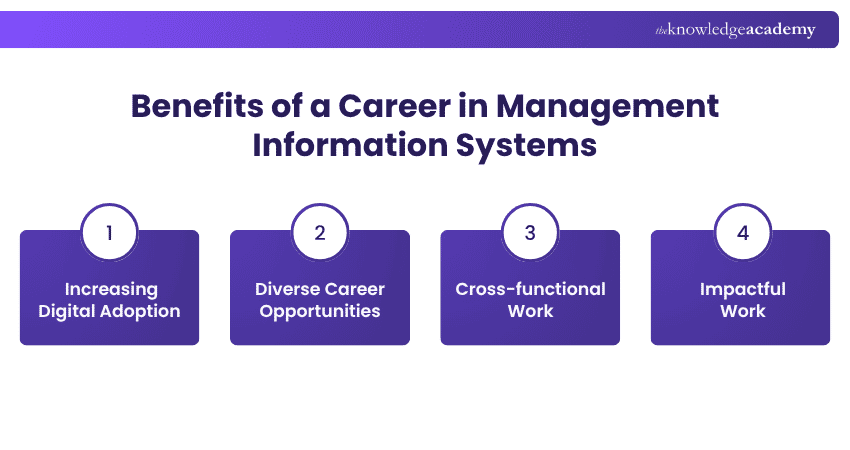
1) Increasing Digital Adoption: MIS professionals support organisations using technologies including data science, Internet of Things (IoT), artificial intelligence, and other digital tools.
2) Diverse Career Opportunities: MIS knowledge can support careers across systems analysis, IT management, business intelligence, database management and related technology roles.
3) Cross-functional Work: MIS professionals often work across technology and business functions, helping organisations connect technical capabilities with operational needs.
4) Impactful Work: MIS professionals can support improvements in customer service, sales performance, and cost efficiency, contributing to broader organisational goals.
Understand key concepts in data modelling and effective database handling with the Business Intelligence Reporting Training – Join now!
Essential Career Skills for Management Information Systems
Information Systems (IS) professionals bridge the gap between business and information technology (IT), requiring a blend of business acumen and technical skills. Key skills include:
1) Business Acumen: Knowledge in areas like accounting, finance, marketing, and operations to align technology with business needs.
2) Technical Skills: Understanding of programming, database technologies, and emerging fields like machine learning and cybersecurity.
3) Analytical Skills: Ability to analyse data and identify trends.
4) Communication: Effectively conveying technical concepts to both technical and non-technical stakeholders.
5) Problem-solving: Developing creative solutions for complex issues.
6) Project Management: Managing projects, setting goals, and meeting deadlines.
7) Adaptability: Staying current with evolving technologies and business needs.
8) Collaboration: Working well with diverse teams.
9) Continuous Learning: Keeping skills up to date with industry advancements.
Management Information Systems Career Paths
Aspiring MIS professionals can pursue career paths based on their interests. Some common job roles include:
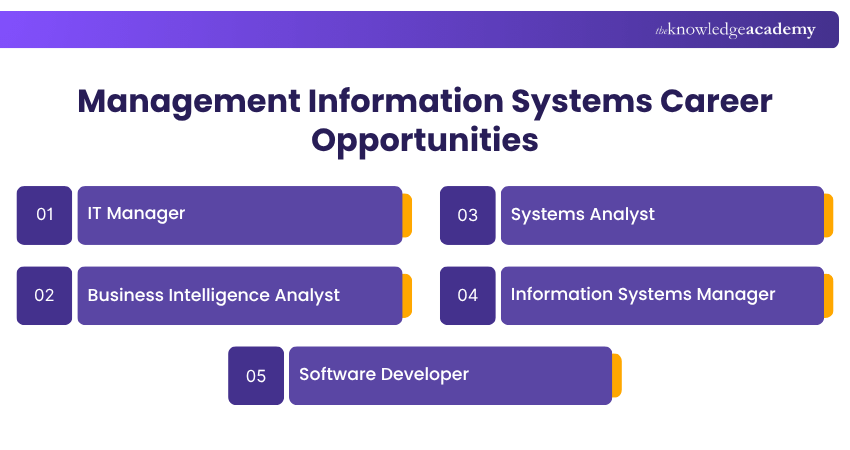
1) IT Manager
IT managers plan, coordinate and oversee an organisation's technology activities. They help determine IT requirements, manage technology projects and teams, and ensure that computer systems support organisational goals.
2) Business Intelligence Analyst
Business intelligence analysts enhance organisational performance by analysing business data, identifying trends and developing reports or insights that support decision-making. They possess strong analytical and problem-solving skills and understand business needs to provide practical recommendations.
3) Systems Analyst
Systems analysts examine an organisation's existing computer systems and processes, identify areas for improvement and help design technology solutions that meet business requirements.
4) Information Systems Manager
Information systems managers plan, coordinate and oversee an organisation's information systems and related technology activities. They may manage IT teams, assess technology requirements, oversee system implementation and ensure information systems support organisational goals.
5) Software Developer
Software developers design, develop and maintain software applications and systems. They use programming and technical skills to create and improve software solutions that meet organisational or user requirements.
Future of Management Information Systems
MIS is increasingly incorporating technologies such as artificial intelligence, cloud computing, automation and advanced data analytics to improve processes and provide deeper insights. MIS professionals can play an important role in advancing digital transformation, automating tasks, and supporting strategic decision-making within organisations.
Role and Importance of MIS Departments
MIS departments help manage information systems that support core business operations. Their responsibilities can include maintaining legacy systems, supporting modernisation and ensuring that technology remains aligned with organisational requirements.
| Aspect | Description |
| Role of MIS Teams | Oversee critical systems that support core business operations, such as accounting and order entry. Manage legacy software and hardware. |
| Legacy Systems | May have been developed by former programmers and can have limited documentation. |
| Importance of MIS | MIS supports enterprise functionality, information management, business operations and informed decision-making. |
| Management Awareness | Coordination between MIS teams and senior management helps align information systems with organisational priorities and operational requirements. |
Understand how to add new reports to a document and resize columns and rows with the Business Objects Reporting Training – Sign up now!

The Knowledge Academy develops accessible learning content across Project Management, IT, Cybersecurity, Data Science, Business Analysis, HR, Accounting and Finance, Leadership and Health and Safety. Its resources combine subject research with clear explanations to help professionals build practical knowledge across a wide range of disciplines.
View Detail

 If you wish to make any changes to your course, please


