


 Top Rated Course

We may not have the course you’re looking for. If you enquire or give us a call on 01344203999 and speak to our training experts, we may still be able to help with your training requirements.
What is IT Infrastructure & How Can IT Help Businesses?
John Davies 17 August 2026IT Infrastructure explains the core components that support IT operations, including hardware, software, networks, and data systems within an organisation. It helps professionals understand how systems run efficiently and develop skills to manage, maintain, and optimise infrastructure for reliable performance and business continuity.

Training Outcomes Within Your Budget!
We ensure quality, budget-alignment, and timely delivery by our expert instructors.
Table of Contents
According to a detailed research report by Market Research Future (MRFR), "Global IT Infrastructure Services Market information by Type, by Service Type, by Organization Size and Region - Forecast to 2027", the market is predicted to grow at 11.1% CAGR to reach GBP 106.94 billion in 2026.
As per the future projections, the size of the worldwide data centre infrastructure market will increase from GBP 84.16 billion in 2019 to GBP 126.66 billion in 2027, with a CAGR of 5.5% during the forecast period. A report titled "Data Center Infrastructure Market Forecast, 2026-2027," Fortune Business Insights offers this information.
Table of Contents
1) What is IT Infrastructure?
2) Components of the IT Infrastructure
3) What are the Types of IT Infrastructure?
4) How is IT Infrastructure useful for Business?
5) What is IT Infrastructure Security, and How Does it Benefit?
6) What is IT Infrastructure Management?
7) Benefits of IT Infrastructure
8) Conclusion
What is IT Infrastructure?
The components needed to operate and administer corporate IT environments are referred to as Information Technology (IT) infrastructure. IT Infrastructure services can be set up on-site on the company's premises or in a cloud computing system.
The components utilised to supply IT services and solutions comprise - hardware, software, networking elements, an Operating System (OS), and data storage. IT Infrastructure products are offered as online services provided by service providers, such as Infrastructure-as-a-Service, or as downloaded software applications that run on top of already-existing IT resources, such as Infrastructure-as-a-Service (IaaS).

Components of the IT Infrastructure
These are the components of IT Infrastructure:
Hardware
Hardware comprises all the necessary elements required to support the essential functions of the machines and other equipment. It includes personal computers, routers, switches, hubs, servers, cabling, and other equipment.
The power, cooling, dedicated rooms, and other facilities can also be considered a part of the hardware infrastructure.
Software
The term "software" refers to the applications, scripts, and programs that a business uses to execute a specific task, with a set of instructions, such as web servers, content management systems, and the Operating System (Example: Windows & Linux). The Operating System establishes the connections between all your software and the functional hardware and oversees managing system hardware and resources.
Networking
Network operations, management, and communication between internal and external systems are made possible by interconnected network components. The network includes hardware, switches, routers, cables, firewalls, internet connectivity, network enablement, and security.
To lessen the risk of data theft or damage, it makes sure that staff may only access shared and accumulated data from rigidly controlled access points.
Get your Agile IT Service Management Training Now!
What are the Types of IT Infrastructure?
IT Infrastructure can be divided into three types of Infrastructure, mentioned as follows
Traditional Infrastructure
The components of a traditional infrastructure are entirely controlled and owned by the company within its premises, including datacentres, data storage, and other equipment. Traditional infrastructure is frequently regarded as expensive to maintain and requires a significant quantity of gear, such as servers, power, and dedicated physical space.
Cloud Infrastructure
The components and resources required for Cloud Computing are known as cloud infrastructure. The resources that are solely available to you will enable you to build your private cloud. One also can use a public cloud service by renting a cloud infrastructure from a particular cloud provider like Google, Microsoft, Amazon and more.
You can build a hybrid cloud by integrating some level of automation, workload mobility, and management across various clouds. Many users (like Uber, Netflix, and Hulu) depend highly on the hybrid cloud model due to their pay-per-use features.
Hyperconverged Infrastructure
You can control your computing, network, and data storage resources from a single interface - it is all attributed to the Hyperconverged Infrastructure. By combining software-defined computing and data storage, you may serve more concurrent workloads with scalable architectures on hardware that is widely used.
How is IT Infrastructure useful for Business?
Technology now powers every aspect of modern organisations, including worker labour, operations, and the production of goods and services. Technology can help with communication, efficiency, and output when properly networked.
A corporation may accomplish its objectives and get a competitive edge in the market with the aid of an adaptive, dependable, and secure IT Infrastructure. Businesses' imprecise infrastructure configuration can lead to productivity, connectivity, and security difficulties, such as system failures and breaches.
A successful corporation maintains the right management team and decides on wise investments for hardware, software, and network services. It is not wise to economise on your IT Infrastructure to save money to meet the immediate target, having the short-term intent. Even something as simple as poor wiring or cabling can make a high-end software product useless.
Hence, Business leaders must participate in the infrastructure discussions, highlighting the significance of IT Infrastructure and determining the investments necessary for the future to address the challenges posed by the next generation of IT.
Build practical understanding of service lifecycles, relationships, and governance with the ITIL® 5 Service Certification – Register now!
What is IT Infrastructure Security and How Does it Benefit?
The process of protecting the underlying networking infrastructure via installing preventative measures to prevent unauthorised access, modification, deletion, and theft of resources and data is known as network infrastructure security. A few examples of these security measures include firewalls, access control, application security, behavioural analytics, virtual private networks (VPN), wireless security, and intrusion prevention systems.
Network infrastructure security requires a comprehensive approach to contemporary procedures and practices to guarantee that the underlying infrastructure is secured.
When deciding which strategies to implement, the Cybersecurity and Infrastructure Security Agency (CISA) suggests considering several different angles.
1) It comprises function and network segmentation.
2) Reducing lateral communications that are not necessary.
3) Hardening network devices and following best encryption practices.
4) Secure access to trusted users.
5) Out-of-band (OoB) network management.
6) Verify the hardware & software integrity to avoid malicious attacks.
What is IT Infrastructure Management?
IT Infrastructure Management coordinates IT resources, systems, platforms, people, and environments. The following are a few of the most typical types of technology Infrastructure Management:
1) OS Management: Manages content, patches, provisioning, and subscriptions for environments that use the identical Operating System.
2) Cloud Management: Provides control over end users, data, applications, and services running in a cloud by managing resource deployments, integration, use, and disaster recovery.
3) Virtualisation Management: The physical hardware that supports them makes it easier to manage resources, improve Data Analysis, and streamline processes that interact with virtual environments.
4) Business Process Management: This is the practice of analysing, modelling, and optimising business processes that are predictable or frequently repeated.
5) IT Automation: Also known as infrastructure automation, IT Automation develops concurrent instructions and procedures to minimise or lower human interaction with IT systems.
6)Application Programming Interfaces (API) Management: Distributes, regulates, and analyses the (APIs) that link data and applications across ventures and clouds.
7) Repository orchestration: Automates the management, scaling, networking, and deployment.
8) Configuration Management: Regularly maintain servers, software, computer systems and other arrangements in a desired and stable state.
9) Data Management: Data management uses the gathered and stored data for companies to realise - the type of data they have, who owns it, where it is stored, who can view it, and how to access it.
10) Risk management: Risk management is about identifying, evaluating, and developing plans to reduce or control risks and their effects.
Understand governance, AI, automation, and DevOps in product-driven service delivery with the ITIL® 5 Product Certification – Join today!
Benefits of IT Infrastructure
An ideal IT Infrastructure can optimise your business productivity, entitling your business with high-capacity storage, security, a High-speed network, efficient WAN (Wide Area Network), virtualisation, and zero disruption time.
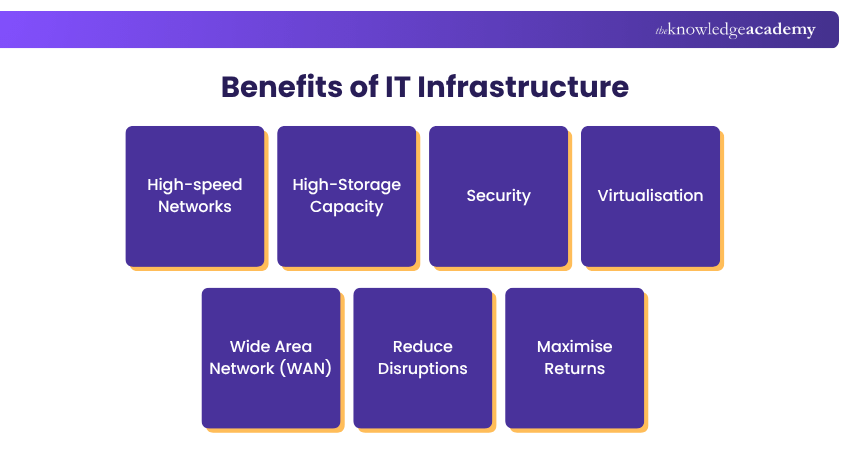
1) High-speed Networks:
It optimises the computer network to reduce high-volume data flow delays by deploying superior infrastructure components.
2) High-Storage capacity:
It offers a rigid backup facility to store data in bulk without affecting performance and speed, also the provision to recover the data with effect to any untoward incident or disaster.
3) Security:
Security systems that control data availability and information access are included in infrastructures. It can assist in shielding a business from cyberattacks and data breaches, preserving customer confidence.
4) Virtualisation:
It enables faster server provisioning, higher uptime, disaster recovery, and energy savings.
5) WAN (Wide Area Network):
Systems that manage information access and data availability are included in infrastructures. It can help protect a company from data breaches and cyberattacks, ensuring customer trust is maintained.
6) Reduce Disruptions:
Many organisations are susceptible to outages, downtime, and system failure. Switching to cloud-based infrastructure can minimise business disruptions and eliminate system downtime to maintain costs and increase revenues.
7) Maximise Returns:
It can optimise your revenue and create prominent business opportunities by cutting costs and influencing customers to invest for the long term.
Conclusion
The blog concludes that - Your IT Infrastructure must offer dependable and secure multi-vendor IT solutions. The solutions should comprise hardware, software, and services to maintain the long-term survival of an organisation. Proceeding with smart investments towards the infrastructure can help you to meet the challenges and make your business prosper and flourish.
Learn modern ITIL concepts for digital products, services, and value creation with the ITIL® 5 Foundation Certification – Join now!
Frequently Asked Questions
What are the 7 Components of IT Infrastructure?

The 7 components of IT Infrastructure include hardware, software, networking, data storage, security, cloud services, and IT services. Together, they support system operations, enable communication, protect data, and ensure reliable performance, helping organisations run efficiently and meet business goals.
Which are Examples of IT Infrastructure?
IT Infrastructure includes the components needed to run and manage an organisation’s IT environment. Examples include hardware like servers and computers, software such as operating systems and CRM systems, networking tools like routers and firewalls, and cloud services supporting storage and applications.

John Davies


Cyber Security Governance & Assurance Specialist
John Davies is a cybersecurity expert specialising in governance, risk management, and compliance. With over 15 years in the field, he has led enterprise-wide security programmes across finance, healthcare and public sector organisations. His content provides practical guidance on building secure environments, managing risk and aligning with regulatory frameworks.


 If you wish to make any changes to your course, please


