


 Top Rated Course

We may not have the course you’re looking for. If you enquire or give us a call on 01344203999 and speak to our training experts, we may still be able to help with your training requirements.
What is Arbitrage: Types, Benefits And Risks Explained
The Knowledge Academy 03 February 2026Arbitrage is buying and selling the same asset simultaneously in different markets to exploit temporary price differences, earning risk-free profits quickly. Successful Arbitrage requires speed, precision, and minimal transaction costs to ensure profitability. Its typical types include spatial, merger, and statistical Arbitrage.

Training Outcomes Within Your Budget!
We ensure quality, budget-alignment, and timely delivery by our expert instructors.
Table of Contents

Ever seen a product cheaper on one website than another? That’s Arbitrage in action, buying low in one place and selling high in another to have the difference. It is a simple idea and the foundation of one of the smartest financial strategies used across markets worldwide.
Now imagine applying that concept to stocks, Cryptocurrencies, currencies, or even concert tickets. With the right tools and timing, Arbitrage can offer opportunities to earn. Ready to learn how to turn market inefficiencies into profit? In this blog, you can explore What is Arbitrage, its main types and its benefits. Let’s dive in!
Table of Contents
1) What is Arbitrage?
2) How Does Arbitrage Work?
3) Different Types of Arbitrages
4) Benefits of Arbitrage
5) Drawbacks of Arbitrage
6) Arbitrage Examples
7) How Do Regulatory Changes Impact Arbitrage Opportunities?
8) Can You Lose Money in Arbitrage?
9) Conclusion
What is Arbitrage?
Arbitrage is a strategy where an investor buys and sells the same asset in different markets at the same time. They do this to profit from small price differences. These gaps are usually brief, but high volumes can make the gains worthwhile. Hedge funds and advanced investors frequently use this technique.
Arbitrage also helps keep financial markets efficient by smoothing out price inconsistencies across exchanges. When traders quickly act on these small differences, prices naturally move closer together, creating a more balanced and fair market. Although it may seem straightforward, successful arbitrage often requires speed, technology, and careful risk management to execute effectively.

How Does Arbitrage Work?
Arbitrage is a powerful strategy that relies on market inefficiencies, and it unfolds through a structured process. Here’s how it works step by step:
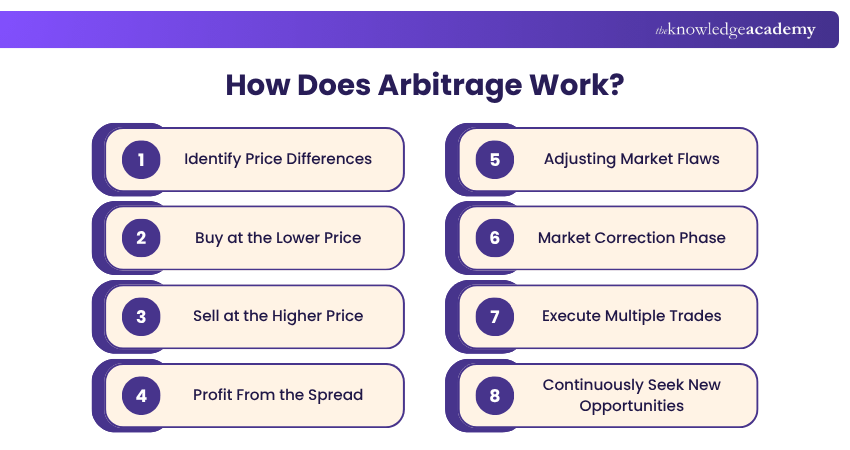
1) Identify Price Differences: The first step in identifying the same asset’s price, security, or commodity differences is to identify them across two different markets or exchanges. For example, a stock might be at a lower price on one exchange and higher on another.
2) Buy at the Lower Price: Once there is a price difference identification, the Arbitrageur buys the asset at the lower price in the first market or exchange.
3) Sell at the Higher Price: The Arbitrageur then performs the same asset selling in the second market or exchange with the higher price.
4) Profit From the Spread: The price difference between the two markets is known as the Spread, and this represents the profit that every Arbitrageur makes.
5) Adjusting Market Flaws: By exploiting the price difference, the Arbitrageur helps improve market efficiency by correcting the pricing flaw. As the market adjusts, there is a considerable shrinking of the price difference.
6) Market Correction Phase: Once the market corrects itself, the price difference disappears, and the opportunity for Arbitrage profit ends.
7) Execute Multiple Trades: In efficient markets, prices are stable and don’t drastically change. Therefore, to make a meaningful profit, Arbitrageurs often need to execute multiple trades across different markets.
8) Continuously Seek New Opportunities: Since Arbitrage opportunities are usually short-lived, Arbitrageurs must constantly look for new price differences to exploit and make profits.
Different Types of Arbitrages
Now that you’ve heard What is Arbitrage and how it works, let’s look at the three common types of Arbitrage strategies used by Traders and investors:
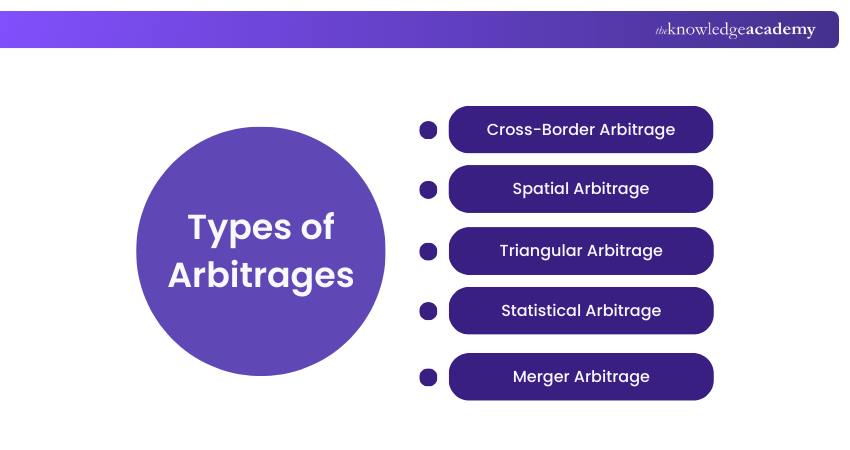
1) Cross-Border Arbitrage
a) This type focuses on exploiting price differences for assets or commodities in different countries.
b) Arbitrageurs take advantage of market exchange rates, tariffs, or differing conditions fluctuations between nations to buy low in one country and sell it at higher price in another country.
c) For instance, particular asset’s (like a stock or commodity) price might be cheaper in the U.S. than in Japan. An Arbitrageur could buy it in the U.S. and sell it in Japan, profiting from the differences in price.
2) Spatial Arbitrage
a) This involves buying product or assets in one location where it is lower priced and selling it in another location with a higher price.
b) The price differences can occur within a single country or between different states or cities.
c) This Arbitrage type relies on the fact that prices can differ between different locations due to local market conditions and Supply Chain.
3) Triangular Arbitrage
a) This Arbitrage form deals specifically with the Foreign Exchange (Forex) market’s currency.
b) The process involves exchange rates discrepancies of the three different currencies.
c) If the currency’s exchange rates don’t perfectly align, the Trader can make a profit.
d) For example, if the exchange rates are off by small amounts, the Trader will end up with more of the original currency (USD) than they started with, capturing the profit from the differences in conversion rates.
Master Blockchain markets with Cryptocurrency Trading Training- Sign up today!
4) Statistical Arbitrage
a) Statistical Arbitrage uses Math and historical data to find patterns between related assets.
b) If two assets usually move together in price but suddenly don’t, a Trader can bet that they’ll return to their usual relationship and make money when they do.
c) For example if two technological Stocks usually rise and fall together, but one suddenly drops, a Trader might buy the one that dropped and sell the one that rose.
5) Merger Arbitrage
Merger Arbitrage is applied during corporate events like mergers and acquisitions. This happens when one company is buying another.
The Stock price of the company being bought usually rises. Traders buy shares in the target company to profit when the deal goes through.
For example, if Company A is buying Company B for £50 per share, but Company B is still trading at £47, a Trader might buy shares in Company B. This is done hoping to make £3 per share when the deal is completed.
Turn your interest in stocks into a serious skill with our Stock Trading Course – Register today!
Benefits of Arbitrage
Arbitrage offers several advantages, both for Traders and the broader finance market. Here are some of the key benefits:
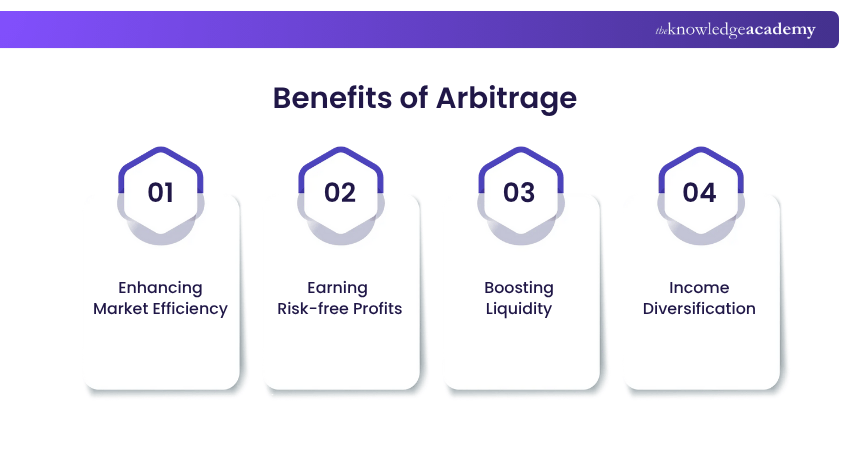
1) Enhancing Market Efficiency
Arbitrage helps improve market efficiency by correcting price discrepancies. When Arbitrageurs exploit price differences, they bring the asset prices closer to their true value. This ensures that prices are more accurately aligned across markets.
This process benefits the market comprehensively, making it more efficient and ensuring that assets are fairly priced, which ultimately leads to markets that are more stable and transparent.
2) Earning Risk-Free Profits
Arbitrage provides a distinct Trader’s opportunity to earn profits with minimal or no risk. By identifying the same asset’s price differences in different markets, Traders can buy low in one market and sell high in another.
Since the transactions simultaneously occur, the Trader’s market fluctuations fluctuation is very limited, making it one of the safest profitable ways in the financial markets.
3) Boosting Liquidity
Arbitrage plays a key role in increasing liquidity in financial markets. When Arbitrageurs actively buy and sell assets across different exchanges, they add more transactions to the market. This ensures that there are more buyers and sellers available at any time.
It also helps reduce the bid-ask spread, which is the gap between what the price buyers can pay and the price sellers ask for. It improves the overall health and efficiency of the market.
4) Income Diversification
Arbitrage provides an alternative income stream by profiting from short-term price differences, rather than relying on long-term market trends. This helps Traders diversify their earnings and reduce dependence on a single investment strategy.
This makes Arbitrage useful in volatile or uncertain markets, where traditional investments may underperform. You can enjoy consistent earnings across different market conditions.
Manage portfolios and reduce risk with our Investment and Portfolio Management Course – Join now!
Drawbacks of Arbitrage
Arbitrage can be a smart way to make low-risk profits, but it also comes with some challenges. Below are some common drawbacks associated with it:
1) High Transaction Costs
Beginners often overlook the various Arbitrage Trading’s transaction costs, such as commissions, broker fees and taxes. These costs can quickly affect the potential profit addition, reduction, and elimination, especially if there is a small price difference between markets. Moreover, it’s important to account for all these costs before making profitable trades
2) Potential Model Risk
Using information that is not accurate can significantly impact trading decisions. Market conditions, prices of assets, quick economic factors changing, and relying on old data can lead to poor judgment and missed opportunities. Beginners need access to data in real-time and the ability to make fast, informed decisions for Arbitrage Trading success.
3) Liquidity Risk
Arbitrage Trading requires quick execution of multiple trades execution. If there is a slow market or low liquidity (i.e., not enough buyers and sellers), there are price-changing risks before the completion of trades, leading to losses.
4) Regulatory and Legal Risk
Different markets have different regulations that can affect trading strategies. Beginners might not be fully aware of the legal constraints or market rules that govern trade in different countries or exchanges.
Discover smarter strategies to grow revenue with our Revenue Management Training – Sign up soon!
Arbitrage Examples
Let’s start with a simple example:
a) Imagine a local market selling apples for £1 each.
b) Meanwhile, a nearby school event is buying them for £2 each due to limited supply.
c) Buying apples at the market and selling them at the event instantly earns £1 profit per apple.
d) This small price gap creates a straightforward Arbitrage opportunity.
Now let’s look at a more complex example:
a) Consider cryptocurrency Arbitrage between exchanges.
b) Bitcoin might be priced at £40,200 on Exchange A and £40,450 on Exchange B due to differences in demand.
c) A Trader could buy on Exchange A and sell on Exchange B, earning a £250 profit per Bitcoin before fees.
d) This type of Arbitrage is common in fast-moving digital markets.
How Do Regulatory Changes Impact Arbitrage Opportunities?
Regulatory changes can impact Arbitrage by affecting transaction costs, market access, and trading rules. New regulations might create fresh opportunities by introducing restrictions or inefficiencies, but they can also reduce existing profits by increasing fees, limiting cross-border trading, or improving market transparency.Traders must stay updated on legal changes, as failing to comply could lead to penalties, blocked trades, or reduced Arbitrage potential in certain markets.
Can You Lose Money in Arbitrage?
Although Arbitrage is often viewed as a low-risk strategy, it is not entirely free from potential losses. Because price gaps between markets are typically small, even minor issues such as trade delays, technical errors, or unexpected fees can eliminate profits.
In some cases, market prices may change before trades are completed, reducing or reversing gains. Liquidity shortages, counterparty risks, or flawed trading models can also lead to setbacks. To reduce these risks, Traders must rely on accurate data, swift execution, and strong Risk Management practices.
Conclusion
Arbitrage is a powerful strategy that allows Traders to profit from temporary price differences across markets. With a clear knowledge of What is Arbitrage, you can improve market efficiency. While often seen as low risk, it requires speed and a deep understanding of market mechanics. When used wisely, Arbitrage contributes to efficient and balanced markets overall.
Want to understand how markets really work? Explore with our Investment and Trading Training now!
Frequently Asked Questions
Is Arbitrage Good or Bad?

Arbitrage is neither inherently good nor bad; it’s a kind of strategy. It benefits Traders by exploiting profit price differences while enhancing the efficiency of the market. However, it requires expertise and risks, costs, and regulatory awareness. If done in a responsible way, it can be a valuable financial growth tool.
Why is Arbitrage Illegal?
Arbitrage itself is not illegal; it is a legitimate trading strategy. However, it becomes unlawful when it involves unethical practices, such as market manipulation, insider trading, or exploiting privileged information. Regulations ensure fair markets and prevent unfair advantages in Arbitrage activities.
What are the Other Resources and Offers Provided by The Knowledge Academy?
The Knowledge Academy takes global learning to new heights, offering over 3,000+ online courses across 490+ locations in 190+ countries. This expansive reach ensures accessibility and convenience for learners worldwide.
Alongside our diverse Online Course Catalogue, encompassing 19 major categories, we go the extra mile by providing a plethora of free educational Online Resources like Blogs, eBooks, Interview Questions and Videos. Tailoring learning experiences further, professionals can unlock greater value through a wide range of special discounts, seasonal deals, and Exclusive Offers.
What is The Knowledge Pass, and How Does it Work?
The Knowledge Academy’s Knowledge Pass, a prepaid voucher, adds another layer of flexibility, allowing course bookings over a 12-month period. Join us on a journey where education knows no bounds.
What are the Related Courses and Blogs Provided by The Knowledge Academy?
The Knowledge Academy offers various Investment and Trading Training, including Investment Management Course, Cryptocurrency Trading Training, and Forex Trading Course. These courses cater to different skill levels, providing comprehensive insights into Revenue Forecasting.
Our Business Skills Blogs cover a range of topics related to Arbitrage, offering valuable resources, best practices, and industry insights. Whether you are a beginner or looking to advance your Investment and Trading skills, The Knowledge Academy's diverse courses and informative blogs have got you covered.

The Knowledge Academy


Global Training Provider
The Knowledge Academy is a world-leading provider of professional training courses, offering globally recognised qualifications across a wide range of subjects. With expert trainers, up-to-date course material, and flexible learning options, we aim to empower professionals and organisations to achieve their goals through continuous learning.

Upcoming Business Skills Resources Batches & Dates
Date
 Investment Management Course
Investment Management Course
Fri 22nd May 2026
Investment Management Course
Fri 21st Aug 2026
Investment Management Course
Fri 13th Nov 2026

 If you wish to make any changes to your course, please


