


 Top Rated Course

We may not have the course you’re looking for. If you enquire or give us a call on 01344203999 and speak to our training experts, we may still be able to help with your training requirements.
What is an Integer? Definition, Rules, and Properties Explained
The Knowledge Academy 16 July 2026Understanding What Is an Integer refers to any whole number that includes positive numbers, negative numbers, and zero without fractions or decimals. They follow a specific set of rules and properties that steer operations, including subtraction, addition, multiplication, and division, in both mathematics and real life.

Training Outcomes Within Your Budget!
We ensure quality, budget-alignment, and timely delivery by our expert instructors.
Table of Contents
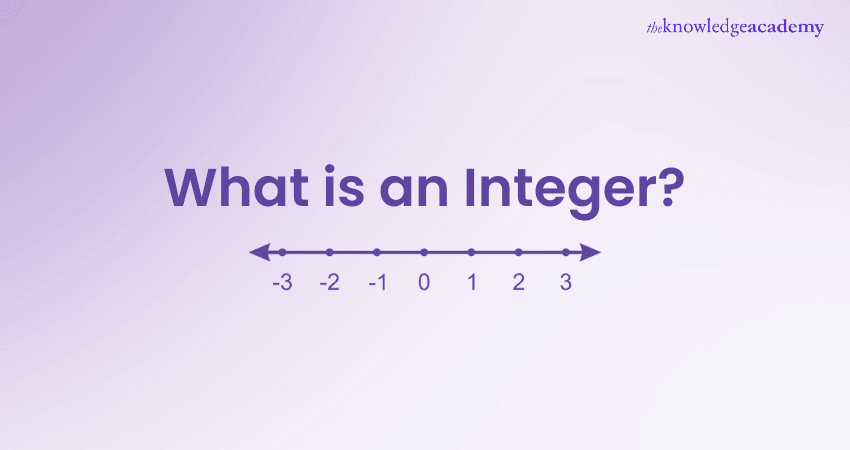
Visualise you’re checking the weather: it’s -5°C. Then, you see your bank balance: - £30. Both numbers are different but have something in common - they’re Integers! While it may sound simple, understanding What Is an Integer can unlock confidence in math, programming, finance, and data.
According to various educational surveys, most students struggle with Integer rules in their early stages. In this blog, we’ll break down What is an Integer, its types, rules, properties, and everyday uses to make your learning smooth and practical!
Table of Contents
1) What Is an Integer with Examples?
2) Types of Integers
3) Rules of Integers
4) Properties of Integers
5) Applications of Integers
6) Conclusion
What Is an Integer with Examples?
An Integer is any whole number, whether positive, negative, or zero, that does not include fractions or decimals like 5/4 or 1.25. In the field of mathematics and computer science, Integers play a key role in the representation of countable or ordered values, such as the number of users on a system or the website’s ranking.
The common Integer examples include -3, -1, 0, 5, and 20. For instance, in the temperature context, -5°C and 30°C are both Integers. Similarly, in programming, integer data types are used to store whole numbers, such as user IDs or inventory counts.

Types of Integers
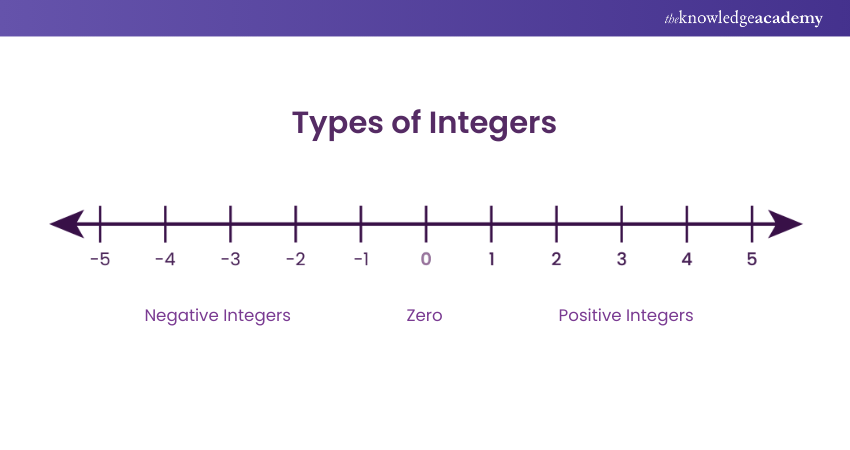
Integers are grouped into three main types. These categories help us gain a better understanding of number behaviour and number lines and how they are used in daily life and mathematics. Below is a brief overview of each of these types:
1) Zero
Zero is neither positive nor negative. It acts as the number line’s central point that separates the Positive Integers from the negative ones. In mathematics, zero is often used as a starting point or reference. For example, when there is a 0°C displayed on the Thermometer, it means the temperature is at the water’s freezing point.
2) Positive Integers
Positive Integers are always greater than zero, including numbers like 1, 2, 3, etc. They are always placed to the number line’s right of zero. Positive Integers are used for object count, gains representation, or quantity measurements like age, height, or money earned.
3) Negative Integers
Negative Integers are always less than zero. These include -1, -2, -3, etc. They are located on the number line to the left of zero. Negative Integers are commonly used for losses display, below zero temperatures, or decreasing values.
Optimise your workflow with proven time structuring techniques- Sign up for our Time Management Training today!
Rules of Integers
Understanding the Integer rules helps in problem-solving of basic mathematics, such as addition, subtraction, multiplication, and division. Here’s a simple breakdown of its rules:

1) Addition of Integers
a) When two positive Integers are added, the result is always positive.
b) When there are two negative Integers in addition, the result is always negative.
c) When there is an addition of positive as well as negative Integer, subtract the smaller absolute value from the larger one and use the number sign with the larger absolute value.
For example: -4 + 7 = 3
2) Subtraction of Integers
a) For Integer subtraction, change the subtracted number signs and follow the addition rules.
For example: 5 - (-3) becomes 5 + 3 = 8
3) Multiplication and Division
a) When there are same signs in both Integers, (both positive or both negative), the result is positive.
b) When the Integers have different signs, the result is always negative.
For example: (-4) × 2 = -8; (-6) ÷ (-2) = 3
Transform your writing with Expert-Led Techniques- Join our Creative Writing Course today!
Properties of Integer
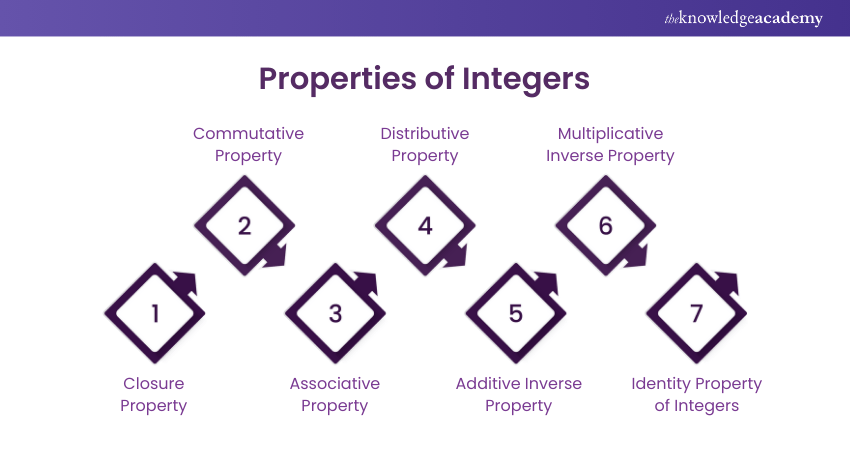
Integers' properties make problem-solving easier and more reliable. Let's explore some of the main properties of Integers:
1) Closure Property
The closure property states that when addition, subtraction, and multiplication of two Integers are there, the result is always an Integer.
For example: 5 + (-3) = 2, which is also an Integer.
2) Commutative Property
This property means the numbering order doesn't affect the result with Integer addition or multiplication.
For example: 4 + (-2) = (-2) + 4 = 2; 3 × (-5) = (-5) × 3 = -15
3) Associative Property
The Associative Property tells us how the numbers are grouped and doesn’t change the result during Integer’s addition and multiplication.
For example: (2 + 3) + 4 = 2 + (3 + 4); (-1 × 2) × 3 = -1 × (2 × 3)
4) Distributive Property
This property combines addition and multiplication. It states that Integer multiplication by the sum of two others is the same as Integer with each number, and then the results are added.
For example: 2 × (3 + 4) = (2 × 3) + (2 × 4) = 6 + 8 = 14
5) Additive Inverse Property
For every Integer, there is an opposite (negative or positive) number that, when added together, equals zero.
For example: The additive inverse of 6 is -6 because 6 + (-6) = 0
6) Multiplicative Inverse Property
This property does not apply to Integers in general because the multiplicative inverse of an Integer is usually a fraction, and fractions are not Integers.
For example: The multiplicative inverse of 4 is 1/4, which is not an Integer.
7) Identity Property of Integers
Additive Identity: Adding 0 to any Integer does not change its value.
For example: 7 + 0 = 7
Multiplicative Identity: Multiplying any Integer by 1 does not change its value.
For example: -3 × 1 = -3
Optimise your performance DNA- Sign up for our Motivation and Goal Setting Training now!
Applications of Integers
Here are five common and practical applications of Integers in everyday life:
1) Temperature Measurement: Integers are used to show temperatures above and below zero, such as 25°C or -10°C.
2) Banking and Finance: Positive Integers represent deposits, and negative Integers represent withdrawals or debts.
3) Elevator Levels: Floors above ground are marked with positive numbers, and underground levels use negative Integers.
4) Sports Scores: Integers are used to record scores, with gains and losses in games or ranking systems.
5) Computer Programming: Integers help store data like user IDs, item counts, and loop values in various applications.
Unlock deep listening intelligence- Sign up for our Strategic Planning and Thinking Course today!
Conclusion
The idea of What is an Integer might seem simple, but it’s actually very useful in real life. We use Integers to measure things, solve problems, and even write computer programs. They help bring order and make calculations easier. Once you understand their types, rules, and properties, you’ll feel more confident working with numbers.
Engineer your attention span with our Attention Management Training- Join today!
Frequently Asked Questions
What Is an Integer Vs a Whole Number?

Integers are the ones that involve all positive and negative whole numbers and zero. In comparison, whole numbers include only non-negative numbers, such as 0, 1, 2, 3, etc. Thus, it is right to say that whole numbers are Integers, but not all Integers are whole numbers.
Is 1.5 an Integer?
No, 1.5 is not an Integer. Integers are whole numbers that don’t contain decimal or fractional parts. Since 1.5 has a decimal, it does not qualify as an Integer.

The Knowledge Academy


Global Training Provider
The Knowledge Academy is a world-leading provider of professional training courses, offering globally recognised qualifications across a wide range of subjects. With expert trainers, up-to-date course material, and flexible learning options, we aim to empower professionals and organisations to achieve their goals through continuous learning.


 If you wish to make any changes to your course, please


