


 Top Rated Course

We may not have the course you’re looking for. If you enquire or give us a call on 01344203999 and speak to our training experts, we may still be able to help with your training requirements.
What is an API (Application Programming Interface)? Explained
Scarlett Adams 15 December 2025An Application Programming Interface (API) is a set of rules and protocols that allows communication and interaction between different Software Programs. APIs form the backbone of modern Software Development and integration. They enable functionalities such as data retrieval, user authentication and payment processing.

Training Outcomes Within Your Budget!
We ensure quality, budget-alignment, and timely delivery by our expert instructors.
Table of Contents
It's not just people; even apps can talk to each other like old friends by sharing data, triggering a variety of actions and working together seamlessly. This connectivity is enabled by the power of Application Programming Interfaces, be it logging in with Google to tracking a food delivery in real time. These are the invisible connectors that make our digital world work smoothly.
This blog explores What is an API in detail, highlighting its benefits, types, workings and more, showing how it functions as the silent engine behind actions like booking a cab or checking the weather. So read on and gain a deeper insight into these digital messengers that connect software systems!
Table of Contents
1) What is an API?
2) What are the Different Types of APIs?
3) How Do APIs Work?
4) Benefits of APIs
5) API Examples
6) Conclusion
What is an API?
API stands for Application Programming Interface. Here, an 'application' refers to any software designed to perform a specific function, while the interface acts as an agreement that defines how two applications communicate. This agreement outlines the process for submitting requests and the format for responding.
APIs allow multiple different software systems to exchange data using defined rules and protocols. For example, a phone’s weather app communicates with a weather service’s servers through an API to fetch and display weather updates in real time.

What are the Different Types of APIs?
APIs can be categorised based on their usage and access level. While the architecture defines how an API functions technically, the scope of use determines who can interact with it and for what purpose. Here are the key types:
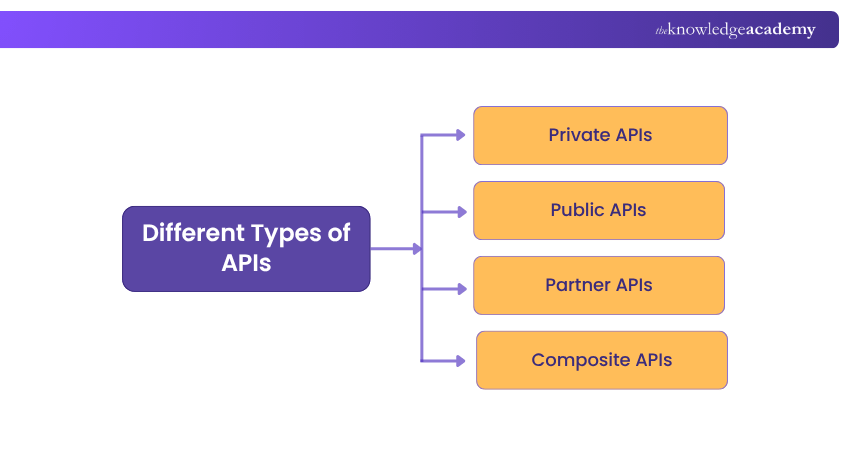
1) Private APIs
Private APIs are used internally within an organisation to connect systems and securely share data between internal services. They help streamline operations and improve integration across internal tools.
2) Public APIs
Public APIs are available for external users and developers, often with optional authentication and usage limits. They help businesses expand their ecosystem by enabling third-party innovation and service integration.
3) Partner APIs
Partner APIs are accessible only to approved external partners or developers to support business-to-business collaboration. They allow controlled data sharing while maintaining security and trust between partners.
4) Composite APIs
Composite APIs combine multiple APIs into a single request to handle complex operations more efficiently. They are useful when an action requires data or functionality from multiple services at once.
Master HTML & CSS, build beautiful, responsive sites. Sign up for our HTML And CSS Course now!
How Do APIs Work?
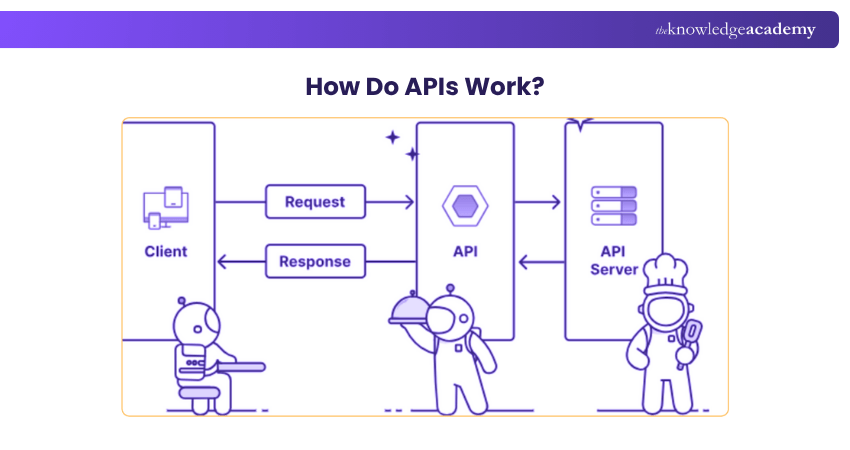
When a request is made, the API retrieves or processes the required data and sends it back to the requester. Here's a breakdown of how this flow works:
1) API Client
The API client initiates communication by sending a request to the API server. This action could be triggered by a user clicking a button, typing a command or by an automated system event in the background. The API client doesn't need to know how the other system works; it simply uses the API to make a standardised call.
2) API Request
An API request varies based on API type. But it generally contains the following:
1) Endpoint: This is a specific URL that points to a particular resource. An example is /articles for article-related operations.
2) Method: It defines the action such as GET, POST, PUT, or DELETE, to be performed on the resource.
3) Parameters: These are the additional inputs passed through the URL or query string to refine or customise the request.
4) Request Headers: These are metadata that include details like authentication tokens or content format.
5) Request Body: This contains the actual data needed to create, update or modify a resource. An example of this would be the content and author details when submitting a blog post.
Tap into innovation and build engaging mobile apps with our Mobile App Development Course - Register now!
3) API Server
Once the server receives the API request, it first checks authentication to ensure the requester has valid access rights. After verification, it validates the input data to confirm that it meets the required format and security standards.
The API server then communicates with databases or business logic layers to either retrieve relevant information or apply updates. Finally, it processes the response into a structured format, such as JSON or XML, and sends it back to the client for further use.
4) API Response
Finally, the server returns a response to the client, which includes:
1) Status Code: This is a three-digit code like 201 Created, 200 OK, or 404 Not Found, which indicates the result of the request.
2) Response Headers: These are extra information about the response, similar in structure to request headers.
3) Response Body: This is the actual data requested or an error message explaining what exactly went wrong.
Benefits of APIs
Thanks to APIs, organisations can ensure better performance, smoother user experiences and streamlined operations can be guaranteed. Some of the key advantages include:
1) Automation
APIs help automate repetitive and time-consuming tasks, thus reducing manual effort significantly. This allows the team to prioritise more strategic work instead of routine processes. This is the key to boosting efficiency.
2) Innovation Opportunities
Public APIs allow Developers to build new solutions by harnessing existing services and features. This speeds up the development cycles and encourages creative problem-solving without requiring a complete restart.
Master UI/UX design and shape how the world interacts with tech. Sign up for our UI UX Design Course now!
3) Enhanced Security
APIs add a strong layer of protection by enforcing authentication and authorisation before granting access to data. They help control who can access what, thus making systems more secure and traceable.
4) Cost Efficiency
By integrating third-party services through APIs, businesses can use ready-made tools instead of developing everything internally. This reduces development time and lowers the costs for infrastructure and maintenance.
API Examples
APIs have become a foundation of many modern digital services, by improving convenience, connectivity and user experience. Here are some popular and familiar examples:
1) Social Media
Social Media platforms like X, Instagram and Facebook offer APIs so that Developers can embed dynamic content into websites and apps. For example, Instagram’s API lets businesses showcase live photo feeds on their websites. This automatically update as new posts are added. This not only boosts engagement but also keeps content fresh without manual updates.
2) SaaS Applications
Software-as-a-Service (SaaS) tools include Customer Relationship Management (CRM) systems, Project Management apps and marketing platforms. They harness APIs to connect with other services. For example, a CRM can integrate with Email Marketing tools, Social Media platforms and messaging apps through APIs. This ensures smooth data flow across the systems and helps teams collaborate better.
3) Travel Booking Comparisons
Travel websites like Skyscanner or Booking.com use APIs to pull real-time data from airlines, hotels and travel agencies. Instead of visiting each site individually, you can compare the prices and availability in one place. APIs make this possible by fetching up-to-date information instantly, thus improving both speed and accuracy in decision-making.
4) Navigation Apps
Navigation apps like Uber, Google Maps and food delivery platforms heavily depend on APIs. These APIs provide access to map data, traffic conditions, estimated travel times, and nearby points of interest. When you search for directions or track a delivery, the app sends a request to an API. Then it returns the most current route and location data.
5) Universal Logins
If you've ever signed into a new app using your Google or Facebook account, then you should know that this is an API at work. These authentication APIs allow users to log in without creating new credentials. It goes a long way to streamline the onboarding process and improve security. It’s a win-win: users save time and Developers avoid managing sensitive login data.
6) Internet of Things (IoT)
Smart home gadgets such as thermostats, fridges and voice assistants use APIs to communicate with apps and Cloud services. For example, a smart fridge might use an API to sync with a grocery app, suggest recipes based on available ingredients and even send alerts to your phone when supplies run low. APIs enable these devices to exchange data and respond intelligently to user needs.
Conclusion
Knowing What is an API is like having the key to flawless digital experiences in a world dominated by apps. Your favourite platforms can communicate, collaborate more effectively and produce faster results, thanks to the power of APIs. They are like your digital helpers handling everything behind the scenes, from booking your next vacation to logging in with a single click.
Learn how to build sleek websites and powerful apps with our comprehensive App & Web Development Training - Sign up now!
Frequently Asked Questions
What is SOAP and REST API?

SOAP and REST are two major types of web APIs used for communication between systems over the internet:
1) Simple Object Access Protocol (SOAP): It’s a protocol that relies on XML messaging and strict standards.
2) Representational State Transfer (REST): It’s an architectural style that uses standard HTTP methods and formats like JSON.
Which Language is Best for API?
There is no single best language for building APIs. It comes down to your project needs, performance requirements and development environment. Popular choices include:
1) Python for quick development
2) JavaScript (Node.js) for real-time applications
3) Java and C# for enterprise systems
4) Go for high-performance APIs
What are the Other Resources and Offers Provided by The Knowledge Academy?
The Knowledge Academy takes global learning to new heights, offering over 3,000 online courses across 490+ locations in 190+ countries. This expansive reach ensures accessibility and convenience for learners worldwide.
Alongside our diverse Online Course Catalogue, encompassing 19 major categories, we go the extra mile by providing a plethora of free educational Online Resources like Blogs, eBooks, Interview Questions and Videos. Tailoring learning experiences further, professionals can unlock greater value through a wide range of special discounts, seasonal deals, and Exclusive Offers.
What is The Knowledge Pass, and How Does it Work?
The Knowledge Academy’s Knowledge Pass, a prepaid voucher, adds another layer of flexibility, allowing course bookings over a 12-month period. Join us on a journey where education knows no bounds.
What are the Related Courses and Blogs Provided by The Knowledge Academy?
The Knowledge Academy offers various App & Web Development Courses, including the API Crash Course, JavaScript & jQuery Training and the Git & GitHub Fundamentals Course. These courses cater to different skill levels, providing comprehensive insights into API Integration.
Our Programming & DevOps Blogs cover a range of topics related to Application Programming Interface, offering valuable resources, best practices, and industry insights. Whether you are a beginner or looking to advance your App and Web Development skills, The Knowledge Academy's diverse courses and informative blogs have got you covered.
Upcoming Programming & DevOps Resources Batches & Dates
Date
 API Crash Course

 If you wish to make any changes to your course, please


