


 Top Rated Course

We may not have the course you’re looking for. If you enquire or give us a call on +971 8000311193 and speak to our training experts, we may still be able to help with your training requirements.
What is an Acronym: A Complete Guide
Charlotte Wilson 16 July 2026An Acronym is a word formed from the initial letters or syllables of a phrase and pronounced as a single word rather than letter by letter, simplifying terms. This makes communication quicker and clearer in everyday language and professional settings. Acronyms are therefore widely used across technology, business, and organisations.

Training Outcomes Within Your Budget!
We ensure quality, budget-alignment, and timely delivery by our expert instructors.
Table of Contents

Acronyms are an indispensable part of modern communication. From texting your BFF to setting your ATM PIN, we live in a world run by letters. They are the powerhouse of efficient language: bold, brief, and often more famous than the full words they came from. Essentially, Acronyms are busy doing your brain’s heavy lifting, compressing clunky phrases into sleek, memorable words.
In this blog, we peel back the curtain on these linguistic shape-shifters and explore in detail What is an Acronym. We’ll reveal how Acronyms sneak into your texts, your workplace, and even your favourite snacks (yes, we’re looking at you, KFC). It’s time to see just how much these tiny letter combos run your world. So, let’s dive in!
Table of Contents
1) What is an Acronym?
2) When are Acronyms Used?
3) Different Types of Acronyms
4) Popular Acronym Examples
5) Acronyms vs Abbreviations vs Initialisms
6) Examples of Commonly Used Acronyms in Daily Communication
7) Conclusion
What is an Acronym?
An Acronym is a shortened word formed from the first letters of a group of words that make up a longer phrase or name. Instead of repeating lengthy terms, Acronyms provide a simple and quick way to communicate the same idea. They make language clearer, easier to remember, and faster to use in both everyday conversations and written communication.
Acronyms are widely used in daily life, workplaces, technology, and organisations. Many are pronounced as single words, making them easy to recognise and use. For example, include NASA 'National Aeronautics and Space Administration', RADAR 'Radio Detection and Ranging', SIM 'Subscriber Identity Module', and everyday terms like LOL 'Laugh Out Loud', ASAP 'As Soon As Possible', and FYI 'For Your Information'.

When are Acronyms Used?
Acronyms shorten long phrases to make communication quicker and easier. They use the first letters of words to convey the same meaning, helping people communicate more efficiently in both everyday and professional settings.
Here are some common situations where Acronyms are used:
1) Everyday Communication
Acronyms are commonly used in daily conversations, text messages, and online communication. They help make messages shorter and faster to write or read. For example, people often use terms such as LOL, meaning 'Laugh Out Loud', or FOMO, referring to 'Fear Of Missing Out', in informal communication.
2) Professional and Business Communication
In workplaces, Acronyms help simplify communication by replacing long or frequently used terms. They make emails, reports, and discussions clearer and more concise. For instance, business communication often includes terms such as CEO, referring to 'Chief Executive Officer', or KPI, meaning 'Key Performance Indicator'.
3) Science, Technology, and Medical Fields
Many technical fields involve complex terminology, so Acronyms help professionals refer to concepts and tools more easily. For example, terms like MRI, referring to 'Magnetic Resonance Imaging', or CD-ROM, meaning 'Compact Disc Read-only Memory', are widely used in technical discussions.
4) Names of Organisations and Programmes
Acronyms are often used to shorten the names of organisations, institutions, and international groups. Well-known examples include NASA, referring to 'National Aeronautics and Space Administration', and UNESCO, meaning 'United Nations Educational, Scientific and Cultural Organization'.
Different Types of Acronyms
Acronyms appear in different forms depending on how they are created and pronounced. Some are read as full words, while others are spelled out letter by letter. Over time, a few have even become part of everyday language. Below are the most common types you’ll come across:
1) Acronyms Pronounced as Words:
a) GEICO: Government Employees Insurance Company
b) GIF: Graphics Interchange Format
2) Acronyms Pronounced Letter by Letter:
a) CBS: Columbia Broadcasting System
b) ATM: Automated Teller Machine
3) Acronyms that Became Words:
a) RADAR: Radio Detection and Ranging
b) SCUBA: Self-contained Underwater Breathing Apparatus
4) Acronyms Shortened with Common Letters:
a) WWF: World Wrestling Federation (spoken as “W-double-F”)
b) BBB: Better Business Bureau (spoken as “B-triple-B”)
Learn powerful communication techniques to influence, inspire, and lead effectively with our Communication Skills Course – Join now!
Popular Acronym Examples
Acronyms often become so commonly used that we forget they even stand for something longer. Below are some everyday Acronyms, some you likely use all the time and a few that may be unfamiliar to you:
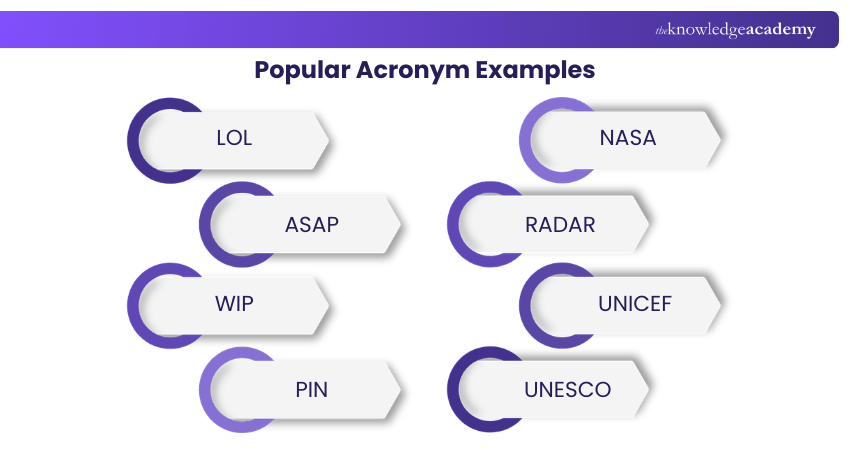
1) LOL: Laugh out loud
2) ASAP: As soon as possible
3) WIP: Work in progress
4) PIN: Personal Identification Number
5) NASA: National Aeronautics and Space Administration
6) RADAR: Radio Detection and Ranging
7) UNICEF: United Nations International Children’s Emergency Fund
8) UNESCO: United Nations Educational, Scientific and Cultural Organisation
9) RAM: Random Access Memory
10) ROM: Read-Only Memory
11) CAPTCHA: Completely Automated Public Turing test to tell Computers and Humans Apart
12) LASER: Light Amplification by Stimulated Emission of Radiation
13) SIM: Subscriber Identity Module
14) LAN: Local Area Network
15) WAN: Wide Area Network
16) SWOT: Strengths, Weaknesses, Opportunities and Threats
17) SCUBA: Self-Contained Underwater Breathing Apparatus
18) NATO: North Atlantic Treaty Organisation
19) IELTS: International English Language Testing System
20) TOEFL: Test of English as a Foreign Language
Understand audience engagement techniques for impactful presentations with our Public Speaking Course – Register now!
Acronyms vs Abbreviations vs Initialisms
Acronyms, abbreviations, and initialisms are often confused, but they differ in keyways. Acronyms are formed from the first letters of words and pronounced as a new word, like National Aeronautics and Space Administration (NASA).
Abbreviations are shortened versions of words, such as “Dr.” for “Doctor.” Initialisms also use first letters but are pronounced one letter at a time, like FBI (Federal Bureau of Investigation). All help simplify language, but in different ways.

Examples of Commonly Used Acronyms in Daily Communication
Some commonly used Acronyms in daily communication include the following examples. These terms are often used in messages, emails, and online conversations to make communication quicker. The following examples highlight some of the most commonly used Acronyms:
1) LOL: Laugh Out Loud
2) ASAP: As Soon As Possible
3) WIP: Work In Progress
4) POV: Point of View
5) OTP: One-time Password
6) FYI: For Your Information
7) ETA: Estimated Time of Arrival
8) ATM: Automated Teller Machine
9) WiFi: Wireless Fidelity
10) IDK: I Don’t Know
11) DM: Direct Message
12) EOD: End of Day
13) DOB: Date of Birth
14) SMS: Short Message Service
Conclusion
Understanding What is an Acronym helps simplify communication in both everyday and professional settings. By turning long phrases into short, memorable words, Acronyms make information easier to share and understand. As language continues to evolve, Acronyms remain an essential part of modern communication across technology, business, and daily conversations.
Say everything better with our Effective Communication Skills Course. Elevate your skills the smart way!
Frequently Asked Questions
Is KFC an Acronym?

Yes, it’s an Acronym. KFC stands for “Kentucky Fried Chicken,” but it’s technically an initialism, not an Acronym. That’s because we say each letter (K-F-C) instead of pronouncing it as one word. While it shortens a longer name, it doesn't meet the definition of an Acronym since it’s not spoken as a single word.
Is OMG an Acronym?
Yes, OMG is considered an Acronym because it stands for “Oh My God” and is often pronounced as a word in speech or text. It’s widely used in casual conversation, especially online and in texting, making it one of the most recognisable and commonly used Acronyms in pop culture.

Charlotte Wilson


Soft Skills and Business Training Manager
Charlotte Wilson is an expert in soft skills development, with over 14 years of experience helping individuals and teams improve communication, productivity and emotional intelligence in the workplace. Her training content is focused on enhancing interpersonal effectiveness and fostering positive, collaborative environments across all levels of an organisation.
View Detail

 If you wish to make any changes to your course, please


