




We may not have the course you’re looking for. If you enquire or give us a call on 01344203999 and speak to our training experts, we may still be able to help with your training requirements.
What Does a SOC Analyst Do: Roles & Responsibilities
ByScarlett AdamsLast updated on: 18 August 2026
This blog explains what a SOC Analyst does day-to-day, from monitoring threats to responding to incidents. It also covers their key responsibilities, skills and role in a cyber security team.
Key Takeaways
1. A SOC Analyst often acts as a first responder to cyber threats, investigating alerts and safeguarding an organisation's data.2. Core responsibilities of a SOC Analyst include monitoring, detection, response, and reporting.3. SOC Analysts work as part of a wider team, collaborating with IT, network operations, and incident response to coordinate a faster response.4. Success in the role depends on a mix of technical skills (SIEM tools, networking, malware analysis) and soft skills like analytical thinking and communication under pressure.
Every day, an organisation's network handles countless login attempts, file transfers, and system alerts. Most are harmless. A few aren't. Someone has to tell the difference, and act on it before it becomes a breach.
That someone is a SOC Analyst. But What Does a SOC Analyst Do when a potential threat appears?
Sensitive information is now central to how every organisation operates, and modern Security Operations Centres exist to protect it. As part of a specialised team, SOC Analysts monitor, analyse, and respond to security incidents, safeguarding organisational data.
These experts build situational awareness, investigate attacks, and help organisations prepare for and recover from cyber threats, a role in growing demand.
Who is a SOC Analyst?
A Security Operations Center (SOC) Analyst is a professional responsible for an organisation's Cyber Security operations. They act as first responders to cyber threats by identifying, analysing and resolving security issues. They also report threats to management, helping stakeholders take appropriate measures to protect organisational data.
A SOC Analyst reviews incident notifications and vulnerability assessments, then reports their findings to senior management. In short, a SOC Analyst's day-to-day work is centred on the security operations of the company they work for. Safeguarding its data is the constant thread running through everything they do.

What Does a SOC Analyst Do?
A SOC Analyst helps detect, investigate, and respond to security threats within a Security Operations Centre. Many SOCs organise analyst responsibilities into tiers, although the exact structure and duties vary between organisations.
Tier 1: Triage
Tier 1 Analysts typically handle the initial review and triage of security alerts. They monitor dashboards, review incoming alerts, and make the initial call on whether an alert is a genuine threat or a false positive, flagging anything that needs deeper investigation to Tier 2.
Tier 2: Investigation
Tier 2 Analysts take over once an alert is escalated. They correlate events across multiple data sources, investigate the cause and scope of incidents, and support or carry out containment actions, such as isolating a compromised endpoint or disabling a compromised account.
Tier 3: Threat Hunting
Tier 3 Analysts often take on advanced investigations and proactive threat hunting. Instead of relying only on existing alerts, they may hunt for threats that bypass detection, develop new detection rules and support or lead responses to complex incidents.
Did You Know?
SOC teams receive an average of 4,484 security alerts every single day. Sorting genuine threats from that volume of noise is one of the biggest daily challenges a SOC Analyst faces.Source: Vectra AI, 2023 State of Threat Detection report
Responsibilities of a SOC Analyst
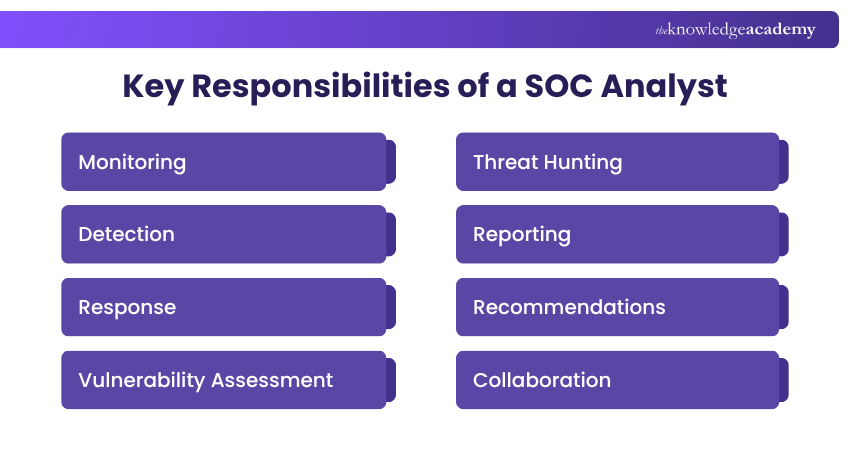
Across all three tiers, a SOC Analyst's day-to-day work falls into these core areas:
1) Monitoring
SOC Analysts continuously monitor alerts, logs, and security dashboards to identify suspicious activity across networks, endpoints, applications and systems. Two tools sit at the centre of this work:
a) SIEM (Security Information and Event Management): Collects and correlates log and event data from across the organisation's network, servers, and applications into a single dashboard, so analysts can spot patterns and correlations that may not be visible when examining one system alone.
b) EDR (Endpoint Detection and Response): Monitors individual devices, such as laptops and servers, for suspicious behaviour like unusual file changes or unauthorised process activity, and allows analysts to investigate or isolate an affected endpoint directly.
2) Detection
They analyse and triage alerts to distinguish genuine threats from false positives, using threat intelligence and correlation techniques. This step prioritises high-risk incidents for investigation.
3) Response
When a threat is validated, SOC Analysts act swiftly, initiating containment, eradication, and recovery efforts. They document actions taken to support forensic analysis and continuous security improvement.
4) Vulnerability Assessment
SOC Analysts may review vulnerability scan results and security weaknesses that could increase an organisation's exposure to threats. Depending on the SOC structure, they may work with vulnerability management, IT, or security teams to prioritise and address identified weaknesses.
5) Reporting
They document incidents, findings, and response actions in clear, structured reports. These reports support compliance and continuous improvement and help other teams understand security trends and vulnerabilities over time.
6) Recommendations
SOC Analysts develop and propose security improvements, including updates to configurations, policies, and detection rules. They recommend corrective actions based on incident findings and work with relevant teams to improve security controls, configurations and procedures.
7) Collaboration
SOC Analysts don't work in isolation. They collaborate with IT, network operations and incident response teams to coordinate investigations. They may also work with external providers when specialist support is required, ensuring efficient threat handling and a coordinated response to security risks.
One-Minute Recap
1. Monitoring: "Watch everything, all the time."2. Detection: "Is this alert real or noise?"3. Response: "Contain it, fix it, document it."4. Vulnerability Support: "Where are we exposed?"5. Reporting & Recommendations: "What happened, and how do we stop it next time?"6. Collaboration: "No analyst works in isolation."
Protect your digital assets today and fortify your future by joining our Cyber Security Risk Management Course today!
Key Skills of SOC Analysts
SOC Analysts need a mix of technical know-how and soft skills to do the job well and stay effective under pressure. Some of the skills include:
Technical Skills
a) SIEM Tools: Proficiency in platforms like Splunk, ArcSight, or the Elastic Stack to monitor and correlate security events.
b) Networking Knowledge: A strong grasp of protocols such as TCP/IP, DNS, and HTTP to analyse traffic and spot anomalies.
c) IDS/IPS Familiarity: Understanding intrusion detection and prevention systems for timely threat identification.
d) Basic Malware Analysis: The ability to recognise and evaluate malware behaviour when investigating an incident.
Soft Skills
a) Analytical Thinking: Assessing incidents, spotting trends, and making fast, sound judgement calls.
b) Effective Communication: Explaining findings clearly to both technical teams and non-technical stakeholders.
c) Attention to Detail: Catching the small, easy-to-miss signs that separate a real threat from noise.
d) Calm Under Pressure: Staying focused and methodical during high-stress, fast-moving incidents.
Key Insights
Certifications such as CompTIA Security+ can help aspiring SOC Analysts build foundational cyber security knowledge. Combining certification study with hands-on practice using alerts, logs, and investigation scenarios can help develop practical skills.
Conclusion
SOC Analysts are like the guardians of our digital world. They keep a close watch on our computer systems, detect suspicious activity, and respond swiftly to protect us from cyber threats. If you've ever wondered What Does a SOC Analyst Do, they are the professionals whose skills and dedication ensure that businesses can operate safely in technology-driven environment.
Discover the secrets to protecting your digital world – Join our Introduction to System and Network Security Course today!

 If you wish to make any changes to your course, please


