


 Top Rated Course

We may not have the course you’re looking for. If you enquire or give us a call on 01344203999 and speak to our training experts, we may still be able to help with your training requirements.
Traditional Testing vs Agile Testing: A Detailed Comparison
Richard Harris 15 July 2026Traditional Testing is a phase-based approach where testing occurs after the development is complete. Agile Testing is a flexible approach that involves testing alongside development. This blog explores Traditional Testing vs Agile Testing, comparing their differences and benefits and helping you choose the best approach for your project.

Training Outcomes Within Your Budget!
We ensure quality, budget-alignment, and timely delivery by our expert instructors.
Table of Contents
Software development is constantly evolving, and selecting the appropriate testing method is essential for project success. "Traditional Testing vs Agile Testing" is a hot topic, as both methods offer unique advantages. Traditional Testing provides a structured, predictable process, while Agile Testing emphasises flexibility and continuous feedback through iterative cycles and frameworks like Agile Testing Quadrants.
This blog discusses the key features, benefits, and differences of each approach, helping you decide which is best suited for your project needs. Get ready to explore the fascinating world of software testing and make an informed decision!
Table of Contents
1) What is Traditional Testing?
2) What is Agile Testing?
3) Differences Between Traditional Testing and Agile Testing
4) Traditional Testing vs Agile Testing: Which one to choose?
5) Conclusion
What is Traditional Testing?
Traditional Testing, often referred to as Waterfall Testing, follows a sequential and linear process. It is a phase-driven approach where each stage of the software development lifecycle must be completed before moving on to the next. This method is characterised by its structured and methodical nature, ensuring thorough testing at each phase.
Features of Traditional Testing
Here are the features of Traditional Testing:
a) Sequential Phases: The development and testing phases are distinct and follow a strict sequence.
b) Comprehensive Documentation: Emphasis on detailed documentation at every stage.
c) Clear Requirements: Testing begins after the requirements and specifications are complete.
d) Predictability: The process is predictable, with defined milestones and deliverables.

Benefits of Traditional Testing
Some of the advantages of Traditional Testing include:

a) Well-defined Process: The structured approach ensures that each phase is completed thoroughly before moving to the next.
b) Easy to Manage: The linear process makes it easier to manage large projects with clear timelines.
c) Detailed Documentation: Extensive documentation helps maintain a clear record of the project.
d) Stable Requirements: Works well when requirements are clear and unlikely to change.
Boost your testing skills with Agile Software Testing Training. Sign up now and master testing in Agile environments!
What is Agile Testing?
Agile Testing is a continuous and iterative process. It is integrated into the Agile software development methodology, which focuses on incremental development, flexibility, and collaboration. Testing is carried out simultaneously with development, allowing for immediate feedback and adjustments.
Features of Agile Testing
Here are the features of Agile Testing:
a) Iterative Process: Testing is continuous and happens in short cycles called sprints.
b) Collaboration: Close collaboration between Developers, Testers, and stakeholders.
c) Flexibility: Adaptability to changes even late in the development process.
d) Continuous Feedback: Frequent feedback loops enhance product quality.
Benefits of Agile Testing
Some of the advantages of Agile Testing include:

a) Early Detection of Defects: Continuous testing helps in identifying and fixing defects early.
b) Customer Satisfaction: Regular updates and feedback ensure that the product meets customer expectations.
c) Flexibility: Agile testing accommodates changes and new requirements easily.
d) Improved Quality: Continuous integration ensures quality by following the Agile Testing Pyramid.
Learn to install NUnit with our Unit Testing Course – Join today!
Differences Between Traditional Testing and Agile Testing
Here are the key differences:
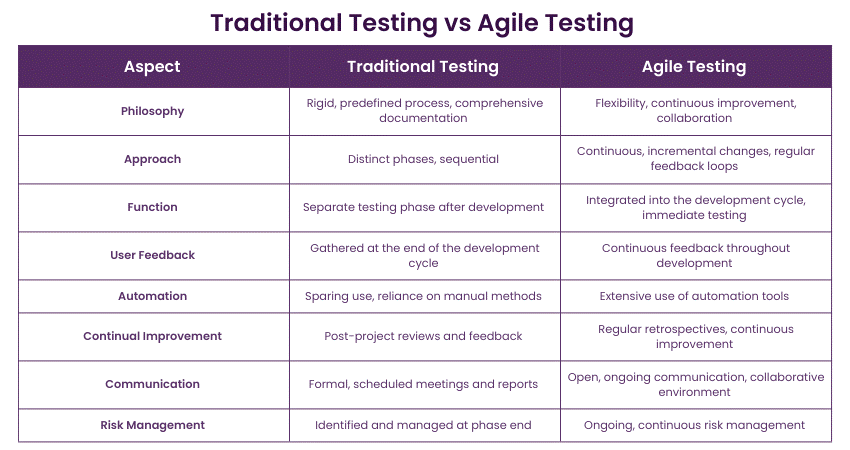
1) Philosophy
Traditional Testing follows a rigid, predefined process with a strong emphasis on comprehensive documentation and a clear sequence of steps. On the other hand, Agile Testing focuses on flexibility and continuous improvement. It encourages collaboration and adaptability throughout the development process.
2) Approach
Traditional Testing is performed in distinct phases, and each phase must be completed before moving on to the next. In contrast, Agile Testing occurs continuously alongside development, with small, incremental changes and regular feedback loops.
3) Function
In Traditional Testing, there is a separate testing phase after the development is complete, ensuring all features are tested at once. On the other hand, Agile Testing is integrated into the development cycle, allowing for immediate testing of new features as they are developed.
4) User Feedback
In Traditional Testing, user feedback is typically gathered only at the end of the development cycle after the product is fully built.
On the other hand, Agile Testing follows continuous feedback from users and is incorporated throughout the development process. It allows for adjustments and improvements in real-time.
5) Automation
In Traditional Testing, automation is used sparingly, with a greater reliance on manual testing methods. On the other hand, automation tools are extensively used in Agile Testing to support continuous testing and integration, improving efficiency and accuracy.
6) Continual Improvement
Improvements are generally made after the project is completed in Traditional Testing based on post-project reviews and feedback. In contrast, in Agile Testing, continuous improvement is a core principle, with regular retrospectives to identify and implement enhancements during the project.
7) Communication
Traditional Testing requires communication to be formal and scheduled, often involving regular meetings and detailed reports. On the other hand, Agile Testing requires open and ongoing communication among all team members, fostering a collaborative environment.
8) Risk Management
Risks are identified and managed at the end of each phase in Traditional Testing, with mitigation strategies developed as needed. On the other hand, risk management is an ongoing process in Agile Testing, with potential issues addressed continuously throughout the development cycle.
Traditional Testing vs Agile Testing: Which one to Choose?
Choosing between Traditional Testing and Agile Testing depends on the nature of the project and the organisational needs. Traditional Testing is suitable for projects with well-defined requirements and a clear scope. It is ideal for larger projects where changes are minimal.
However, Agile Testing is better suited for projects where requirements are expected to evolve. It is ideal for dynamic and fast-paced environments where customer feedback and flexibility are crucial.
Improve your testing skills with our Agile Software Testing Course – Join today!
Conclusion
Both Traditional Testing and Agile Testing are suited to different types of projects. Understanding the differences in each can help you choose the right approach for your project. By evaluating your project's specific needs, you can effectively compare Traditional Testing vs Agile Testing, considering factors like Agile Tester Roles and Responsibilities to determine which methodology will lead to the best outcomes.
Learn about test automation with our Agile Tester Training – Join today!
Frequently Asked Questions
How can a Team Decide Whether to use Agile or Traditional Methods?

A team can decide based on the project's requirements, flexibility, and scope of change. If the project needs frequent updates and continuous feedback, Agile is preferable.
Which Approach is More Cost-effective, Agile or Traditional?
The cost-effectiveness of Agile or Traditional approaches depends on the project's nature and requirements. Agile can be more cost-effective for projects needing flexibility and frequent updates, while Traditional methods might be better for projects with stable, unchanging requirements.

Richard Harris


Senior Full Stack Developer and Technology Educator
Richard Harris is a highly experienced full-stack developer with deep expertise in both frontend and backend technologies. Over his 12-year career, he has built scalable web applications for startups, enterprises and government organisations. Richard’s writing combines technical depth with clear explanations, ideal for developers looking to grow in modern frameworks and tools.


 If you wish to make any changes to your course, please


