




We may not have the course you’re looking for. If you enquire or give us a call on 01344203999 and speak to our training experts, we may still be able to help with your training requirements.
Stakeholder Capitalism: How it Works and Why it Matters
BySubiksha ArulprakashLast updated on: 03 October 2026
What is stakeholder capitalism? It is a form of capitalism in which businesses consider the interests of multiple stakeholders, not just shareholders. It promotes long-term value creation, sustainable growth, and corporate responsibility, ensuring companies contribute to society and the environment while achieving financial success.

The Gist
1. Stakeholder capitalism considers the interests of employees, customers, suppliers, communities, and shareholders.2. It focuses on balancing financial performance with social and environmental responsibility.3. Businesses can apply it through fair employment practices, responsible sourcing, community investment, and transparent decision-making.4. The approach can support long-term value creation but may involve competing stakeholder priorities.5. Effective stakeholder management depends on clear accountability, measurable actions, and consistent engagement.
Have you heard the buzz about stakeholder capitalism but not sure what it means? While shareholder-focused business models have been highly influential, stakeholder-oriented approaches have gained renewed attention as businesses consider wider social and environmental responsibilities. So, what is stakeholder capitalism exactly?
Stakeholder capitalism means businesses consider everyone affected, employees, customers, suppliers, and even the environment, not just shareholders. By adopting this approach, companies can build a more sustainable and responsible model that benefits all stakeholders.
In this blog, we’ll explore what is stakeholder capitalism in detail, its key principles, potential benefits, and how businesses can put it into action.
What is Stakeholder Capitalism?
Stakeholder capitalism is an economic philosophy that values the interests and well-being of all stakeholders in a company. It focuses on employees, customers, suppliers, local communities, and the environment, not just shareholders. This approach means recognising the broader impact of your actions and striving to balance profit with social and environmental responsibility.
By integrating ethical practices into your operations, you promote a sustainable and inclusive form of capitalism. This philosophy encourages businesses like yours to consider how your decisions affect everyone involved, fostering a more holistic approach to success and growth.

The Ripple Effect
Business Decision → Employees → Customers → Suppliers → Communities → EnvironmentA single business decision can create effects across multiple stakeholder groups.
History of Stakeholder vs Shareholder Capitalism
Shareholder capitalism became increasingly dominant in the late 20th century, particularly as shareholder primacy gained influence in corporate governance. It places strong emphasis on generating financial returns for shareholders, driving business decisions aimed at increasing stock prices and dividends.
Stakeholder capitalism on the other hand has earlier roots but gained prominence in the late 20th and early 21st centuries as a response to the limitations of shareholder capitalism. Stakeholder capitalism emphasises the interests of all stakeholders, employees, customers, suppliers, communities, and the environment, alongside those of shareholders. This model advocates for balancing profit with social and environmental responsibility, promoting long-term sustainability and inclusivity.
Stakeholder-oriented business practices became more prominent in the mid-20th century, particularly during the post-war decades, when companies often maintained stronger ties with employees, suppliers, customers, and local communities. Recently, there has been a resurgence of interest in stakeholder capitalism, driven by growing awareness of corporate social responsibility and sustainable business practices.
What Does Stakeholder Capitalism Look Like in Practice?
Stakeholder capitalism is a business approach in which companies consider the interests of employees, customers, suppliers, communities, shareholders, and wider society when making decisions. Companies can demonstrate commitment by:
a) Paying fair wages
b) Providing opportunities for employee development and participation
c) Ensuring workplace safety
d) Following responsible and transparent tax practices
e) Providing excellent customer service
f) Engaging in honest marketing
g) Investing in local communities
h) Preventing environmental damage
What are the Types of Stakeholders?
Stakeholders can be classified in different ways depending on their relationship with an organisation and the extent to which they affect or are affected by its activities. Common classifications include internal and external stakeholders, as well as primary and secondary stakeholders. Some frameworks also distinguish connected stakeholders.
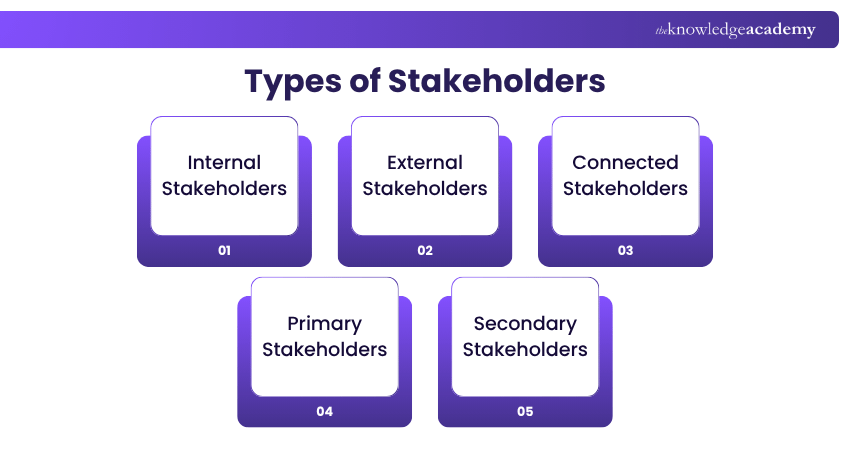
1) Internal Stakeholders: These are individuals or groups within the organisation, including employees, managers and directors.
2) External Stakeholders: These are individuals or teams outside the organisation that affect or can be affected by its activities. Examples include:
a) Customers: People or organisations buying and using the company's products or services.
b) Suppliers: Providers of goods or services to the organisation.
c) Investors: Individuals or organisations that provide capital to the business.
d) Regulators: Government or regulatory bodies overseeing relevant aspects of the organisation's operations.
e) Communities: Communities that may be affected by the company's activities.
f) Competitors: Other organisations operating in the same market or industry.
3) Connected Stakeholders: Connected stakeholders have a direct economic or contractual relationship with the organisation. Examples can include shareholders, customers, suppliers, lenders and distributors.
4) Primary Stakeholders: Primary stakeholders are individuals or groups with a direct and significant relationship with an organisation or its activities. Depending on the context, they may include employees, customers, shareholders, suppliers and local communities.
5) Secondary Stakeholders: Secondary stakeholders generally have a more indirect relationship with the organisation but may still influence or be affected by its activities. Examples can include the media, advocacy groups and some government or community groups, depending on the context.
Stakeholder Lens
Look at one decision from six viewpoints:Employee | Customer | Supplier | Investor | Community | Environment
What do Stakeholders Mean in Economics?
A stakeholder is an individual or entity with a vested interest in a company, where they can influence or be influenced by the company's activities and results. In the context of microeconomics, stakeholders' decisions and actions can significantly affect market dynamics and company outcomes. In simpler terms, they hold a stake in the business and its consequences, whether it's a direct or indirect connection.
Understand key analysis techniques to drive business success with our Business Analyst Fundamentals Training – Register now!
What is the Difference Between a Stakeholder and Shareholder?
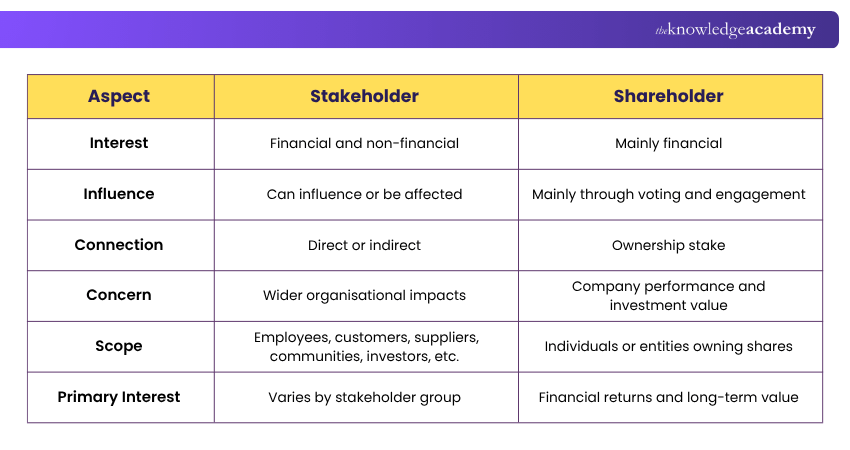
Shareholders, also known as stockholders, are a subset of stakeholders. They are individuals or entities that own shares or stocks in a company. Shareholders have a financial interest in the organisation because the value of their investment is directly linked to the company's performance and profitability. They typically have voting rights and may receive dividends.
Stakeholders have a wide range of interests, including financial, social, environmental, and ethical concerns. Their relationship with the company is not solely based on financial investments but includes various interactions and dependencies. Stakeholders may seek to influence the company's decisions and actions to address their respective concerns, which may go beyond financial returns.
Challenges and Critiques of Stakeholder Capitalism
Below are some of the challenges and critiques of stakeholder capitalism:
a) Implementation Difficulties: Translating stakeholder capitalism into practical strategies is challenging, requiring a balance of diverse and conflicting interests.
b) Accountability and Conflicting Interests: Prioritising multiple stakeholders can obscure accountability and complicate decision-making, potentially affecting efficiency and profitability.
c) Short-term vs. Long-term Focus: Stakeholder capitalism is generally intended to support long-term value creation, but organisations may still face pressure to balance immediate stakeholder demands with longer-term business and sustainability goals.
d) Measurement and Metrics: Measuring success across various stakeholders can be complex because organisations may use different frameworks, standards and metrics to assess stakeholder outcomes.
e) Impact on Shareholders: Critics argue that prioritising other stakeholder interests may conflict with the objective of maximising shareholder value.
f) Potential for Greenwashing: Companies might claim stakeholder focus for publicity without meaningful changes.
g) Regulatory and Legal Challenges: Corporate governance and directors’ duties vary across jurisdictions. Some legal frameworks incorporate stakeholder considerations, while others place different emphasis on shareholder interests, which can affect how stakeholder-focused strategies are implemented.
Trade-off Map
1. Higher Wages ↔ Short-term Costs2. Sustainable Sourc.ing ↔ Supplier Changes3. Lower Environmental Impact ↔ Upfront Investment4. Community Investment ↔ Longer-term Returns
Stakeholder Capitalism Examples
These are the examples of stakeholder capitalism:
1) Patagonia:
Patagonia, an outdoor clothing company, directs the profits not reinvested in the business to the Holdfast Collective, a nonprofit organisation that supports environmental protection and climate-related initiatives. The company also maintains commitments to responsible sourcing and environmental action.
2) Unilever:
Unilever identifies six stakeholder groups as critical to its future success: shareholders, employees, consumers, customers, suppliers and business partners, and planet and society. Its Board considers these stakeholder interests when setting strategy and making decisions, while its sustainability priorities focus on climate, nature, plastics, and livelihoods.
Improve your analytical and problem-solving skills with the Business Analyst Course – Join now!

Subiksha Arulprakash is a Copywriter with 5+ years of experience in content writing, editing, content development and digital marketing. Her experience researching and writing about Business Skills, ISO standards and compliance enables her to produce clear, accessible content for different audiences.
View Detail

 If you wish to make any changes to your course, please


