




We may not have the course you’re looking for. If you enquire or give us a call on 44 1344 203 999 and speak to our training experts, we may still be able to help with your training requirements.
What is Social Responsibility: Definition, Types and Advantages
ByThe Knowledge AcademyLast updated on: 03 October 2026
Social Responsibility involves considering how individual and organisational actions affect society and the environment. Explore its major types, principles, benefits, practical examples and the challenges organisations may face when putting responsible practices into action.

Main Idea
1.Understanding your impact on society and communities2. Making ethical choices in everyday situations3. Supporting sustainable and responsible business practices4. Building trust through accountability and transparency5. Encouraging inclusivity, fairness, and ethical conduct6. Creating long-term value for people and society
Social Responsibility is the principle that individuals and organisations should consider how their actions affect society, communities and the environment. It fosters the virtues of ethics, community growth, and sustainability, at the same time building trust and creating long-term value. This blog will take you through its types and benefits.
What is Social Responsibility?
Social Responsibility is the principle that individuals and organisations should consider the social, environmental and ethical impacts of their decisions and actions. It involves acting responsibly towards stakeholders, communities and the environment while considering long-term consequences.
In organisations, Social Responsibility can influence areas such as working practices, environmental impact, responsible sourcing, consumer treatment and community involvement. When applied in a business context, it is commonly associated with Corporate Social Responsibility (CSR).

Types of Social Responsibility
Social Responsibility can take different forms depending on how an organisation addresses environmental, ethical, legal and community-related responsibilities. The following are four commonly discussed types:
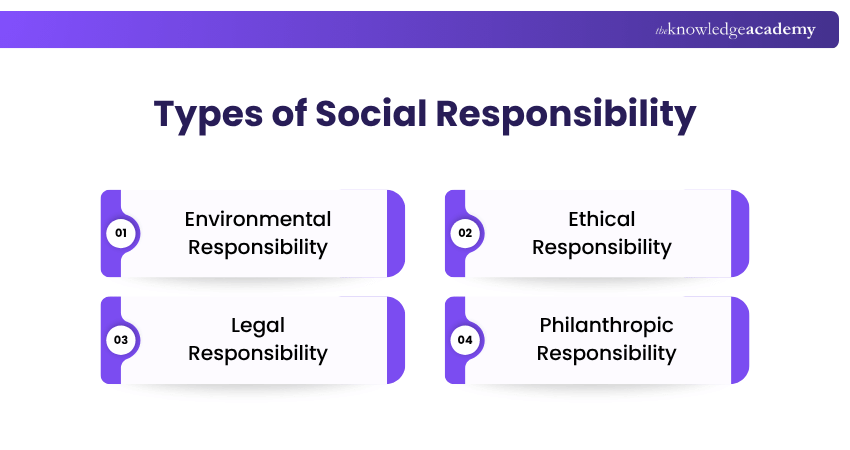
1) Environmental Responsibility
This type of responsibility pertains to an organisation’s commitment to conducting its business in an environmentally friendly manner. Companies with this aim typically focus on three key actions:
a) Reduction: Companies can implement practices and initiatives to reduce their negative environmental impact, such as limiting pollution, plastic waste, emissions and water contamination.
b) Sustainability: Companies can use renewable energy, reduce resource consumption, choose more sustainable materials, and increase the use of recycled or reusable resources in their operations.
c) Environmental Compensation: Organisations may work to reduce their own environmental footprint and, where appropriate, support additional initiatives such as reforestation, carbon-removal research or environmental restoration projects. Examples of such work include planting trees, donating to research aimed at removing carbon from the environment, and funding charitable projects.
2) Ethical Responsibility
Ethical responsibility refers to an organisation’s commitment to operating in a fair and ethical manner towards its employees, customers, and the surrounding community:
a) Employees: A business can demonstrate ethical responsibility by treating employees fairly, respecting their contributions, providing safe working conditions and offering fair compensation.
b) Customers: Businesses can act responsibly towards customers by providing safe products, making accurate claims, honouring commitments and maintaining fair and transparent customer service practices.
c) Community: Businesses can demonstrate ethical responsibility by considering how their operations, products and sourcing practices affect local communities. This can also include responsible sourcing practices that reduce the risk of supporting unsafe working conditions, forced labour, child labour or harmful impacts on local communities.
3) Legal Responsibility
Legal responsibility refers to an organisation's obligation to comply with applicable laws and regulations. Although legal compliance is a basic requirement rather than voluntary Social Responsibility, it forms an important foundation for responsible business conduct. There are three aspects of a company’s legal responsibility:
a) Regulations: Government regulations are established to protect customers and the economy. A business has a duty to comply with these regulations, regardless of their impact on profitability.
b) Taxes: Businesses are required to meet applicable tax obligations in the jurisdictions where they operate. Responsible tax compliance supports lawful and transparent business conduct.
c) Criminal Law: A company and its managers are accountable for adhering to the same legal standards as private individuals. This means they must not endanger lives, steal property, or engage in any illegal activities.
4) Philanthropic Responsibility
Philanthropic responsibility involves voluntarily supporting social or community causes through donations, partnerships, volunteering or other forms of contribution. These activities may support causes directly related to the organisation’s mission or broader community needs.
a) External Philanthropic Organisation Related to Their Stated: Some businesses support charities or organisations whose causes align closely with their mission. For example, a company that supplies educational materials may support projects that improve access to education.
b) External Philanthropic Organisation Unrelated to Their Stated Mission: Businesses may also support causes that are not directly connected to their core mission, such as hunger relief, disaster response or community development. For instance, a tech enterprise may donate to a company that provides food to the hungry.
c) Internal Philanthropic Organisation: Some organisations establish foundations, charitable trusts or dedicated programmes to manage their philanthropic activities and long-term community initiatives.
Enhance your communication, confidence, and relationship-building abilities with Social Skills Training - Get started now!
Advantages of Social Responsibility
Engaging in Social Responsibility offers clear benefits for businesses, employees, investors and customers alike. Below are four key advantages with supporting details.
1) Attracting Strong Candidates for Job Vacancies
A strong commitment to social and ethical responsibility can make an organisation more attractive to candidates who value purpose, sustainability and responsible business practices.
2) Making the Business Attractive to Investors
Responsible environmental, social, and governance practices can influence some investors' assessments of long-term risk, reputation, and business resilience. The practices mentioned indicate the company's commitment to long-term stability and responsible management. Also, ethical credibility makes investor confidence stronger and access to capital easier.
3) Keeping Employees Happy
Social Responsibility programs have a positive impact on the morale and engagement of employees. The presence of workers in the realisation of meaningful objectives makes them feel satisfied and encouraged. When employees identify with meaningful organisational values and initiatives, it may support engagement, satisfaction and retention.
4) Attracting New Consumers
Consumers are more likely to back brands that are responsible and eco-friendly. Ethical practices bring about the loyalty of the customers and also the good image of the brand. Responsible and transparent practices can strengthen brand reputation and may influence purchasing decisions among consumers who value ethical or environmental considerations.
Pro Tip: Start with Social Responsibility initiatives that connect directly to the organisation’s operations, stakeholders or community needs rather than choosing causes at random.
Examples of Social Responsibility
Many companies have successfully integrated Social Responsibility into their core operations, setting examples for others to follow. Here are a few notable examples:
a) Starbucks: Starbucks uses its Coffee and Farmer Equity (C.A.F.E.) Practices programme to assess coffee sourcing against economic, social and environmental criteria. It also supports farmers through initiatives such as farmer support centres, loans and agronomy programmes.
b) Ben & Jerry’s Homemade Holdings Inc.: Ben & Jerry's sources core ingredients such as cocoa, sugar, vanilla, coffee and bananas on Fairtrade terms as part of its values-led sourcing approach.
c) Salesforce: Salesforce.com Inc. has developed what it calls the “1-1-1 model,” dedicating 1% of its equity, 1% of its product, and 1% of its employees’ time to community initiatives.
d) Target: Target's Dream to Be education benefit provides eligible U.S. team members with access to tuition-free or partially funded education programmes, supporting skills development and career progression.
Challenges of Social Responsibility
Just as there are many advantages to Social Responsibility, there are also several disadvantages for businesses. A few factors include:
a) Some Social Responsibility initiatives require significant upfront investment and may create short-term cost pressures.
b) Measuring the long-term impact of Social Responsibility initiatives can be difficult.
c) Resources spent on Social Responsibility initiatives might be diverted from core business activities.
d) Balancing the interests of multiple stakeholders can be challenging and may lead to conflicts.
e) Companies might engage in superficial Social Responsibility efforts to enhance their reputation without making meaningful changes.
Social Responsibility is most effective when ethical, environmental and social considerations are built into everyday decisions. A balanced approach can support positive impact while keeping organisational priorities practical and sustainable.

The Knowledge Academy develops accessible learning content across Project Management, IT, Cybersecurity, Data Science, Business Analysis, HR, Accounting and Finance, Leadership and Health and Safety. Its resources combine subject research with clear explanations to help professionals build practical knowledge across a wide range of disciplines.
View Detail

 If you wish to make any changes to your course, please


