




We may not have the course you’re looking for. If you enquire or give us a call on 01344203999 and speak to our training experts, we may still be able to help with your training requirements.
Top 8 Organisational Behaviour Theories: A Complete Overview
ByVidhya NairLast updated on: 03 October 2026
This comprehensive blog delves into the world of organisational behaviour. From the classic Scientific Management Theory to the modern X & Y Management Theory, these organisational behaviour theories shape workplace dynamics. Continue reading this blog to understand how these frameworks drive organisational success.
Key Highlights
1. Organisational behaviour theories explain how people, teams and management structures influence workplace performance.2. Scientific Management Theory focuses on task efficiency, standardisation and productivity.3. Bureaucracy Theory explains how formal authority, hierarchy and organisational rules shape behaviour.4. Human Relations Theory highlights the importance of recognition, relationships and positive group dynamics.5. French and Raven's Five Bases of Power show how authority can come from position, expertise, rewards, relationships or coercion.6. McGregor's Theory X and Theory Y demonstrate how managers' assumptions about employees can influence leadership and workplace practices.
Every Monday morning, the same office runs on an invisible set of rules, who reports to whom, who gets listened to in a meeting, why one team pulls together while another falls apart. None of it is written down, but everyone follows it anyway.
Organisational behaviour theories exist to explain exactly this: the hidden logic behind how people actually behave at work, not just how an org chart says they should. From factory-floor efficiency to modern ideas about trust and motivation, these frameworks reveal why some workplaces thrive and others quietly struggle.
Organisational Behaviour Theories
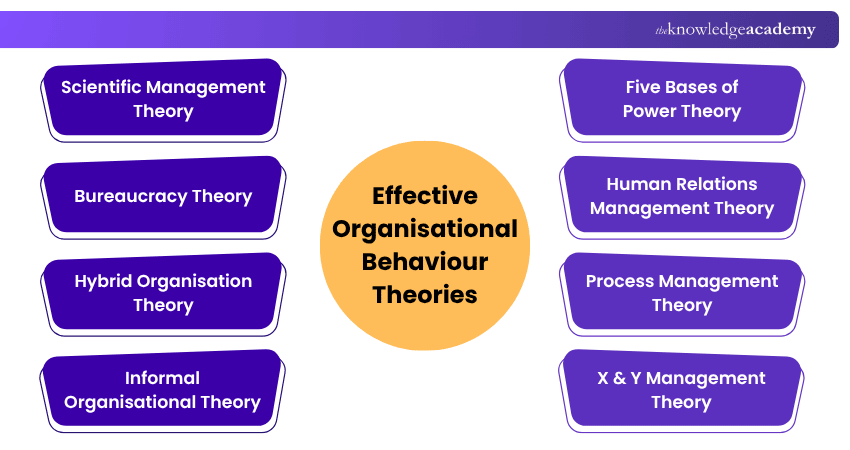
Organisational behaviour theories play a crucial role in guiding real-time evaluation and effective management of individuals within the workplace. Managers and human resources professionals benefit significantly from studying these theories, which provide valuable insights into employee behaviour, motivation, and performance. Let's discuss some of the effective organisational behaviour theories in detail:
1) Scientific Management Theory
In 1911, Frederick Winslow Taylor challenged a widely held belief: that simply pushing people to work harder was the best way to boost productivity. His research proposed something radically different.
His revolutionary idea was to break jobs down into simple tasks and promote collaboration between managers and workers. At the time, factory managers and employees had minimal interaction, so this emphasis on collaboration marked a significant shift in how workplaces operate. Without standardisation, workers were primarily motivated by monetary incentives, leading them to work only as much as required.
Taylor advocated rewarding workers based on their productivity levels, a concept that continues to influence management practices today. Over time, his theories transformed the professional landscape, fostering closer relationships between employees and managers. Managers now recognise the value of rewarding high-quality performance.
Taylor's four key principles for business leaders include developing a scientific approach for each element of a job to replace old rule-of-thumb methods, scientifically selecting and training workers rather than leaving them to train themselves, matching workers to tasks based on their capabilities, and monitoring worker performance to guide them in working efficiently.

2) Bureaucracy Theory
Walk into any organisation and it's clear some people hold more influence than others. Hierarchies exist everywhere, whether people are actively climbing them or content to stay where they are. Bureaucracy Theory, developed by sociologist Max Weber, examines where that authority actually comes from. Weber identified three distinct types of authority that shape how organisations are structured:
a) Charismatic Authority: This power stems from a leader's unique appeal or personal magnetism. Charismatic leaders inspire followers through their vision, personality, and ability to motivate.
b) Legal Authority: Legal authority is conferred upon an individual based on their official position or rank within the organisational hierarchy. It derives from formal rules, regulations, and job descriptions.
c) Traditional Authority: This arises from long-standing customs, beliefs, or historical traditions. Over time, people accept the legitimacy of this authority system, reinforcing its power.
3) Hybrid Organisation Theory
A hybrid organisation is a unique blend of social mission and commercial goals. Unlike traditional for-profit companies prioritising profit maximisation, hybrid organisations seek to create a positive social impact while remaining financially sustainable.
These organisations operate at the intersection of business and social purpose. Key characteristics of Hybrid Organisation Theory include:
a) Dual Objectives: Hybrid organisations recognise that financial success and social impact are not mutually exclusive.
b) Social Mission: These organisations are driven by a clear social or environmental purpose.
c) Innovative Business Models: Hybrids often adopt innovative business models that integrate social impact into their core operations.
d) Measuring Impact: Hybrid organisations track financial performance (profits, revenue) and social impact (number of lives improved, environmental footprint).
4) Informal Organisational Theory
People naturally form connections at work that have nothing to do with the official org chart. Someone in payroll becomes friends with a colleague in marketing, who in turn knows someone in legal, and before long, an entire informal network exists alongside the formal one.
Informal Organisational Theory acknowledges these hidden networks within formal company structures. These informal groupings can significantly influence performance, either positively or negatively.
5) Five Bases of Power Theory
In organisational behaviour, power isn't solely tied to job titles, it also thrives within relationships. French and Raven's Five Bases of Power Theory offers a useful framework for identifying where influence actually comes from within an organisation. Here are the five bases:
a) Legitimate Power: Those with legitimate power hold official titles, such as team leaders, managers, or executives. Their authority stems from their position within the hierarchy.
b) Reward Power: Individuals wield this power by rewarding others for meeting expectations. Whether through bonuses, promotions, or recognition, they motivate performance.
c) Expert Power: Subject Matter Experts (SMEs) possess specialised knowledge and skills. Their expertise makes them go-to resources for problem-solving and learning.
d) Referent Power: Derived from relational skills, referent power belongs to well-liked and respected individuals. They bridge gaps, foster collaboration, and build trust.
e) Coercive Power: Coercive power arises from emotional manipulation, often through punishment. Those who wield it can influence behaviour through fear or consequences.
Learn business analysis skills with BCS Certificate in Business Analysis Practice Course – Join today!
6) Human Relations Management Theory
The Hawthorne Studies, conducted at Western Electric's Hawthorne plant between the 1920s and 1930s, explored how social interactions between employees and managers impact business success. Key insights from the research include:
a) Personal Investment: Companies benefit when they invest in their employees as individuals, recognising their humanity beyond mere productivity. Treating employees with care and respect fosters loyalty and commitment.
b) Rewards and Recognition: Rewarding employees for their successes and skills enhances performance. Recognition, incentives, and a supportive work environment contribute to overall effectiveness.
c) Positive Group Dynamics: Team dynamics significantly influence morale. A cohesive, collaborative atmosphere promotes productivity and job satisfaction.
7) Process Management Theory
Henri Fayol, a French Mining Engineer turned Management Theorist, pioneered Process Management Theory, also known as "Administrative Theory." Unlike earlier theories that emphasised worker efficiency, Fayol shifted the focus to the overall organisation and structure of work tasks. Let's explore some key points about Process Management Theory:
a) Top-down Approach: Fayol advocated a top-down approach to enhance organisational efficiency and decision-making. Effective management should guide the entire process.
b) Work Groups and Departments: Fayol proposed creating distinct work groups and departments, each responsible for unique activities. This division of labour streamlines operations.
c) Correlation With Productivity: Fayol believed that well-organised management directly correlates with workers' productivity. A smoothly functioning organisation leads to better outcomes.
8) X & Y Management Theory
Working in the 1950s and 1960s, Douglas McGregor developed the X&Y Management Theory. According to this theory, all managers and supervisors can be categorised into two distinct groups:
Theory X Managers:
a) Perception: These managers view employees negatively, believing they need external pressure to work hard. They tend to micromanage and closely monitor tasks.
b) Assumptions: Employees lack intrinsic motivation and must be controlled through strict supervision and discipline.
c) Approach: Theory X Managers emphasise compliance and often rely on carrot-and-stick methods.
Theory Y Managers:
a) Beliefs: Theory Y Managers hold a positive view of employees. They believe that individuals are inherently motivated to work.
b) Approach: These managers focus on empowering employees. They provide development opportunities, trust employees to handle tasks independently, and foster a collaborative work environment.
c) Team culture: Theory Y Managers create welcoming workplaces encouraging cohesion, cooperation, and mutual respect.
McGregor's conclusion:
McGregor argued that Theory Y Managers achieve better results. Organisations can enhance morale, productivity, and profitability by combining a positive team environment with personalised growth opportunities.
Identify business gaps and evaluate solutions with BCS Foundation Certificate in Business Analysis Course - Join today!
Importance of Organisational Behaviour Theories
For managers, grasping the elements of organisational behaviour has never been more crucial. These theories underpin a company's competitiveness and success. Beyond economic compensation, employees consider various factors when deciding to stay, making it essential for companies to understand these variables.
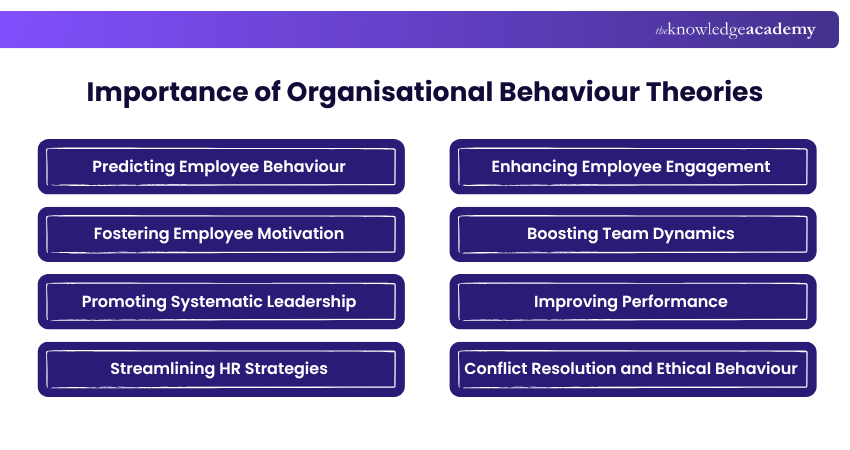
Here are the key reasons why organisational behaviour theories matter in understanding and managing human behaviour within organisations.
Predicting Employee Behaviour
These theories help managers anticipate how individuals and groups behave within the organisation. Informed decisions, setting expectations, and scenario planning rely on understanding employee behaviour.
Fostering Employee Motivation
Managers can create supportive work environments by comprehending employee needs and applying motivational theories. Addressing these needs inspires higher engagement, commitment, and performance.
Promoting Systematic Leadership
Organisational behaviour replaces guesswork with evidence-based study and research. Informed decision-making and effective leadership result from this systematic approach. Leadership in organisational behaviour plays a key role in applying these principles, guiding teams, and fostering an environment of strategic decision-making.
Streamlining HR Strategies
Insights from organisational behaviour theories guide HR professionals. Tailoring recruitment, retention, and talent development efforts optimise workforce management.
Enhancing Employee Engagement
These theories provide tools to boost job satisfaction and engagement. Engaged employees are more productive and committed. They're also less likely to leave, which reduces the ongoing cost and disruption of staff turnover.
Boosting Team Dynamics
Understanding team dynamics enables effective teamwork. Managers can build and lead high-performing teams based on this knowledge. Recognising how individuals interact within a group also helps managers spot friction early, before it affects the wider team.
Improving Performance
Organisational behaviour theories identify factors that hinder success. Addressing these leads to better corporate performance. This often means tackling root causes, like unclear roles or poor communication, rather than just responding to symptoms after the fact.
Conflict Resolution and Ethical Behaviour
Understanding conflict dynamics and ethical decision-making fosters a harmonious work environment. When employees see conflicts handled fairly and consistently, it builds trust in leadership and reinforces a stronger workplace culture.
Pro Trainer's Tip
Rather than applying one organisational behaviour theory to every workplace situation, assess the team, task and organisational structure first. Combining relevant principles from different theories can help managers adapt their leadership approach to changing employee and business needs.

Vidhya Nair is a Senior Copywriter with 7+ years of experience across copywriting, content writing and communication. Her extensive research and editorial experience supports her ability to present topics across Business Skills and Human Resources with clarity and purpose.
View Detail

 If you wish to make any changes to your course, please


