




We may not have the course you’re looking for. If you enquire or give us a call on 01344203999 and speak to our training experts, we may still be able to help with your training requirements.
3 Fundamental Models of Communication
ByShristi RoyLast updated on: 03 October 2026
Explore this blog to understand the fundamentals of models of communication and their significance in the workplace. Dive into the Linear Model, Interactive Model and Transactional Model to gain a comprehensive grasp of communication theories and learn their key concepts. Read ahead to learn more.
Quick Preview
Discover how Linear, Interactive, and Transactional Models explain the way messages are sent, received, interpreted, and refined through feedback. You’ll also explore key models such as Aristotle’s, Shannon-Weaver, Osgood-Schramm, Barnlund’s, and Dance’s Helical Model.
Have you ever wondered how the models of communication shape the way we exchange information and ideas with others? They help establish the basic process of communication, which also necessitates active participation from both the sender and the receiver. They provide valuable frameworks to understand and improve the exchange of information. By applying these Models, one can enhance their communication skills, minimise misunderstandings, and foster meaningful connections.
So, if you want employee satisfaction at your workplace, it’s time to take action. Read this blog to learn about the key models of communication and understand the communication process with a detailed representation.
What is a Model of Communication?
A Model of communication refers to a simplified representation or framework that helps individuals understand how communication works. It's like a map that guides and navigates them through the complex process of exchanging information, ideas, and emotions with others. It provides insights into the different elements involved in communication. Below, you can explore three fundamental models of communication.
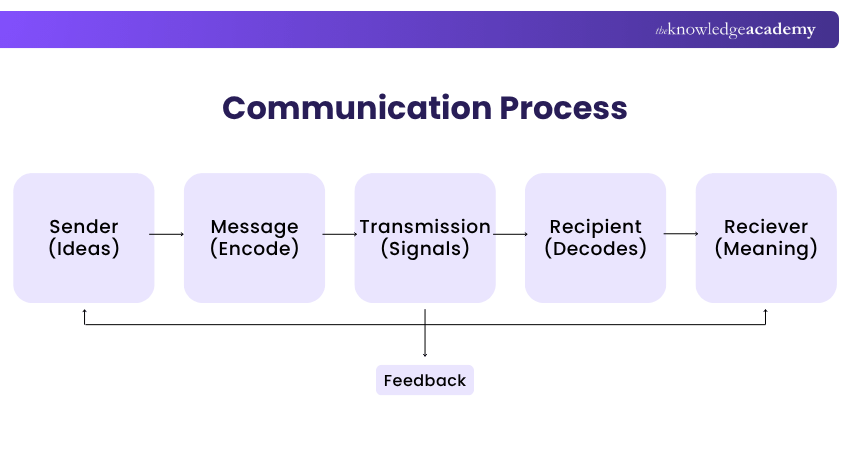
By studying the various models of communication, individuals can clearly understand how effective communication takes place and how they can improve their communication skills.
Each model offers its own perspective and helps people analyse their communication techniques from various angles. This enables them to communicate more effectively in different situations. The key benefits of models of communication include the following:
a) Enhanced understanding
b) Improved clarity
c) Effective message design
d) Strategy development
e) Increased adaptability
Linear Model
The Linear Model, also known as the Transmission Model, defines communication as a one-way process in which a sender knowingly conveys a message to a receiver. This Model mainly focuses on the sender and the message within a communication process. Although the receiver is included in the Model, this role is considered more of a target or endpoint instead of part of a continuous process.
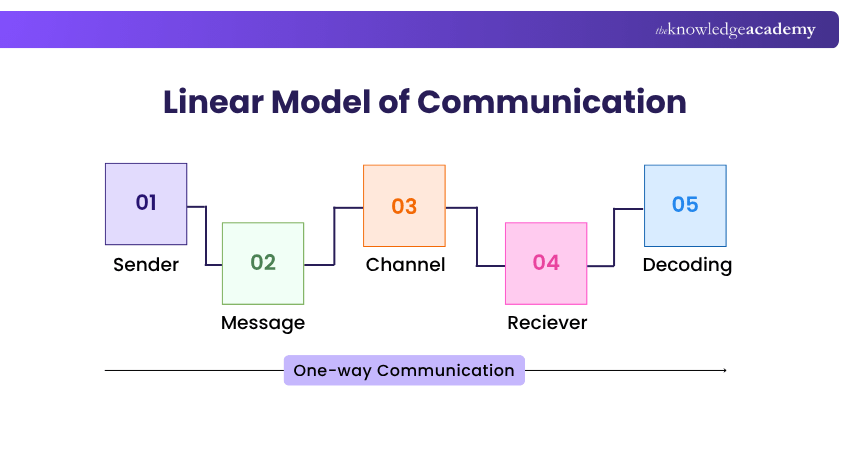
The scholars who developed this model were influenced by the rise of contemporary communication technologies, such as radio and telegraphy, and you can observe these technical influences within the Shannon & Weaver Model. For instance, a radio message is transmitted from a person in a studio to you listening in your car.
Similarly, the sender is considered a radio announcer who encrypts a verbal message that is sent by a radio tower via electromagnetic waves and ultimately reaches your ears through an antenna and speakers to be translated. The radio announcer is not aware of whether you get their message or not, but if the equipment is working and there is a clear signal on a channel, then there is a high chance that the message was received successfully.
The following models illustrate how the Linear approach explains one-way communication, message transmission, and the influence of the sender, channel, and audience.
Aristotle's Model
Aristotle's model of communication, proposed by the ancient Greek philosopher Aristotle, focuses on persuasive communication. The sender aims to influence the receiver's beliefs or actions by presenting convincing arguments. Here's a breakdown of Aristotle's model in simple terms:
1) Speaker: The sender who delivers the message, credibility and skill are central.
2) Speech: The actual content or message being conveyed.
3) Occasion: The context or situation (e.g., courtroom, rally, lecture).
4) Audience: The receiver(s) whose beliefs or actions the speaker aims to influence.
5) Effect: The intended impact, such as persuasion, motivation, or behavioural change.
Further, Ethos, pathos, and logos strengthen persuasive communication by building credibility, appealing to emotions, and using logic and evidence. A message may then conclude with a clear call to action that encourages the audience to respond, support a cause, make a decision, or change their behaviour.
Bonus Tip
Before sending an important message, ask yourself: “What could the receiver understand differently from what I intend?” This simple check can uncover unclear wording, hidden assumptions, and missing context before they cause confusion.
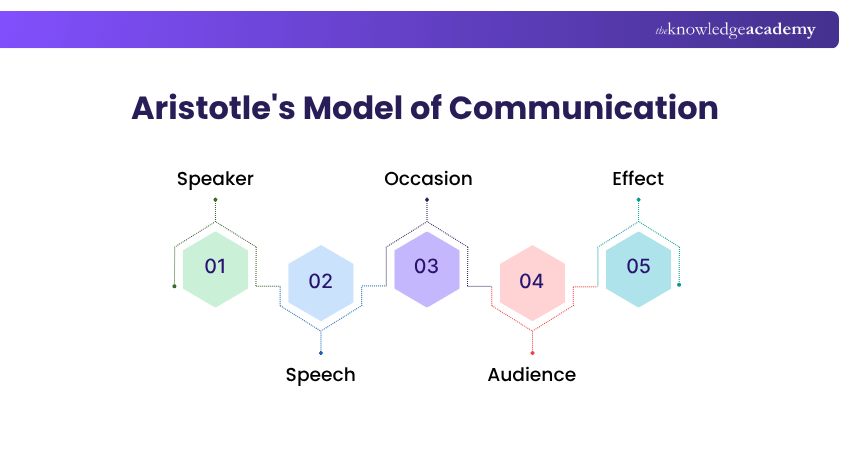
Example: In a class presentation about recycling, a student establishes credibility by sharing their research and evokes emotions by highlighting the positive impact on endangered animals. Lastly, they present logical reasons for recycling. They conclude by urging classmates to take action and actively participate in recycling efforts.
Want to enhance your interpersonal skills to manage teams? Join our Interpersonal Skills Course now.
Lasswell's Model
Lasswell's model offers a structured approach to understanding the basic elements of communication. This includes the sender, message, channel, audience, and effect. It outlines five key elements that are essential in any communication process. It is often used to analyse and understand the process of communication. The five elements are as follows:
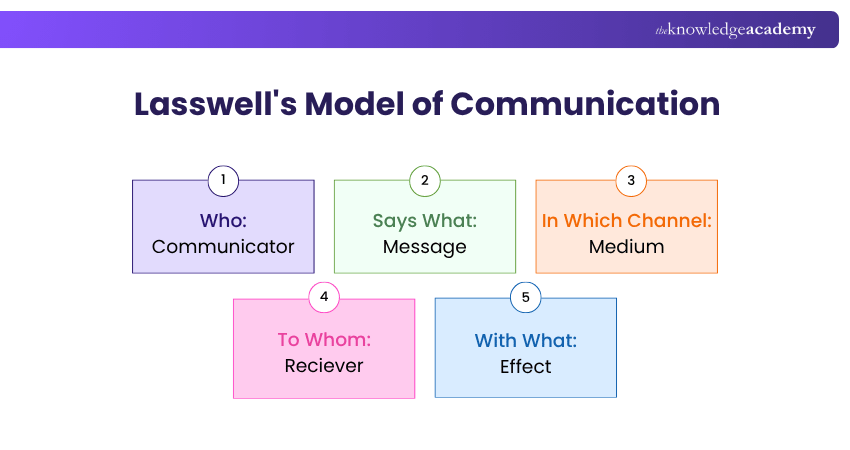
a) Who: It addresses the question of who is sending the message. For example, in a news report, the "who" would be the journalist or news organisation responsible for conveying the information.
b) Says what (Message): This question pertains to the content or message being communicated. It examines the specific information, ideas, or opinions being shared. In a political speech, the "says what" could be the candidate's policy proposals or campaign promises.
c) Through which channel: It explores the medium or channel through which the message is being transmitted. This could include face-to-face communication, television, radio, social media, or print publications. For instance, a music artist may release a new song through various streaming platforms.
d) To whom (Receiver): This question focuses on the intended audience or receivers of the message. It considers the demographics, interests, and characteristics of the target audience. For example, a children’s toy advertisement would be directed towards parents or caregivers.
e) With what effect: It examines the impact or effect of the communication on the audience. This includes evaluating whether the message was understood, influenced opinions, or prompted desired actions. For instance, a public service announcement about the importance of wearing seatbelts aims to increase awareness and encourage safer driving habits.
Shannon - Weaver Model
The Shannon - Weaver model of communication is a widely recognised model that addresses the impact of "noise" on communication. In simple terms, it refers to any factors that can disrupt the message.
The model developed by Shannon and Weaver aimed to identify the most effective communication channels. It consists of the following five components:
a) Sender: The person or entity who initiates and sends the message.
b) Encoder: The process of converting the message into a suitable form for transmission, such as words, sound, or visuals.
c) Channel: The medium or pathway through which the message is transmitted, like a phone line, email, or radio waves.
d) Decoder: The process of interpreting and making sense of the received message.
e) Receiver: The intended recipient of the message, who receives and understands it.
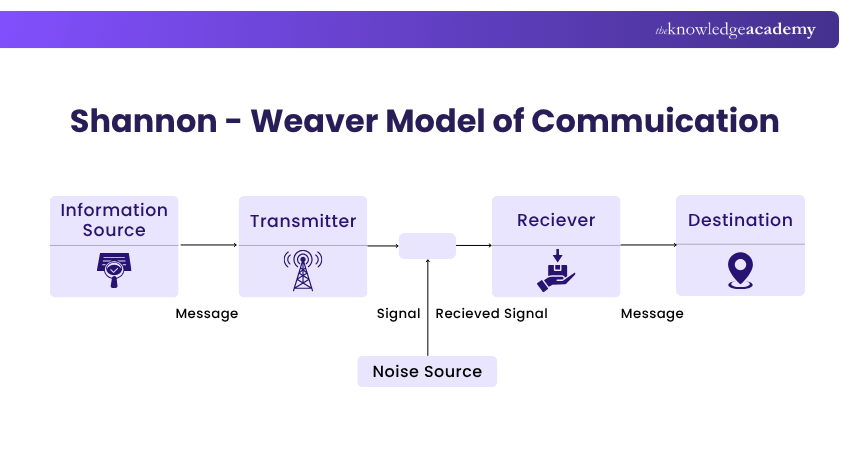
Shannon and Weaver recognised that various issues like background noise in a phone call, typos in an email, or other disturbances can significantly affect communication quality. A more recent version of this Model includes "feedback" as the sixth component, making it more interactive and collaborative rather than strictly linear.
Berlo's S-M-C-R Model
Berlo's S-M-C-R Model stands for Source, Message, Channel, and Receiver. It also focuses on the elements involved in the communication process. Here's an explanation of Berlo's Model using the following mediums:
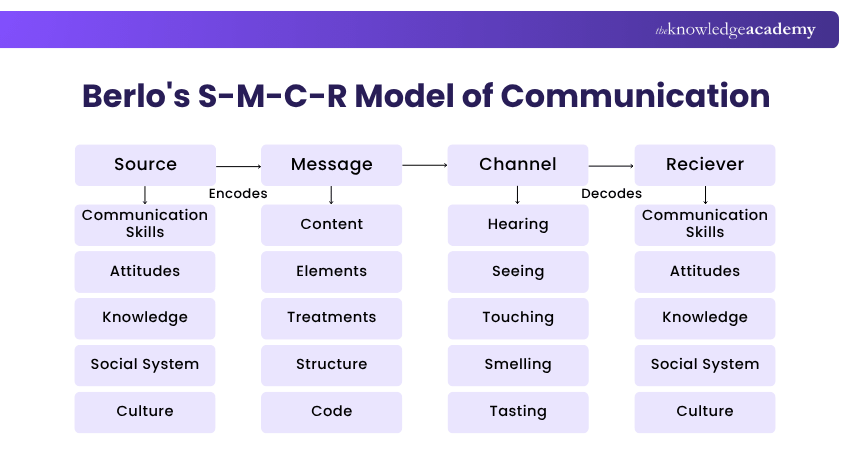
a) Source: The source is the person or entity that initiates the communication. They create and send messages to be conveyed.
b) Message: The message is the information, ideas, or thoughts that the source wants to communicate. It can be in spoken words, written text, gestures, or any other mode of expression.
c) Channel: The channel refers to the means or medium through which the message is transmitted from the source to the receiver. It can be face-to-face conversations, phone calls, emails, or social media platforms.
d) Receiver: The receiver is the person or group for whom the message is intended. They receive and interpret the message sent by the source.
Berlo's Model emphasises the importance of understanding the receiver's characteristics, including their knowledge, attitudes, and communication skills. This understanding helps the source to design the message effectively. It also helps ensure better comprehension and reception by the receiver.
Interactive Model
The Interactive model of communication describes that when people Communicate, they take turns being the ones who talk and listen. They create meaning by sending messages and getting responses in different situations.
According to the Interactive Model, there's a back-and-forth conversation, and people's responses are called feedback. It's like having a conversation where you respond to what the other person says. The Interactive Model doesn't focus much on messages but mainly focuses on interaction.
While the Linear Model focuses on how a message is sent and whether it was received or not, this Model is more focused on the communication procedure itself. In fact, this Model recognises that there are a lot of messages being sent at one time, and some of them may not even be received.
The Interactive Model includes a physical and psychological context. The physical context contains the environmental factors in a communication encounter, such as the size, temperature, layout, and lighting of a space that may affect in-person communication. On the other hand, the psychological context contains emotional and mental factors, such as anxiety, stress, and emotions, that can affect communication.
The following models below show how the Interactive approach explains feedback, interpretation, and the influence of context in two-way communication.
Pro Tip
Use communication models as diagnostic tools. If a message is misunderstood, trace where the breakdown happened: source, message, channel, interpretation, feedback, or context. This makes communication problems easier to correct.
Osgood - Schramm Model
The Osgood-Schramm model of communication focuses on how individuals interpret and understand messages. It emphasises the role of perception in communication and considers three key elements:
a) Source: The person or entity who sends the message.
b) Message: The information or ideas being communicated.
c) Receiver: The person who receives and understands the message.
One interesting aspect of this Model is that everyone brings their unique background to the communication process. This affects how they understand and respond to messages. It reminds people consider their differences and cultural backgrounds when communicating. It is because it's not just about what they say, but also how others perceive and interpret messages.
Example: Imagine two colleagues discussing a project. Each colleague's interpretation of the information shared may differ based on their unique backgrounds and perspectives. This illustrates how the Osgood - Schramm Model recognises individual perception in communication.
Westley and Maclean Model
The Westley and Maclean model is one of the crucial models of communication, emphasising the role of feedback and the impact of the social environment on the communication process. It recognises that the interaction between the sender, the receiver, and the larger social context influences communication.
This Model explains that the sender initiates a message based on their understanding of the receiver and the social situation. The receiver, in turn, interprets and responds to the message, providing feedback. This feedback loop helps refine future communication interactions.
One unique aspect of the Westley and Maclean Model is the inclusion of the social environment. It acknowledges that communication is not isolated but influenced by cultural norms, social structures, and media. These external factors shape how messages are constructed and understood.
Example: Imagine two colleagues discussing a project. After sharing their ideas, one colleague asks for feedback from the other. The feedback received helps the first colleague refine their approach and make improvements. This interactive exchange exemplifies the feedback loop in the Westley and Maclean Model.
Gain practical communication skills that are applicable in real-life organisational settings - join our Communication Skills Training today.
Transactional Model
The Transactional Model of Communication deals with messengers or communicators, creating social realities within rational, social and cultural contexts. This Model comes under Barnlund's Transactional Model.
The idea is that people don’t just convey their messages; they communicate to build relationships, form self-concepts and intercultural alliances and get in contact with others to create communities. Hence, this Model considers communication as a powerful tool that creates the realities.
In the Transactional Model, the roles of the sender and receiver vary significantly from the other Models. Rather than labeling participants as senders and receivers, the people engaged in communication are considered communicators.
It indicates that an individual can be a sender and a receiver simultaneously. This is an essential complement to the Model as it enables people to understand how they can change their communication styles.
The following models mentioned below show how the Transactional approach views communication as a dynamic, simultaneous process shaped by feedback, context, relationships, and shared meaning.
Barnlund's Transactional Model
Barnlund's Transactional model is one of the crucial models of communication, recognising the interactive and dynamic nature of Interpersonal Communication. It emphasises that communication is not a one-way process but rather a simultaneous exchange of messages between the sender and receiver.
In this Model, both verbal communication and nonverbal cues, such as body language and context, play significant roles in conveying meaning. It highlights the importance of shared meaning, where both parties actively participate in interpreting and understanding the messages being exchanged.
Barnlund's model promotes active listening, empathy, and open-mindedness, fostering effective communication and building stronger relationships. It allows individuals to enhance their communication skills, deepen understanding, and establish meaningful connections with others.
Example: Imagine two colleagues engaged in a discussion during a team meeting. As one colleague presents a new idea, the other listens attentively, nodding and providing verbal feedback. They exchange nonverbal cues like facial expressions and gestures, actively participating in the conversation.
This interactive exchange reflects Barnlund's Transactional Model, where both colleagues contribute to understanding. They also respond to each other's messages in an engaging manner.
Want to enhance your interpersonal skills to manage teams? Join our Communication And Interpersonal Skills Course now.
Dance's Helical Model
Dance's Helical model views communication as a dynamic spiral. This spiral evolves over time, incorporating feedback for deep understanding and creating shared meaning. It emphasises the iterative nature of communication and encourages ongoing learning for effective and meaningful interactions. The spiral shape symbolises how communication continually evolves and builds upon previous interactions. It looks something like the following image:
As communication progresses, it becomes more complex, incorporating new understandings and insights. Further, this Model recognises that both past experiences and the present context influence communication. It highlights the importance of feedback and how it shapes future interactions. This leads to a deeper understanding and improved communication over time.
Example: Imagine a student and a teacher discussing a complex topic. As the conversation progresses, the student’s understanding deepens. This leads to new questions and insights. With each interaction, the communication spiral of Dance’s Helical Model unfolds. As a result, it allows for continuous growth and a richer knowledge exchange between the student and teacher.
Communication Model Checklist
Before analysing a communication situation, check:
1) Direction: Is communication one-way or two-way?2) Feedback: Can the receiver respond or clarify?3) Context: Could the environment, emotions, or culture affect meaning?4) Noise: Is anything disrupting or distorting the message?5) Roles: Are people taking turns or communicating simultaneously?6) Outcome: Was the intended message understood and acted upon?
Ultimately, communication is more than simply sending a message. Understanding these models helps reveal how meaning is shaped, shared, and strengthened through every interaction.

Shristi Roy is a Content Writer with experience in journalism, article writing and web content development. Her experience researching and writing about Business Skills and Accounting and Finance enables her to communicate specialised information through clear, engaging narratives.
View Detail

 If you wish to make any changes to your course, please


