




We may not have the course you’re looking for. If you enquire or give us a call on 01344203999 and speak to our training experts, we may still be able to help with your training requirements.
Key Elements of Organisational Behavior (OB): An Overview
ByGaurav KalitaLast updated on: 03 October 2026
Key elements of Organisational Behaviour encompass vital qualities essential for comprehending and managing a company's traits effectively. By looking into its essential components, we get insights into how to build a productive and peaceful workplace.
Key Highlights
1. A workplace issue may involve several elements of Organisational Behaviour at the same time, so examining only the most obvious factor can give an incomplete picture.2. Individual behaviour should be considered alongside group dynamics, as team norms and relationships can influence how employees act at work.3. Formal organisational structure and day-to-day working practices may differ, making role clarity and actual decision-making authority important areas to examine.4. Introducing new technology can create wider organisational changes, including new skill requirements, altered responsibilities and different ways of working.5. Managers can use the four elements as a diagnostic framework to identify where a workplace problem originates before deciding how to address it.
Organisational Behaviour shapes how people, structure, technology and environment come together to influence how a company actually functions day to day. Understanding these elements helps explain why some workplaces run smoothly while others struggle with the same basic challenges.
A problem that looks like a people issue on the surface, for example, can often trace back to unclear structure or outdated technology instead. This blog explores the key elements of Organisational Behaviour and how each one contributes to shaping a modern organisation. So, let's read ahead to learn more!
What is Organisational Behaviour?
Organisational Behaviour (OB) is the study of how individuals and groups behave within organisational settings and how workplace conditions influence their behaviour. It helps organisations understand factors that shape how people think, interact and perform at work.
OB is commonly examined at three levels: individual, group and organisational. These cover individual attitudes and motivation, group interactions such as teamwork and leadership, and broader organisational structures and processes. Together, they provide a more complete understanding of workplace behaviour.

Key Elements of Organisational Behaviour
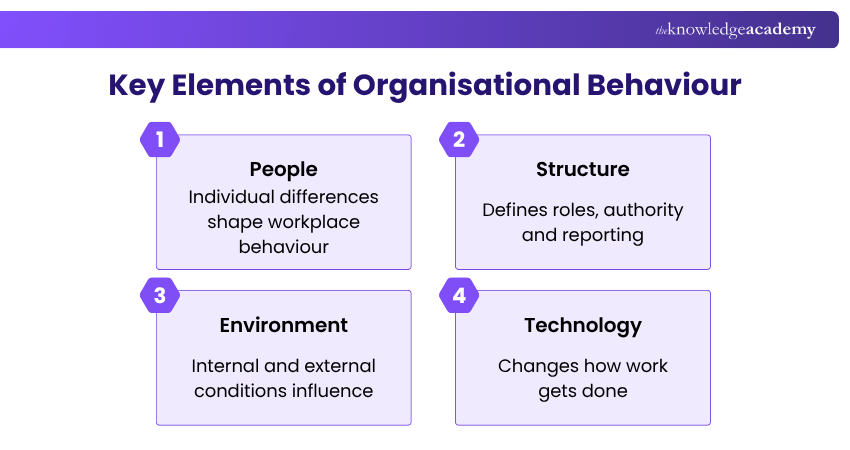
Organisational Behaviour involves the study of human behaviour within the context of an organisation. Understanding its elements provides insights into how individuals, groups, and technology interact to shape organisational dynamics. Let's look at them below:
1) People
People are the individuals who make up an organisation, employees, managers, leaders and teams, each bringing their own background, skills, personality and experience. Organisational Behaviour examines people at three levels: as individuals, within groups, and as part of the wider organisation.
At the individual level, this includes things like a person's role, qualifications and personal working style. At the group level, it covers how teams are formed and how members relate to one another. At the organisational level, it looks at the workforce as a whole, its overall composition, diversity and collective capability.
2) Structure
Structure is the formal framework that defines roles, reporting lines and authority within an organisation. It includes elements such as departmentalisation, hierarchy, span of control and how much decision-making is centralised versus distributed across teams.
Departmentalisation refers to how work is divided into units such as departments or functions. Span of control describes how many people report to a single manager. Centralisation and decentralisation describe where in the hierarchy key decisions are actually made.
Pro Tip
An organisational chart shows formal reporting relationships but not always how work happens in practice. Assess whether employees understand their responsibilities, decision-making authority, and approval or support channels, as changing the chart alone may not resolve unclear working relationships.
3) Technology
Technology refers to the tools, systems and platforms an organisation uses to carry out its work, from data analytics and automation to communication and collaboration software. It forms part of the physical and digital infrastructure employees rely on daily.
This can range from basic office software to advanced data analytics platforms. It also includes the machinery, equipment and digital systems specific to an industry or role. Communication tools, from email to collaboration platforms, are also a core part of this component.
4) Environment
Environment covers the internal and external context an organisation operates within. Internally, this includes culture, values and policies. Externally, it includes economic, social, legal and technological conditions that exist outside the organisation's direct control.
Internal environment also covers physical workspace, management style and established norms. External environment includes factors like competitors, industry regulation and broader market conditions. Together, these two layers form the wider context every organisation operates within.
Advance your career with the BCS Foundation Certificate in Business Analysis Course. Join today!
Why Organisational Behaviour Matters?
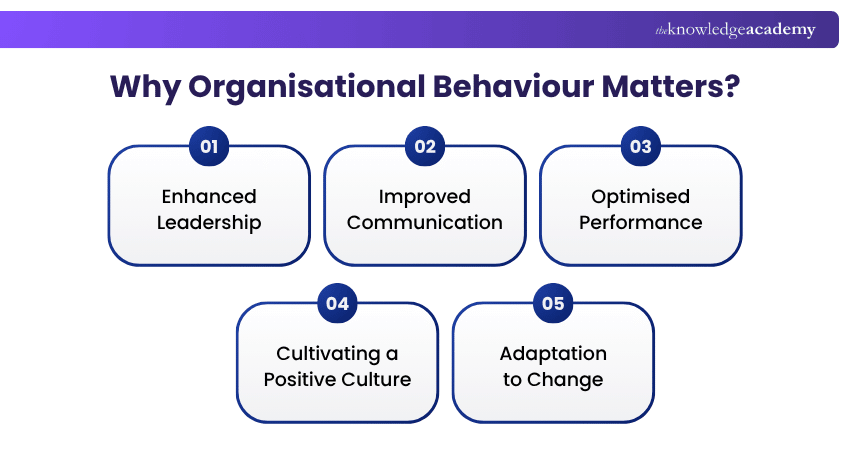
Organisational Behaviour aims to enhance organisational effectiveness by understanding and managing human behaviour within the organisational context. Here's an overview of the key ways Organisational Behaviour makes a difference:
1) Enhanced Leadership
OB equips leaders with insights into human behaviour and organisational dynamics, enabling them to effectively motivate, inspire, and lead their teams towards common objectives. Understanding how individuals and groups function within the organisation empowers leaders to make informed decisions and drive performance, ultimately shaping how effectively a team works towards shared goals.
2) Improved Communication
By comprehending the organisational structure and technological tools available, OB facilitates the establishment of effective communication channels. This fosters collaboration, information sharing, and alignment across different departments and hierarchical levels. Clear and open communication is vital for maintaining transparency, resolving conflicts, and fostering a cohesive work environment.
3) Optimised Performance
Understanding employee needs, motivations and capabilities can help organisations identify factors that influence workplace performance. Organisational Behaviour considers areas such as job design, leadership, group dynamics and organisational processes, while aligning individual responsibilities with organisational objectives can help employees understand their contribution to broader goals.
Quick Insight
Performance problems are not always caused by low motivation. Unclear responsibilities, unsuitable technology, poor communication or inefficient processes can also affect performance, so managers should consider the wider organisational context.
4) Cultivating a Positive Culture
Organisational culture significantly influences employee behaviour, attitudes, and engagement levels. OB focuses on nurturing a supportive, inclusive, and positive organisational culture where employees feel valued, respected, and motivated. A positive culture can support employee engagement, retention and well-being while contributing to organisational effectiveness.
5) Adaptation to Change
Businesses must be ready to adapt to both internal and external changes to be competitive in the ever-evolving business environment. Organisations can more effectively adapt to environmental changes, such as market trends, legislative changes, and technology innovations, with the support of OB. Organisations can succeed in an environment of uncertainty and volatility when they adopt a flexible, creative, and continuous improvement culture, which is promoted by OB.
Learn to build smarter business solutions with the Business Analysis Courses - Join now!

Gaurav Kalita is a Content Writer with 2+ years of experience in content development, research and storytelling. His background in English literature and teaching, combined with his growing interest in AI and Machine Learning, supports his writing across Business Skills and IT and Tech.
View Detail

 If you wish to make any changes to your course, please


