




We may not have the course you’re looking for. If you enquire or give us a call on 01344203999 and speak to our training experts, we may still be able to help with your training requirements.
How to Become a Supervisor: A Step-by-Step Guide
ByVidhya NairLast updated on: 23 September 2026
Explore the comprehensive guide 'How to Become a Supervisor: A Step-by-Step Guide', tailored for aspiring leaders. This blog delves into essential qualifications, effective communication skills, and leadership strategies. Learn about necessary educational paths, gaining relevant experience, and developing key Supervisory skills.
Becoming a Supervisor is not easy, but it can be rewarding and fulfilling. Supervisors are responsible for managing teams, ensuring quality and productivity, and communicating with upper management. Supervisors also have the chance to mentor and coach their employees and help them grow professionally. But How to Become a Supervisor? What skills and qualifications do you need? And what are the benefits of being a Supervisor? In this blog, we will answer these questions and more and provide you with a step-by-step guide on How to Become a Supervisor.
Steps to Become a Supervisor
There is no one-size-fits-all formula for becoming a Supervisor, as different industries and organisations may have different requirements and expectations. However, there are some common steps that you can follow to prepare yourself for this role. Here are some of them:
1) Explore Supervisor education requirements
The first step to becoming a Supervisor is to research the specific skills and knowledge that you need for your desired industry and position. This research often involves understanding the key Functions of a Supervisor. You can do this by reading job descriptions, talking to current Supervisors, or consulting with industry experts. Some of the general skills that most Supervisors need are:

a) Communication skills: Supervisors need to communicate effectively with their employees, peers, and managers, using both verbal and written methods. They also need to listen actively, give constructive feedback, and resolve conflicts.
b) Leadership skills: Supervisors need to motivate and inspire their teams, set clear goals and expectations, delegate tasks, and monitor performance. They also need to demonstrate integrity, accountability, and professionalism.
c) Problem-solving skills: Supervisors need to identify and analyse problems, generate and evaluate solutions, and implement them in a timely and efficient manner. They also need to be adaptable and flexible and cope with changes and challenges.
d) Technical skills: Supervisors need to have a solid understanding of the technical aspects of their work, such as the tools, processes, and standards that they use. They also need to keep up with the latest trends and developments in their field and learn new skills as needed.
2) Start to develop specific Supervisor skills
Once you have identified the skills and knowledge that you need to become a Supervisor, you need to work on improving them. You can do this by taking courses, watching videos, reading books, or attending workshops and seminars that focus on developing your Supervisory Skills.
You can also seek feedback from your managers, mentors, or colleagues' mentors and ask them for advice and suggestions. You can also practice your skills by taking on more responsibilities, leading projects, or volunteering for initiatives that require Supervisory skills.

3) Complete relevant Supervisor training and internships
Another way to prepare yourself for becoming a Supervisor is to gain some practical experience through training or an internship. It will allow you to apply your skills and knowledge in a real work environment and learn from experienced Supervisors.
You can look for opportunities within your current organisation or outside of it, depending on your goals and availability. You can also ask your manager or mentor for recommendations or referrals.
4) Gain additional Supervisor certifications
Depending on your industry and position, you may need to obtain some certifications to become a Supervisor. Earning certifications can showcase your proficiency and reliability, thereby enhancing your prospects of securing employment or advancing in your career. Some of the common certifications for Supervisors are:
a) Certified Professional in Learning and Performance (CPLP): Offered by the Association for Talent Development, this credential recognises expertise in creating, implementing, and assessing learning and performance strategies.
b) Certified Manager (CM): Provided by the Institute of Certified Professional Managers, this certification focuses on essential managerial skills, including planning, organising, leadership, and control.
c) Certified Supervisor (CS): This certification is offered by the National Association of Workforce Development Professionals (NAWDP), and it focuses on the skills and knowledge related to workforce development, such as coaching, mentoring, and performance management.
5) Research Supervisor duties and responsibilities
Before you apply for a Supervisor position, you need to understand the responsibilities and expectations that come with it. Supervisors have a lot of duties and functions, such as:
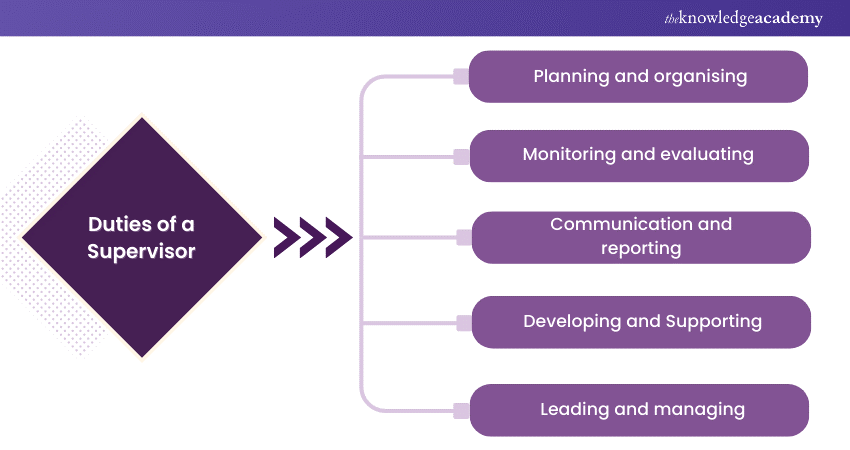
a) Planning and organising: Supervisors need to plan and organise the work of their teams, such as setting goals, assigning tasks, allocating resources, and scheduling activities.
b) Monitoring and evaluating: Supervisors need to monitor and evaluate the work of their teams, such as tracking progress, measuring results, providing feedback, and taking corrective actions.
c) Communicating and reporting: Supervisors need to communicate and report the work of their teams, such as updating managers, informing stakeholders, and documenting outcomes.
d) Developing and supporting: Supervisors need to develop and support their teams, such as training, coaching, mentoring, and motivating them.
e) Leading and managing: Supervisors need to lead and manage their teams, such as creating a positive work environment, resolving conflicts, enforcing policies, and making decisions.
Maximise your productivity and reclaim your time – register for our Time Management Training now to boost your efficiency and achieve your goals!
6) Prepare your Supervisor resume
Once you have acquired the skills, knowledge, experience, and certifications you need to become a Supervisor, you must create your resume. Your resume is a marketing tool, and it should highlight your qualifications and achievements as a Supervisor. Some of the tips for creating a resume are:
a) Use a clear and professional format, and include your contact information, summary, skills, work experience, education, and certifications.
b) Use keywords that match the job description and emphasise your Supervisory skills and accomplishments.
c) Use points to describe your work experience and quantify your results with numbers and metrics.
d) Proofread and edit your resume, and check for spelling, grammar, and punctuation errors.
7) Apply for Supervisor jobs
The final step to becoming a Supervisor is to start applying for relevant positions. You can use various methods to find and apply for jobs, such as:
a) Networking: You can use your personal and professional contacts, such as friends, family, colleagues, managers, mentors, or alumni, to find out about job openings, referrals, or recommendations.
b) Online job boards: You can use job search engines, which are available online for job postings, upload your resume, and apply online.
c) Company websites: You can visit the companies' websites that interest you and check their career pages, where they may post job openings, requirements, application procedures, and even helpful resources like Supervisor Interview Questions to better prepare for the hiring process.
d) Recruitment agencies: You can use recruitment agencies to help you find and apply for jobs, as they may have access to exclusive job opportunities and provide you with guidance and support.
Unlock your full potential and embark on a journey of personal growth with our transformative Personal Development Training – invest in yourself today.
What are the duties and functions of a Supervisor?
As we have seen in the previous section, supervisors have a lot of duties and functions, which can vary depending on the industry, organisation, and position. However, when comparing Superintendent vs Supervisor, it's important to understand the distinct roles each position plays. Some of the common duties and functions of a supervisor are:
a) Supervising the work of employees and ensuring that they follow the rules, regulations, and standards of the organisation.
b) Providing feedback, recognition, and rewards to employees and addressing any issues, concerns, or complaints that they may have.
c) Training, coaching, mentoring, and motivating employees, and helping them develop their skills, knowledge, and performance.
d) Evaluating the performance of employees and conducting appraisals, reviews, and assessments.
e) Hiring, firing, promoting, or disciplining employees, and handling any employee relations matters.
f) Communicate with management and report on the status, progress, and results of the team's work.
g) Collaborating with other Supervisors and managers, and departments, and coordinating the work of the team with other teams or units.
h) Solving problems, making decisions, implementing solutions, and dealing with any challenges or changes that may arise.
i) Planning and organising the work and setting goals, objectives, and priorities.
j) Allocating and managing the resources of the team, such as budget, time, equipment, and materials.
Enhance your organisational skills for a more efficient and successful career – register for our Organisational Skills Course today!
Advantages of pursuing a career as a Supervisor
Becoming a Supervisor can have many advantages, both personally and professionally. Some of the advantages of pursuing a career as a Supervisor are:
a) You can work on your leadership skills and learn how to manage people, projects, and processes.
b) You can advance your career and have more opportunities for growth, promotion, and recognition.
c) You can increase your income and earn more money, benefits, and incentives.
d) You can have more autonomy, control, and influence over your work and your team.
e) You can have more impact and make a difference in your organisation, your industry, and your society.
f) You can have more satisfaction and enjoy your work more as you help your team and your organisation achieve their goals and vision.

Vidhya Nair is a Senior Copywriter with 7+ years of experience across copywriting, content writing and communication. Her extensive research and editorial experience supports her ability to present topics across Business Skills and Human Resources with clarity and purpose.
View Detail

 If you wish to make any changes to your course, please


