




We may not have the course you’re looking for. If you enquire or give us a call on 01344203999 and speak to our training experts, we may still be able to help with your training requirements.
Functions of a Supervisor: A Comprehensive Overview
ByShristi RoyLast updated on: 03 October 2026
This blog explores the key functions of a Supervisor, from planning and leading a team to monitoring performance and communicating between employees and management, along with the skills needed to become one.

Key Highlights
1. Supervisors plan and organise daily work to help teams achieve their goals efficiently.2. Effective supervision involves leadership, communication, motivation and regular performance monitoring.3. Supervisors act as an important communication link between employees and management.4. Workplace safety, employee development and problem-solving are important parts of effective supervision.5. Strong supervisory skills can contribute to team performance and wider organisational objectives.
Every workplace has its moments of chaos. A deadline suddenly moves forward, a team member needs support, and an unexpected problem demands immediate attention. The Supervisor is usually the one who has to make sense of it all, deciding what gets tackled first, who needs help, and how the team keeps moving. From delegating tasks and motivating employees to tracking performance and resolving conflicts, these day-to-day decisions are what actually keep a workplace functioning.
What is a Supervisor?
A Supervisor is a professional who oversees the day-to-day activities of employees and helps ensure that assigned work is completed effectively. They organise tasks, guide employees, monitor performance and provide support when challenges arise.
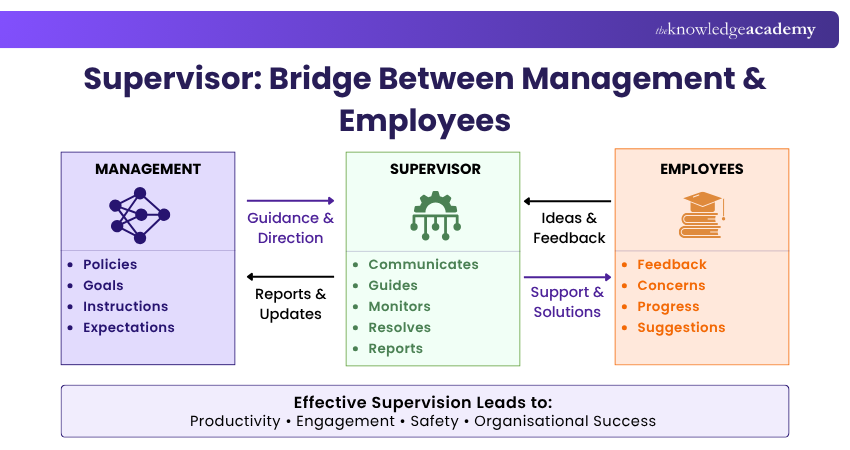
Supervisors also serve as an important link between employees and management. They communicate organisational instructions to their teams while sharing employee feedback, concerns and suggestions with management. This position allows them to support both operational goals and employee needs.

Key Functions of a Supervisor
A Supervisor is a person who oversees the daily activities of employees and helps guide them through their responsibilities. A Supervisor usually performs the following duties:
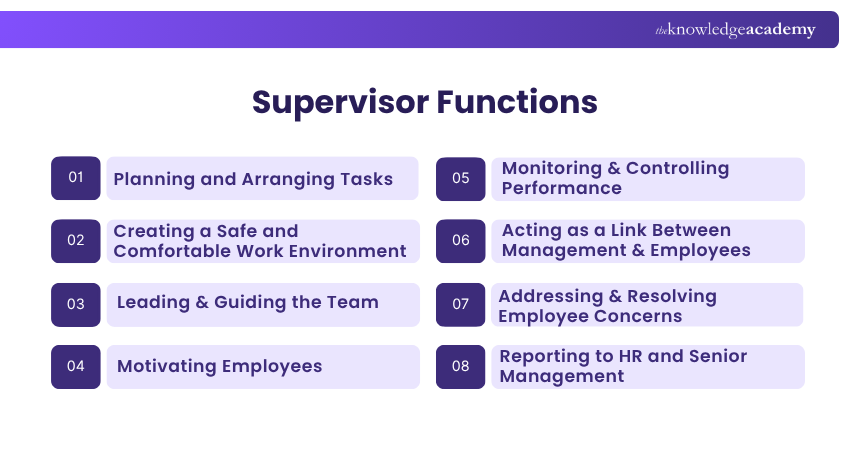
1) Planning and Arranging Tasks
A Supervisor sets goals for deadlines and performance in ways that comply with the company’s vision and plan. A Supervisor organises workflow and ensures that employees understand their duties or delegated tasks. A Supervisor also plans and divides the project into small tasks and then distributes them among their team members. They also provide them with a timeline in which they are expected to complete the work assigned to them.
2) Creating a Safe and Comfortable Work Environment
A Supervisor ensures that the workplace is safe, clean, and conducive to work. A Supervisor follows the company’s policies and procedures regarding safety, health, and hygiene. A Supervisor also provides the necessary equipment, tools, and materials for employees to perform their tasks. A Supervisor also handles any issues or complaints related to the work environment.
3) Leading & Guiding the Team
A Supervisor acts as the leader of the workers who report to them. They lead them by example and inspire them to work their best for the organisation. The Supervisor also guides them by establishing clear and realistic production targets and providing them with instructions and guidelines on achieving those targets. They monitor their progress, give them constructive feedback, and help them overcome any challenges or difficulties they may face.
Pro Tip
Give employees feedback regularly instead of waiting for formal reviews. Timely feedback can help correct problems early while reinforcing good performance.
4) Motivating Employees
A Supervisor motivates their team by recognising their achievements, rewarding their efforts, and providing opportunities for growth and development. A Supervisor also creates a positive work culture that fosters teamwork, collaboration, and innovation. A Supervisor also helps employees cope with stress, challenges, or changes in the work environment.
5) Monitoring & Controlling Performance
Controlling is a vital function of a Supervisor. It involves:
a) Measuring the actual performance against the schedule.
b) Monitoring work progress.
c) Identifying and resolving any deviations.
d) Reporting any unsolved issues to the top management.
6) Acting as a Link Between Management & Employees
A Supervisor acts as a bridge between management and workers. They convey the management’s policies and instructions to the workers. They also maintain close contact with the workers and can relay their issues, feedback, and suggestions to the management. Thus, the Supervisor communicates the workers’ concerns and makes them known to the management.
7) Addressing & Resolving Employee Concerns
A Supervisor addresses any issues or concerns that employees may have regarding their work conditions, compensation, benefits, or career prospects. A Supervisor listens to employee feedback and suggestions for improvement. A Supervisor also implements changes or solutions that address employee needs or expectations.
8) Reporting to HR and Senior Management
A Supervisor frequently reports the performance of the team and each individual to human resources and senior management. Supervisors may have to assess their team members and document their timeliness, goal achievement, conduct, compliance, and other aspects. They may also need to create and implement plans to improve their performance.
9) Giving Out Instructions and Orders
A Supervisor gives clear, specific, and timely instructions to their team members on how to perform their tasks. A Supervisor also clarifies any doubts or questions that employees may have regarding their tasks. A Supervisor also delegates tasks to capable employees according to their skills, abilities, interests, or availability.
10) Introducing New Tools and Methods
Another function of a Supervisor is to introduce new tools or methods that can enhance the efficiency or effectiveness of their team’s work. For example, a Supervisor may introduce new software applications, technologies, processes, or systems that can improve productivity, quality, communication, or customer service.
11) Picking the Right People for the Job
It means selecting candidates who have the skills, qualifications, and personality that match the job requirements and the organisational culture. It also involves assessing their potential and fit for the role and the team, ensuring they possess the necessary supervisory skills for effective leadership.
12) Training and Developing Employees
This means providing employees with the necessary training, coaching, mentoring, and feedback to help them perform their tasks effectively and efficiently. It also involves updating their knowledge and skills according to changing needs and standards.
Pro Tip
Do not rely only on formal training sessions. Use everyday tasks as opportunities to coach employees, explain processes and provide practical feedback.
Great workplace safety starts with great leadership. Sign up for our Supervisor Leadership Skills for a Safe Workplace Training now!
Skills Required for a Supervisor
Effective supervision depends on a mix of interpersonal, organisational and professional skills, not just technical knowledge of the job itself. The following skills are commonly needed to guide and support a team effectively:
a) Strong Communication Skills: Explaining tasks clearly, giving feedback and keeping information flowing between employees and management. Miscommunication at this level often shows up later as missed deadlines or repeated mistakes.
b) Knowledge of the Team or Department: Understanding each team member's role, workload and capabilities to delegate and support effectively. This knowledge is what makes delegation feel fair rather than arbitrary.
c) Calmness Under Pressure: Staying composed during deadlines, conflicts or unexpected problems so the team can rely on clear direction. A visibly stressed Supervisor tends to make the whole team more anxious.
d) Understanding of Company Policies: Applying procedures consistently, particularly around safety, conduct and performance management. Inconsistent application of policy is one of the fastest ways to lose a team's trust.
e) A Strong Work Ethic: Setting a standard for reliability and effort that the team can follow. Teams tend to mirror the standard their Supervisor visibly holds themselves to.
f) Time Management and Punctuality: Balancing planning, monitoring and reporting responsibilities without falling behind. Falling behind here quickly cascades into delays across the whole team.
g) Professionalism and Positivity: Maintaining a constructive tone, even when addressing problems or difficult feedback. How feedback is delivered often matters as much as the feedback itself.
h) Organisational Skills: Structuring tasks, priorities and deadlines so the team's work stays on track. Without this, even a capable team can end up working on the wrong things first.
i) Leadership Ability: Motivating, guiding and supporting a team towards shared goals rather than simply assigning tasks. This is what separates managing tasks from genuinely leading people.
Quick Check
Are You Performing the Core Functions Effectively?
□ I set clear tasks, priorities and deadlines.□ I communicate expectations clearly.□ I monitor team progress regularly.□ I provide constructive feedback and guidance.□ I recognise employees' achievements and support their development.□ I listen to employee concerns.□ I communicate important information between employees and management.□ I promote safe working practices.□ I help employees adapt to new tools, methods and processes.

Shristi Roy is a Content Writer with experience in journalism, article writing and web content development. Her experience researching and writing about Business Skills and Accounting and Finance enables her to communicate specialised information through clear, engaging narratives.
View Detail

 If you wish to make any changes to your course, please


