




We may not have the course you’re looking for. If you enquire or give us a call on +971 8000311193 and speak to our training experts, we may still be able to help with your training requirements.
Superintendent vs Supervisor: Understanding the Difference
ByAkhil KLast updated on: 02 October 2026
Our informative blog highlights the differences between Superintendent vs Supervisor roles in an organisational setting, emphasising their duties and influence. Understanding these key positions can enhance your managerial knowledge and improve team efficiency.
If you are interested in pursuing a career in management or leadership, you may encounter different titles and roles that vary depending on the industry, the project, and the organisation. One of the common sources of confusion is the difference between Superintendent vs Supervisor. These two terms are often used interchangeably, but they refer to distinct positions with different levels of authority, responsibility, and scope.
This blog will explain the comparison of the similarities and differences between Superintendent vs Supervisor, covering their roles, responsibilities, educational qualifications, and salary prospects.
Who is a Superintendent?
A Superintendent is typically responsible for overseeing major operations, projects, sites or organisational functions. Their exact responsibilities and reporting structure vary depending on the industry, employer and type of organisation.
A Superintendent may have multiple Supervisors or Managers under their supervision, and they may delegate tasks and authority to them. A Superintendent is also involved in strategic planning, budgeting, hiring, training, evaluating, and resolving issues that arise in the course of the project or the organisation.
Depending on the industry and role, a Superintendent may also be involved in strategic planning, budgeting, hiring, training, evaluating and resolving operational issues.
Some examples of industries that employ Superintendents are construction, education, mining, and transportation. Some standard job titles for Superintendents are Construction Superintendent, School Superintendent, Mine Superintendent, and Railroad Superintendent.

Who is a Supervisor?
A Supervisor is typically a first-line or Frontline Manager responsible for overseeing the day-to-day activities of a team of employees or workers. A Supervisor usually reports to a Manager, Superintendent or another higher-level role, depending on the organisational structure.
A Supervisor may also have some authority to assign tasks, monitor performance, provide feedback, and enforce rules and policies. A Supervisor is also involved in coaching, mentoring, motivating, and supporting subordinates.
Some examples of industries that employ Supervisors are manufacturing, retail, hospitality, and health care. Some standard job titles for Supervisors are Production Supervisor, Store Supervisor, Restaurant Supervisor, and Nursing Supervisor.
Superintendent vs Supervisor
Now that we have defined what a Superintendent and a Supervisor are, let us compare them based on four key factors: responsibilities, qualifications, skills, and salary.
Roles and Responsibilities
The first criterion we will use to compare and contrast Superintendent vs Supervisor is their Roles and responsibilities. Job duties are the specific tasks and functions that a position entails. They define the scope, level, and nature of a position's work. Job duties can change depending on the industry, the project, and the organisation, but they generally reflect the level of authority and responsibility that a position has.
A Superintendent typically oversees broader operations, projects or site activities, depending on the industry and organisation. They may supervise Managers or Supervisors and coordinate higher-level operational responsibilities.
A Superintendent may have multiple Supervisors or managers under their supervision, and they may delegate tasks and authority to them. A Superintendent is also involved in strategic planning, budgeting, hiring, training, evaluating, and resolving issues that arise in the course of the project or the organisation.
A Supervisor is typically responsible for overseeing the day-to-day activities of a team of employees or workers. A Supervisor usually reports to a Manager, Superintendent or another higher-level role, depending on the organisational structure.
A Supervisor may also have some authority to assign tasks, monitor performance, provide feedback, and enforce rules and policies. A Supervisor is also involved in coaching, mentoring, motivating, and supporting their subordinates.
The main distinction between a Superintendent and a Supervisor is generally the scope and level of responsibility. A Superintendent typically oversees broader operations, projects or site activities, while a Supervisor focuses more closely on a particular team, work area or set of day-to-day activities. However, the exact hierarchy varies by industry and employer.
Maximise your productivity and reclaim your time – Register for the Time Management Training now to boost your efficiency and achieve your goals.
Qualifications
The table provides a comprehensive overview of the distinctions between Superintendents and Supervisors in the construction industry, highlighting key aspects such as educational qualifications, experience, training, certifications, licensing requirements, and the importance of continuous learning for both roles.
|
Aspect |
Superintendent |
Supervisor |
|
Educational Qualifications |
Educational requirements vary by employer. Some positions require or prefer qualifications in construction management, civil engineering, architecture or a related field, while extensive practical construction experience can also provide a pathway into the role. |
Educational requirements vary by employer and role. Supervisors often build on practical construction or trade experience, while some employers may prefer relevant vocational, technical or construction-related qualifications. |
|
Experience |
Typically builds substantial construction experience before advancing into the role, with career pathways varying according to education, trade experience and previous project responsibilities. |
Typically builds relevant construction, site or trade experience that supports effective guidance and oversight of team members. |
|
Training |
May undertake specialised training in areas such as construction management, blueprint reading, project planning, construction safety and management techniques. |
May participate in industry-specific training programs to enhance expertise within their trade. |
|
Certifications |
May pursue industry-specific certifications related to construction safety, project management, or specific construction methods depending on the project requirements. |
May pursue relevant certifications in construction safety, supervision or their specific trade, depending on employer and project requirements. |
|
Licensing |
Licensing requirements vary by jurisdiction and job responsibilities. A Superintendent may need relevant licences where required by local regulations, particularly when their duties involve regulated construction or contracting activities. |
May need trade-specific licences based on the nature of their work and adherence to local regulations. |
|
Continuous Learning |
Benefits from staying current with industry advancements, regulations, and best practices through ongoing education and professional development. |
Like Superintendents, they benefit from continuous learning to stay abreast of industry changes, regulations, and best practices. |
Enhance your organisational skills for a more efficient and successful career – Register for our Organisational Skills Course today.
Skills Comparison
Superintendents and Supervisors require many similar skills, although how they apply them varies according to the scope and responsibilities of their roles:
a) Leadership: Superintendents must demonstrate strong leadership skills to effectively manage diverse construction project teams. They lead large groups of workers, motivating and guiding them toward project goals. Supervisors also need strong leadership skills, but their focus is on guiding and overseeing smaller teams. They maintain team performance, morale, and motivation within their specific trade or area of expertise.
b) Decision-making: Superintendents frequently face complex and unexpected challenges on construction sites. They must make informed, time-sensitive decisions to keep work progressing according to project requirements and schedules. Supervisors make decisions related to their assigned teams, tasks or work areas, with a greater focus on day-to-day execution and team performance.
c) Communication: Effective communication is essential for Superintendents. They interact with diverse stakeholders, including Project Managers, Engineers, Architects, Clients, and team members, requiring clear and concise communication for project coordination. Supervisors also require strong communication skills to convey instructions, provide feedback, and maintain effective communication within their assigned teams.
d) Problem-solving: Superintendents often face intricate challenges that can impact project progress. Strong problem-solving skills are necessary for identifying and addressing these challenges promptly. Supervisors may encounter problems related to their trade or team performance. Their problem-solving focus is on optimising task execution and team efficiency.
e) Time Management: Superintendents coordinate schedules, resources and project priorities to help keep construction work on track. Supervisors organise daily tasks, allocate work and help their teams meet deadlines.
f) Safety Management: Ensuring a safe work environment is paramount for Superintendents. They require a deep understanding of construction safety regulations and practices to protect workers and maintain regulatory compliance. Supervisors also help maintain safety practices and compliance within their assigned teams, work areas or activities.
g) Project Management: Superintendents play an important role in project delivery by coordinating on-site activities, schedules, subcontractors, resources and construction progress. Supervisors typically focus on coordinating workers and tasks within their assigned team, trade or work area.
Trainer's Tip
When evaluating a Superintendent or Supervisor position, ask what decisions the role can make without further approval. Decision authority often reveals the true seniority of a position more clearly than the job title itself.
Salary
The fourth and final criterion we will use to compare and contrast Superintendents and Supervisors is their salary. Salary is the compensation an individual receives for their work. It can differ depending on factors such as industry, location, experience, qualifications, responsibilities, employer and labour-market conditions.
A Superintendent may earn more than a Supervisor where the role carries broader responsibilities and greater accountability. However, salaries, benefits and incentives for both positions vary depending on the industry, employer, location, experience and employment terms.
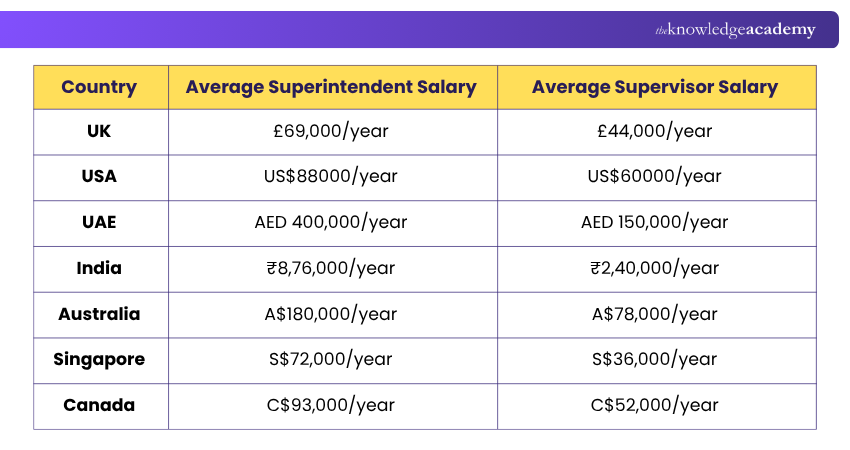
Source: Glassdoor
Unlock your full potential and embark on a journey of personal growth with our transformative Personal Development Training – invest in yourself today.
Keep This in Mind
Job titles do not always tell the whole story. The responsibilities of a Superintendent or Supervisor can vary by industry, employer, project size, and local requirements. When comparing roles or applying for a position, focus on the actual duties, level of authority, reporting structure, and required qualifications rather than the title alone.

Akhil K is a Copywriter and Video Editor with experience in content creation, visual storytelling, advertising and brand communication. His background in journalism, research and audience-focused communication strengthens his ability to create clear and engaging Business Skills content.
View Detail

 If you wish to make any changes to your course, please


